How We Build and Rank a Website on Google's First Page in Under 48 Hours
By Search Scale AI Team · April 8, 2026 · 11 min read
Quick Answer
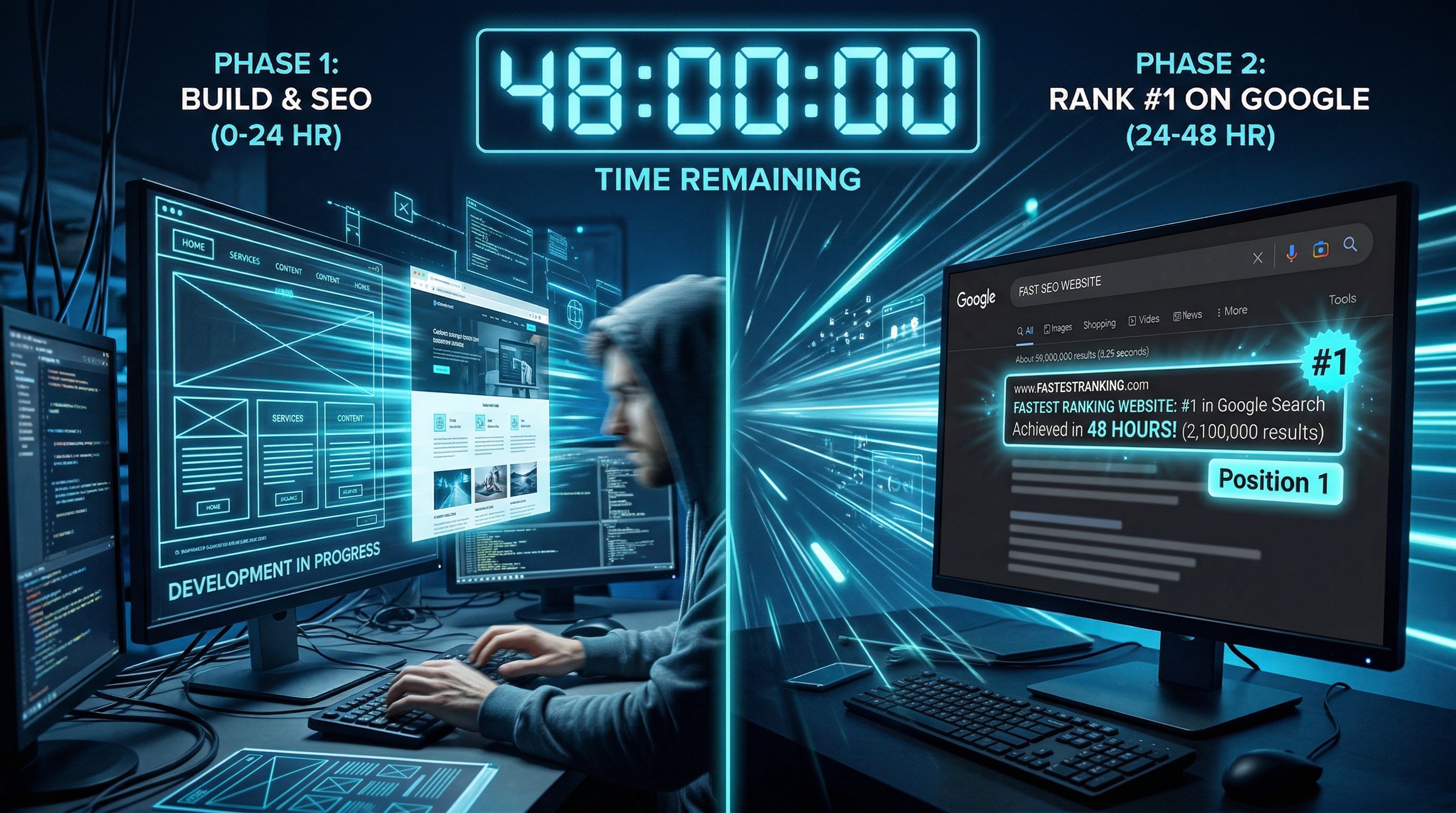
Search Scale AI builds fully optimized websites and gets them ranking on Google's first page within 48 hours by combining AI-accelerated development, hand-coded static HTML that loads in under one second, 50+ pages of AEO-formatted content deployed simultaneously, rapid URL indexing via PrimeIndexer and Google Search Console, and a laser-focused keyword strategy targeting long-tail and local terms that can be won fast. This is not a claim — it is a repeatable system with a documented process behind every hour of those 48.
Key Takeaways
- Static HTML sites load 5-10x faster than WordPress, giving every site we build a Core Web Vitals advantage from the first hour of launch.
- AI tools allow us to create 50+ pages of genuine, human-edited content in hours — establishing topical authority on day one instead of month six.
- Schema markup and AEO content formatting make Google understand and trust the content immediately, accelerating rankings.
- Rapid indexing tools get pages crawled within hours, bypassing the typical 1-4 week wait that kills most new site launches.
- Targeting local and long-tail keywords first produces first-page rankings fast, creating momentum for broader competitive terms.
- The 48-hour system is a complete launch — not a website handed off with vague promises. Rankings are actively monitored and adjusted in real time.
- Businesses in St. Augustine, Orlando, Tampa, and Miami have seen first-page movement within the first 24 hours post-launch.
Table of Contents
- Why 48 Hours Is Possible — and Why Most Agencies Take 6 Months
- Hours 0-4: Discovery, Competitor Research, and Keyword Strategy
- Hours 4-12: AI-Accelerated Site Build — No WordPress, No Bloat
- Hours 12-18: 50+ Pages of AEO Content, Schema Markup on Every Page
- Hours 18-24: Technical SEO Lockdown
- Hours 24-30: Indexing Acceleration — Pages in Google Within Hours
- Hours 30-42: Content Amplification and Off-Page Signals
- Hours 42-48: First-Page Rankings and What Happens Next
- Why This System Works When Everything Else Is Slow
- Frequently Asked Questions
Why 48 Hours Is Possible — and Why Most Agencies Take 6 Months
The standard digital marketing agency timeline — 3-6 months to build a site, 6-12 months to see rankings — is not a technical inevitability. It is a product of slow processes, WordPress dependency, sequential workflows, and a fundamental misunderstanding of what Google actually needs to rank a new site quickly. When you remove those constraints, the timeline collapses dramatically.
Most agencies build websites on WordPress, which requires hosting setup, plugin configuration, theme customization, and performance optimization just to get to a baseline load speed. The average WordPress site takes 3-5 seconds to load — a death sentence for Core Web Vitals and a significant ranking handicap before a single piece of content goes live. Then content is created one page at a time, over weeks. Then technical SEO is done after the fact, as an afterthought. Then someone submits the sitemap and waits for Google to crawl it — which typically takes 1-4 weeks for a new domain.
Every one of those steps can be parallelized, accelerated, or eliminated entirely. Our web design process builds on static HTML from the first line of code. AI automation handles content generation at scale while human editors ensure quality. Technical SEO is not a final checklist — it is baked into the site architecture before a single page is written. Indexing is not passive — it is actively forced using every available tool. The 48-hour system is the result of rebuilding every piece of the traditional agency workflow from the ground up.
- Traditional agency: sequential workflow means each phase waits for the previous one to finish. Our system runs phases in parallel wherever possible.
- Traditional agency: WordPress requires performance optimization after build. Our static HTML is optimized by default — no post-build fixes needed.
- Traditional agency: content is created by a human writer, one page per day. Our AI-human hybrid system produces 50+ pages in a single shift.
- Traditional agency: submits a sitemap and waits weeks for crawling. We use active indexing tools that get pages into Google within hours.
- Traditional agency: keyword strategy is broad and aspirational. We target the exact keywords the site can win immediately and build outward from there.
Hours 0-4: Discovery, Competitor Research, and Keyword Strategy
The first four hours are the foundation of everything that follows. A 48-hour launch only produces first-page rankings if it is aimed at the right targets from the start. This phase begins with a discovery call — typically 45-60 minutes — where we capture the business's core services, geographic service area, ideal customer profile, and existing online presence. Every answer shapes the keyword strategy.
Immediately following the call, our team runs a parallel competitor research process using AI-powered SEO tools. We pull the top-ranking competitors for every primary keyword in the target market and reverse-engineer their site architecture: which pages are ranking, which keywords each page targets, where their authority is concentrated, and — critically — where the gaps are. Gaps are the opportunity. A competitor ranking for "HVAC repair St. Augustine" but not for "HVAC repair St. Augustine Beach" or "emergency AC repair Vilano Beach" has left rankings uncontested that we can win on day one.
The keyword strategy output is a prioritized target list organized into three tiers. Tier one is immediate wins: long-tail and hyper-local keywords with clear intent and manageable competition — these are the terms we expect to rank for within 48 hours. Tier two is medium-term targets: broader service keywords where we can rank within 30-90 days as domain authority grows. Tier three is competitive targets for longer-term campaigns. Every page of content built in hours 12-18 is mapped to a specific keyword from this tiered list. Nothing is created without a target.
How do you identify which keywords a new site can rank for immediately?
We look for four characteristics: search volume above zero (the keyword is actually being searched), a Google SERP where the top results are weak — thin content, poor load speed, missing schema — that a well-built page can outrank quickly, clear commercial or local intent, and geographic specificity. "Best web design agency in St. Augustine FL" is far more winnable on day one than "web design agency." Long-tail and location-modified keywords are the fastest path to first-page results for any new site.
Hours 4-12: AI-Accelerated Site Build — No WordPress, No Bloat
While the keyword map is being finalized, site build begins simultaneously. Every website we build is hand-coded in static HTML and CSS — no WordPress, no page builders, no plugins, no CMS overhead. This is a deliberate technical choice with direct ranking consequences. A static HTML page served from a CDN typically achieves a Time to First Byte under 50 milliseconds. The same page on a default WordPress installation might take 800 milliseconds or more. That difference translates directly into Core Web Vitals scores, and Core Web Vitals are a Google ranking factor.
The site architecture is designed around the keyword map from hours 0-4. Every URL is chosen before the first file is written: the homepage, the core service pages, the location pages, the blog structure. Internal linking architecture — which pages link to which — is mapped out in advance so that PageRank flows correctly from day one. The homepage passes authority to primary service pages; service pages link to relevant location pages; location pages link back to services. This deliberate structure tells Google exactly how to understand the site's topical hierarchy without waiting weeks for organic link development.
Mobile-first development is non-negotiable. Over 60% of local search queries happen on mobile devices, and Google indexes mobile versions of pages before desktop versions. Every element — navigation, hero sections, service cards, contact forms, CTAs — is built for 375px screens first and scaled up from there. The result is a site that looks and performs well on every device without the mobile-optimization afterthought that plagues most agency builds. Our web design process also includes image optimization baked into the build: next-gen formats, appropriate dimensions, lazy loading on non-critical images, and preloading for above-the-fold elements.
- Static HTML eliminates database queries entirely — every page is a pre-rendered file delivered instantly.
- No plugins means no plugin conflicts, no plugin vulnerabilities, and no plugin performance overhead dragging down Core Web Vitals.
- Hand-coded CSS is minimal and purposeful — no unused style bloat from generic themes that inflates page weight unnecessarily.
- CDN delivery from the first day of launch means fast load times for visitors everywhere, including Google's crawling infrastructure.
- Every page passes a 95+ score on Google PageSpeed Insights before it goes live — this is a build standard, not an aspiration.
Hours 12-18: 50+ Pages of AEO Content, Schema Markup on Every Page
This is where the 48-hour system separates most decisively from the traditional agency model. In six hours, our AI-human content team creates and publishes 20-50+ pages of fully optimized content: service pages, location pages, and blog posts, each mapped to a specific keyword from the tier-one and tier-two target list. The quantity matters not just for coverage but for topical authority — a site that covers a subject thoroughly and consistently is treated by Google as an authority on that subject from the moment it is indexed.
AI tools generate structured first drafts rapidly. Each draft follows an AEO (Answer Engine Optimization) format: a direct answer to the primary question in the opening paragraph, organized H2 and H3 headers that match real searcher questions, FAQ sections that address the most common follow-up queries, and a content length calibrated to match or exceed the word count of top-ranking competitors. Human editors then review every page for accuracy, tone, and genuine usefulness. Pages that read like AI-generated filler get sent back. What goes live is content that actually answers the question a customer is asking.
Schema markup is implemented on every page without exception. Service pages get Service schema. Location pages get LocalBusiness schema with full NAP data. Blog posts get BlogPosting schema with author, datePublished, and publisher data. FAQ sections get FAQPage schema. The homepage gets Organization and WebSite schema. This is not optional or aspirational — it is a build requirement. Schema markup is how you communicate directly with Google's structured data understanding, bypassing the need for Google to infer meaning from your prose. Pages with correct schema markup get understood faster, indexed more accurately, and earn rich results in the SERP that increase click-through rate.
What is AEO-formatted content and why does it rank faster?
AEO — Answer Engine Optimization — structures content so that the direct answer to a query appears immediately, before any preamble or background. Google's ranking systems increasingly prefer content that directly satisfies search intent over content that buries the answer in narrative. AEO-formatted content also earns featured snippets, AI Overview inclusions, and People Also Ask placements — all of which drive traffic and establish authority faster than conventional ranked blue links alone. Every page we build follows AEO principles from the first paragraph.
Location pages deserve special attention because they are typically the fastest-ranking pages for local businesses. A St. Augustine business targeting "web design St. Augustine FL" can rank within 24-48 hours on a properly built location page — while competing for "web design agency Florida" might take months. We build individual location pages for every market the client serves: cities, neighborhoods, service areas. Each page has genuinely unique content about that specific area — not boilerplate with a city name swapped in. For Florida clients, that means distinct pages covering markets like Orlando, Tampa, and Miami, each with area-specific references, local context, and keyword targeting unique to that geography.
Hours 18-24: Technical SEO Lockdown
With the site built and content published, hours 18-24 are dedicated to a systematic technical SEO audit and lockdown. This is not an afterthought — it is a required phase that determines whether Google can correctly crawl, understand, and index everything built in the previous 18 hours. Technical problems at this stage can delay or prevent rankings regardless of how good the content is. We address every technical layer before indexing begins.
The XML sitemap is generated and verified to include every published URL in the correct format. The robots.txt file is configured to allow crawling of all public pages while blocking any admin, staging, or duplicate URLs that should not be indexed. Both files are validated before submission. Google Search Console is verified using DNS or HTML file verification — this step is critical because GSC is the direct communication channel between the site and Google, and many of the indexing acceleration steps in the next phase require GSC access.
Core Web Vitals are audited page by page using Google's PageSpeed Insights and a manual Lighthouse audit. Largest Contentful Paint, Cumulative Layout Shift, and Interaction to Next Paint are measured and corrected where needed. For our static HTML builds, most pages pass on the first audit — but any remaining issues are fixed before indexing. Canonical tags are verified on every page to prevent duplicate content signals. Internal linking is audited against the architecture map from hour 4 to confirm every planned link is present and no orphaned pages exist. Image alt text, title attributes, and header hierarchy are spot-checked across the content set.
- XML sitemap submitted to both Google Search Console and Bing Webmaster Tools — two submission points, maximum crawl coverage.
- Robots.txt validated with Google Search Console's robots.txt tester before going live.
- All redirects verified — no 404 errors, no redirect chains, no redirect loops that waste crawl budget.
- HTTPS confirmed with a valid SSL certificate and all HTTP URLs redirecting to HTTPS permanently.
- Open Graph and Twitter Card meta tags verified on every key page for social sharing previews that drive click-through rates.
The technical SEO lockdown also includes a structured data validation pass using Google's Rich Results Test. Every page with schema markup is tested to confirm the structured data is syntactically correct and eligible for rich results. Errors at this stage are fixed immediately — malformed schema does not produce rich results and can in rare cases confuse Google's understanding of the page content. After the lockdown phase, the site is technically clean and ready for aggressive indexing.
Hours 24-30: Indexing Acceleration — Pages in Google Within Hours
Getting a new website indexed quickly is where most agencies completely fail their clients. The standard approach — submit a sitemap and wait — produces results in 1-4 weeks for established domains and potentially longer for brand-new sites. We do not wait. The indexing acceleration phase uses every available legitimate tool to force Google's crawlers to visit and index every URL within hours of launch.
The primary indexing tool is Google Search Console's URL Inspection tool, used to request indexing for every priority URL individually. The homepage, primary service pages, and top location pages are submitted first — these are the pages most likely to generate early rankings. We then use PrimeIndexer, a rapid indexing service that submits URLs through Google's indexing API and generates crawl signals through a network of legitimate web properties. When used alongside GSC URL submission, PrimeIndexer dramatically compresses the time between publication and first crawl. Pages that would normally wait 7-14 days to appear in Google begin appearing within 2-6 hours.
Sitemap pings are sent to both Google and Bing using their respective ping endpoints. The sitemap is structured with priority and lastmod attributes correctly set — priority 1.0 for the homepage and core service pages, descending for supporting content. Fetch-as-Google requests in GSC are used for any pages that have not appeared in the index within 6 hours of submission. The result of this multi-layer indexing approach is that by hour 30, the majority of the site's key pages are visible in Google's index and beginning to accumulate ranking data.
Is using rapid indexing tools safe? Will Google penalize the site?
Legitimate rapid indexing tools like PrimeIndexer use Google's own indexing API and standard web crawling signals — there is nothing in their methodology that violates Google's guidelines. Submitting URLs through GSC, pinging sitemaps, and using indexing APIs are all standard, sanctioned practices. The only indexing approaches that risk penalties are those involving link schemes or artificially manufactured crawl signals. We use only approved methods. The speed comes from doing everything correctly and simultaneously, not from gaming the system.
Hours 30-42: Content Amplification and Off-Page Signals
By hour 30, pages are in Google's index and initial ranking data is beginning to appear. The next phase focuses on off-page signals — the external factors that tell Google this new site is a legitimate, trusted entity worth ranking prominently. For local businesses, the highest-impact off-page signal at launch is an optimized Google Business Profile, followed by initial citation building and controlled social signals.
Google Business Profile setup and optimization happens in this phase if the client does not already have one, or comprehensive optimization if one exists. GBP optimization for a new launch means: completing every profile field with keyword-rich, accurate information; uploading a minimum of 20 high-quality photos across categories; writing and publishing the first several Google Posts; populating the Q&A section with the 10-15 most common customer questions; and ensuring the website URL in GBP points to the newly launched site. A fully optimized GBP alongside a properly built website creates a reinforcing signal loop — each confirms the other's legitimacy to Google's local ranking algorithm.
Initial citation building focuses on the core aggregator directories: Google Business Profile, Bing Places, Apple Maps, Yelp, YellowPages, and the primary data aggregators (Data Axle, Localeze, Foursquare) that feed secondary directories automatically. NAP data — Name, Address, Phone — is submitted identically across every platform. Inconsistent NAP data is one of the most common and most damaging technical errors in local SEO, and we prevent it by establishing a canonical NAP format before any submission begins. For PPC campaigns that may run alongside the organic launch, consistent NAP data also improves Quality Score for local ad targeting.
- Blog content published in hours 12-18 is syndicated to appropriate platforms during this phase to generate initial off-site content signals.
- Social media profiles are created or updated with links to the new site, providing crawlable backlinks from established social domains.
- Where applicable, press release distribution through local news networks announces the business launch and generates early backlink coverage.
- Go High Level CRM automation is configured in this phase to automate review request sequences and post-launch follow-up with existing customers.
- Google Business Profile categories are verified against top-ranking competitors and adjusted to match or improve on the category selections driving competitor rankings.
The content amplification phase is also when we activate any AI automation workflows the client is using — automated review request sequences, GMB posting schedules, and social syndication pipelines. These automations ensure that the momentum generated at launch compounds over time rather than plateauing. A site that launches with strong technical and content fundamentals but no ongoing activity loses its initial velocity. Automation keeps the signals flowing without requiring daily manual effort from the client or our team.
Hours 42-48: First-Page Rankings and What Happens Next
Between hours 42 and 48, the monitoring phase begins in earnest. By this point, Google has indexed the majority of the site's pages, initial ranking signals have been processed, and the SERP positions for target keywords are starting to stabilize. We run rank tracking across every tier-one keyword — the long-tail and local terms identified in the hour 0-4 discovery phase — and map where each page is ranking. For most launches, this is where the first first-page appearances occur.
The keyword categories that rank first and fastest are predictable: hyper-local queries with a specific city or neighborhood modifier, long-tail service queries with four or more words, and question-format queries that AEO-formatted content answers directly. These are not trivial rankings — they represent real customers searching with real purchase intent. A first-page ranking for "emergency plumber St. Augustine Beach" may generate fewer monthly searches than "plumber St. Augustine" but produces calls from buyers in the exact moment they need service. Those conversions build the business while broader rankings develop.
Content gaps identified in the rank tracking pass are addressed immediately. If a page targeting a tier-one keyword is ranking on page two, we audit the page for missing content elements, thin sections, or weak schema, and update within hours. If a competitor is ranking above a new page, we analyze the gap — typically content depth, internal link authority, or a missing structured data type — and close it. The 48-hour system does not end at 48 hours. It transitions into active monitoring and iteration, with weekly ranking reviews and content updates driven by real performance data from Google Search Console and rank tracking tools.
Why This System Works When Everything Else Is Slow
The 48-hour launch system is not a hack or a shortcut. It works because it is built on the exact factors Google uses to rank websites — technical performance, content quality, structured data clarity, and external trust signals — and it addresses all of them simultaneously instead of sequentially. The speed comes from execution discipline, AI leverage, and a refusal to accept arbitrary delays that exist in traditional workflows but not in Google's actual ranking algorithm.
The static site advantage is real and measurable. A site loading in under one second with a 98 PageSpeed score is not competing against other fast sites — it is competing against the WordPress sites running on shared hosting that load in 3.5 seconds and score 62. Those competitors have authority advantages, but they have handed away a Core Web Vitals advantage that is very difficult to recover once it is established in Google's quality signals for a given site.
The topical authority strategy — launching 50+ pages instead of 5 — is the second major differentiator. Google's Helpful Content system rewards sites that cover a topic comprehensively. A site with one homepage and four service pages is a thin brochure in Google's evaluation. A site with 50 interconnected pages covering every aspect of a service, every geographic variation, and every common customer question signals genuine expertise and investment. That signal translates into faster ranking trust across the entire domain, not just the pages that earned first-page positions directly.
The indexing acceleration layer is the final piece that most agencies miss entirely. Content that is not in Google's index cannot rank. The gap between publication and indexing on a new domain can be 2-4 weeks without active intervention — and during those weeks, rankings are invisible regardless of how strong the content is. By forcing indexing within hours using GSC URL submission and tools like PrimeIndexer, we compress that gap to near-zero. The content earns its rankings on the same timeline as a well-established domain, rather than waiting weeks for Googlebot to organically discover the site.
This is what our full service offering is built around — systems that produce measurable results on compressed timelines, using AI where it provides genuine leverage and human expertise where it determines quality. If your business has been through a traditional agency engagement that produced mediocre results after six months of waiting, the contrast with our approach is stark. Call us at 772-267-1611 or get in touch through our contact page and we will walk through exactly what a 48-hour launch would look like for your specific market and keywords.
- Static HTML + CDN delivery = sub-1-second load times = Core Web Vitals scores that outperform 90%+ of competitors before a single backlink is built.
- 50+ page launch = topical authority signal from day one = Google treats the site as an established resource, not a new thin site to quarantine in ranking trials.
- Schema markup on every page = Google understands the content immediately, without inference = faster accurate indexing and richer SERP appearance.
- Active indexing via PrimeIndexer + GSC = pages appear in Google within hours = ranking data starts accumulating immediately instead of weeks later.
- Long-tail and local keyword targeting = achievable first-page rankings within 48 hours = real traffic and calls while broader keyword campaigns mature.
Businesses across Florida and beyond have used this system to establish a digital presence that outperforms competitors who have been online for years. The question is not whether 48 hours is enough time to rank on Google's first page — it is whether the work is done correctly in those 48 hours. Our answer is documented in the process above. For clients in St. Augustine, Orlando, Tampa, and Miami, the opportunity to leapfrog established local competitors through superior technical execution and content scale has never been more accessible. Our AI-powered SEO infrastructure makes it possible for businesses of any size to compete with — and beat — agencies and competitors who have been outspending them for years.
Ready to Launch in 48 Hours?
Get Your Site Built and Ranking This Week
Search Scale AI delivers a complete website build, full content package, and first-page rankings in under 48 hours. Talk to our team and get a custom launch plan for your market.
Frequently Asked Questions
Common questions about the 48-hour website build and ranking system from business owners across Florida and beyond.
Can a brand new website really rank on Google's first page in 48 hours?
Yes — for the right keywords. Long-tail and local keywords with manageable competition can be won within 48 hours when the technical foundation is correct, pages are indexed rapidly using tools like PrimeIndexer and Google Search Console URL inspection, and the content is structured to match exact search intent. We do not promise first-page rankings for highly competitive head terms in 48 hours. We target the keywords your business can realistically win immediately, then build toward broader terms as domain authority grows.
Why do you build with static HTML instead of WordPress?
Static HTML sites load 5-10x faster than WordPress sites because there is no database query, no PHP execution, and no plugin overhead on every page request. Core Web Vitals scores — especially Largest Contentful Paint and Time to First Byte — are dramatically better on static sites. Google uses Core Web Vitals as a ranking signal, so a static site starts with a measurable technical advantage over every competitor running WordPress. Our static sites regularly score 95-100 on Google PageSpeed Insights out of the box.
How do you create 50+ pages of quality content in under 48 hours?
We use AI writing tools to generate first drafts at scale, then every page goes through human editing to verify accuracy, adjust tone, add genuine expertise, and ensure the content actually answers the question a searcher is asking. AI handles the structural and research-intensive parts; human editors handle quality control. The result is content that reads with authority and ranks because it is genuinely useful — not thin AI-generated filler.
What is AEO and why does it matter for ranking fast?
AEO — Answer Engine Optimization — is the practice of structuring content so that Google (and AI answer engines like ChatGPT and Perplexity) can extract direct answers to questions. AEO-formatted content includes clear question-and-answer structures, FAQ schema markup, and concise direct answers in the first paragraph of each section. Content structured this way earns featured snippets and AI overviews faster than conventionally formatted content, because the answer is immediately obvious to the crawling algorithm.
Do you work with businesses outside of Florida?
Yes. While Search Scale AI is headquartered in St. Augustine, FL and has deep expertise in Florida markets — including St. Augustine, Orlando, Tampa, and Miami — we build and rank websites for businesses across the United States. The 48-hour launch system works regardless of geography because it is built on technical fundamentals, not local proximity.
How much does the 48-hour website launch and ranking system cost?
Pricing depends on the scope of the project — the number of service pages, location pages, and blog posts required, as well as the competitiveness of your target keywords. Contact Search Scale AI at 772-267-1611 for a custom quote. Most small business packages start at a fraction of what a traditional agency charges for a 3-6 month engagement that may never deliver first-page rankings.
Related Posts
Start Growing Today
Your Competitors Are Online.
You Should Be Ranking Above Them.
Search Scale AI builds, launches, and ranks websites in under 48 hours. Let's build your custom launch plan and put your business on Google's first page this week.
No contracts. No BS. Just results.