Fort Lauderdale Local SEO: The Strategies Big Agencies Won't Tell You
By Search Scale AI Team · April 10, 2026 · 12 min read
Quick Answer
Businesses seeking local SEO Fort Lauderdale FL expertise will find that the city requires a fundamentally different approach than generic SEO packages deliver. The city's marine industry, multilingual population, distinct neighborhood identities, and position within Broward County's competitive landscape all demand hyper-local strategies that most big agencies — especially those headquartered in Miami — never apply. This guide covers the insider tactics that actually move rankings for Fort Lauderdale businesses: neighborhood-level content targeting, Broward County citation strategies, marine industry SEO, Spanish-language optimization, and the specific reasons a locally focused agency consistently outperforms a large agency treating FTL as a secondary account.
Key Takeaways
- Fort Lauderdale's neighborhood structure — Las Olas, Victoria Park, Wilton Manors, Lauderdale-by-the-Sea, Coral Ridge, Flagler Village — creates distinct micro-markets that require dedicated landing pages, not generic city-level content.
- The marine and boating industry is one of the most underserved sectors in Fort Lauderdale SEO — marine businesses rank far below their potential because most agencies have no marine-specific content strategy.
- Multi-language SEO for Fort Lauderdale's Spanish-speaking and Haitian Creole-speaking communities is a significant and largely untapped competitive advantage.
- Miami agencies routinely underprepare Fort Lauderdale clients — their keyword research, citation building, and content strategies are calibrated for Miami-Dade, not Broward County.
- Zip code-targeted content (33301, 33304, 33308, 33316, 33334) outperforms broad city-level targeting for businesses serving specific Fort Lauderdale neighborhoods.
- Tourism and hospitality SEO in Fort Lauderdale requires seasonal content strategies that most generic packages never account for.
- A proper local SEO investment for a Fort Lauderdale business pays compound returns — the earlier the foundation is built correctly, the larger the lead over competitors who delay.
Table of Contents
- Why Generic SEO Packages Fail Fort Lauderdale Businesses
- Fort Lauderdale Neighborhood SEO: The Micro-Market Advantage
- The Broward County Competitive Landscape
- Marine and Boating Industry SEO: Fort Lauderdale's Unique Opportunity
- Tourism and Hospitality SEO in the Venice of America
- Multi-Language SEO for Fort Lauderdale's Diverse Population
- Hyper-Local Content: Targeting Fort Lauderdale Zip Codes
- How to Beat Miami Agencies That Treat FTL as an Afterthought
- How Search Scale AI Approaches Fort Lauderdale SEO
- Frequently Asked Questions
Why Generic SEO Packages Fail Fort Lauderdale Businesses
The typical agency SEO package is designed for a generic market. It delivers a set number of blog posts per month, builds citations to the same directories used for every client, runs the same technical audit template on every website, and calls that local SEO. For a city like Fort Lauderdale — with its marine economy, multilingual demographics, concentrated neighborhood identities, and seasonal tourism cycles — generic packages miss so much of the actual opportunity that they become expensive exercises in minimal progress.
Consider what a generic package does not address. It does not build content targeting the Fort Lauderdale International Boat Show audience. It does not create Spanish-language landing pages for the large Hispanic business community along Sunrise Boulevard. It does not differentiate between the search behavior of a Las Olas Boulevard restaurant customer and a Flagler Village resident looking for a yoga studio three blocks away. It does not target the zip-code-level search queries that high-intent Fort Lauderdale buyers actually use. These are not edge cases — they represent the majority of local search volume for many Fort Lauderdale business categories.
The failure is structural. Most large agencies build packages for the median client in the median market, then apply them everywhere. Fort Lauderdale is not a median market. It is the yachting capital of the world, a dense urban core surrounded by distinct residential neighborhoods, a tourism destination that experiences dramatic seasonal search shifts, and a city with a genuinely diverse population that searches in multiple languages. Any local SEO strategy for Fort Lauderdale that ignores these dimensions is not a Fort Lauderdale strategy — it is a template with a city name pasted in.
The cost of this generic approach is measured in rankings that competitors with more targeted strategies claim instead. A Fort Lauderdale law firm that builds a dedicated Wilton Manors landing page with genuine neighborhood content will consistently outrank a competitor whose agency produced a single city-level page. A marine electronics retailer near the 17th Street Causeway that builds content around the Fort Lauderdale Boat Show will capture seasonal search demand that no generic package ever touches. The gap between what generic SEO delivers and what genuinely local SEO delivers is largest in markets like Fort Lauderdale — where the local context is rich, specific, and consistently overlooked.
Fort Lauderdale Neighborhood SEO: The Micro-Market Advantage
Fort Lauderdale is not one market — it is a collection of micro-markets with distinct identities, demographics, and search behavior. Treating the entire city as a single SEO target is the first mistake most agencies make. The neighborhoods that matter for local SEO in Fort Lauderdale each have their own search patterns, their own buyer profiles, and their own competitive environments that a single city-level page cannot capture.
Las Olas Boulevard is Fort Lauderdale's premier dining, shopping, and entertainment corridor. Searches here are heavily commercial — restaurants, boutiques, galleries, nightlife, and luxury services. The competition is intense and the searcher intent is high. Businesses on or near Las Olas need dedicated content targeting "Las Olas restaurants," "Las Olas shopping," and category-specific modifiers that reflect the corridor's upscale positioning. A generic "Fort Lauderdale restaurant" page will never capture the searcher who has already decided they want to be on Las Olas.
Victoria Park and Coral Ridge are established residential neighborhoods with high homeownership rates and strong demand for home services, real estate, professional services, and upscale retail. Local businesses serving these neighborhoods need content that speaks to residents, not tourists — references to the neighborhood's tree-lined streets, proximity to the beach, and family character signal local expertise that builds trust with searchers who know these areas well.
Wilton Manors is a distinct incorporated city within Broward County with a strong community identity. Businesses targeting Wilton Manors must understand that residents identify strongly with their city and respond to content that demonstrates genuine local knowledge. "Wilton Manors" is not a Fort Lauderdale neighborhood for SEO purposes — it is a separate municipality requiring its own citations, its own Google Business Profile category management, and its own content strategy.
Flagler Village is Fort Lauderdale's arts and innovation district, with a younger demographic, creative businesses, and a rapidly evolving commercial scene. Search behavior here differs markedly from Las Olas — more discovery-oriented, more focused on new concepts, and more influenced by social proof from local media and community sources. Lauderdale-by-the-Sea is a small beach town with tourist-focused retail and dining. The Hollywood border area serves residents who identify as both Fort Lauderdale and Hollywood customers, making geographic keyword targeting important for businesses in this zone.
The practical application of neighborhood SEO for Fort Lauderdale businesses is straightforward: build a dedicated landing page or content cluster for each neighborhood you actively serve. Each page should include the neighborhood name naturally in the title tag, H1, and opening paragraph. It should reference actual neighborhood landmarks, cross streets, and zip codes. It should contain genuine content about the neighborhood — not boilerplate with a neighborhood name swapped in. And it should have its own schema markup, its own internal links to relevant service pages, and its own citation profile in neighborhood-specific directories and resources.
How specific should Fort Lauderdale neighborhood landing pages be?
Highly specific. Google's local ranking algorithms increasingly reward pages that demonstrate genuine local knowledge over pages that simply include location modifiers. A Las Olas restaurant SEO page that references specific nearby streets, mentions the waterway views, and discusses the area's mix of fine dining and casual options will consistently outrank a page that only includes "Las Olas" as a keyword. Specificity is the signal that separates genuine local expertise from keyword stuffing — and Google's algorithms are effective at distinguishing between the two.
The Broward County Competitive Landscape
Fort Lauderdale businesses operate in one of Florida's most competitive local search environments. Broward County is Florida's second most populous county, with over 1.9 million residents and a dense concentration of businesses across every industry. The competitive pressure in local SEO is higher than most national averages for almost every business category, and the dynamics of competition here are shaped by forces specific to this market.
The most important dynamic is the Miami spillover effect. Miami-Dade County's massive agency ecosystem — hundreds of digital marketing firms serving one of the country's largest media markets — produces an outward pressure on Broward County keywords. Miami-based businesses with strong domain authority frequently rank for Fort Lauderdale keywords they do not particularly intend to target, simply because their broader South Florida SEO presence extends northward. This means Fort Lauderdale businesses competing for generic "Fort Lauderdale" keywords are often fighting not just local Broward competitors but the broader Miami digital marketing machine.
The strategic response is specificity. The more precisely Fort Lauderdale-specific your content is — the more it references actual Fort Lauderdale institutions, geography, and local context — the more effectively it differentiates from Miami-based content that applies generic South Florida language. A Miami competitor cannot effectively target "marine repair near the 17th Street Causeway" or "tax attorney Victoria Park Fort Lauderdale" with the same authority as a genuine Fort Lauderdale business with genuine local expertise demonstrated through content. SEO specificity is your defense against the Miami overlap effect.
Within Broward County itself, the competitive landscape varies significantly by city. Businesses in Pompano Beach, Deerfield Beach, Coral Springs, and Plantation compete differently than Fort Lauderdale proper. For Fort Lauderdale businesses, this creates an opportunity: by building genuine Fort Lauderdale neighborhood authority, you can rank above Broward-wide competitors who dilute their local signal across multiple cities. Owning Fort Lauderdale specifically — neighborhood by neighborhood, zip code by zip code — is a more achievable and defensible position than competing broadly across all of Broward County.
Citation building in Broward County also requires market-specific knowledge. The directories and data aggregators that matter most for Fort Lauderdale local SEO include the Greater Fort Lauderdale Chamber of Commerce, the Broward County business directory, the Las Olas Association, and industry-specific directories relevant to the marine, hospitality, and real estate sectors that dominate the Fort Lauderdale economy. Generic citation packages that submit to the same 50 directories for every client miss the Broward-specific citations that carry the most local relevance signals for Fort Lauderdale rankings.
Marine and Boating Industry SEO: Fort Lauderdale's Unique Opportunity
Fort Lauderdale is one of the world's most important centers for the marine industry. The city hosts the Fort Lauderdale International Boat Show — the largest in-water boat show on earth. It serves as a major hub for yacht charter, mega-yacht provisioning, marine electronics, yacht crew placement, marine repair and maintenance, canvas and upholstery, refrigeration, diesel mechanics, and dozens of other specialized marine trades. The concentration of marine-related search demand in and around Fort Lauderdale is extraordinary — and the local SEO landscape for marine businesses is remarkably underdeveloped.
Most marine businesses in Fort Lauderdale have minimal local SEO presence. Their Google Business Profiles are incomplete or unoptimized. Their websites have thin content with no structure around the specific services and queries their customers use. They have almost no blog content targeting the research phase of the marine service decision. And they have almost no content designed to capture the international yacht community that flows through Fort Lauderdale year-round — a high-value audience searching for provisioning, crew services, and maintenance from locations far outside the local area.
The marine SEO opportunity in Fort Lauderdale is specific and actionable. Service-specific landing pages targeting queries like "yacht detailing Fort Lauderdale," "marine diesel mechanic Fort Lauderdale," "boat upholstery Fort Lauderdale," and "mega yacht provisioning Fort Lauderdale" are high-intent searches with significant commercial value and remarkably low competition in most cases. A marine business that builds a content library around these specific queries will dominate local marine search within months — because most competitors have invested nothing in this area.
The Fort Lauderdale Boat Show creates a specific seasonal SEO opportunity that most agencies miss entirely. Searches for marine services, boat slip availability, yacht provisioning, and marine contractors spike dramatically in the weeks before and during the show. Businesses that build content around the Boat Show — "yacht services Fort Lauderdale Boat Show," "marine contractors available Fort Lauderdale FLIBS" — capture high-intent visitors during the period when marine spending is at its peak in the local area. This is a textbook seasonal AEO content strategy that virtually no Fort Lauderdale marine business has executed.
For marine businesses, Google Business Profile optimization requires specific category selection — categories like "Boat Dealer," "Marina," "Boat Repair Shop," "Marine Supply Store," or "Yacht Broker" each activate different local pack features and attract different search audiences. Photos should include work in progress, finished results, and the Fort Lauderdale waterway environment — visual content that communicates local presence and professional quality simultaneously. Review generation from captains, boat owners, and marina managers builds the credibility signals that move marine businesses into the local 3-pack for the queries that drive their business.
Tourism and Hospitality SEO in the Venice of America
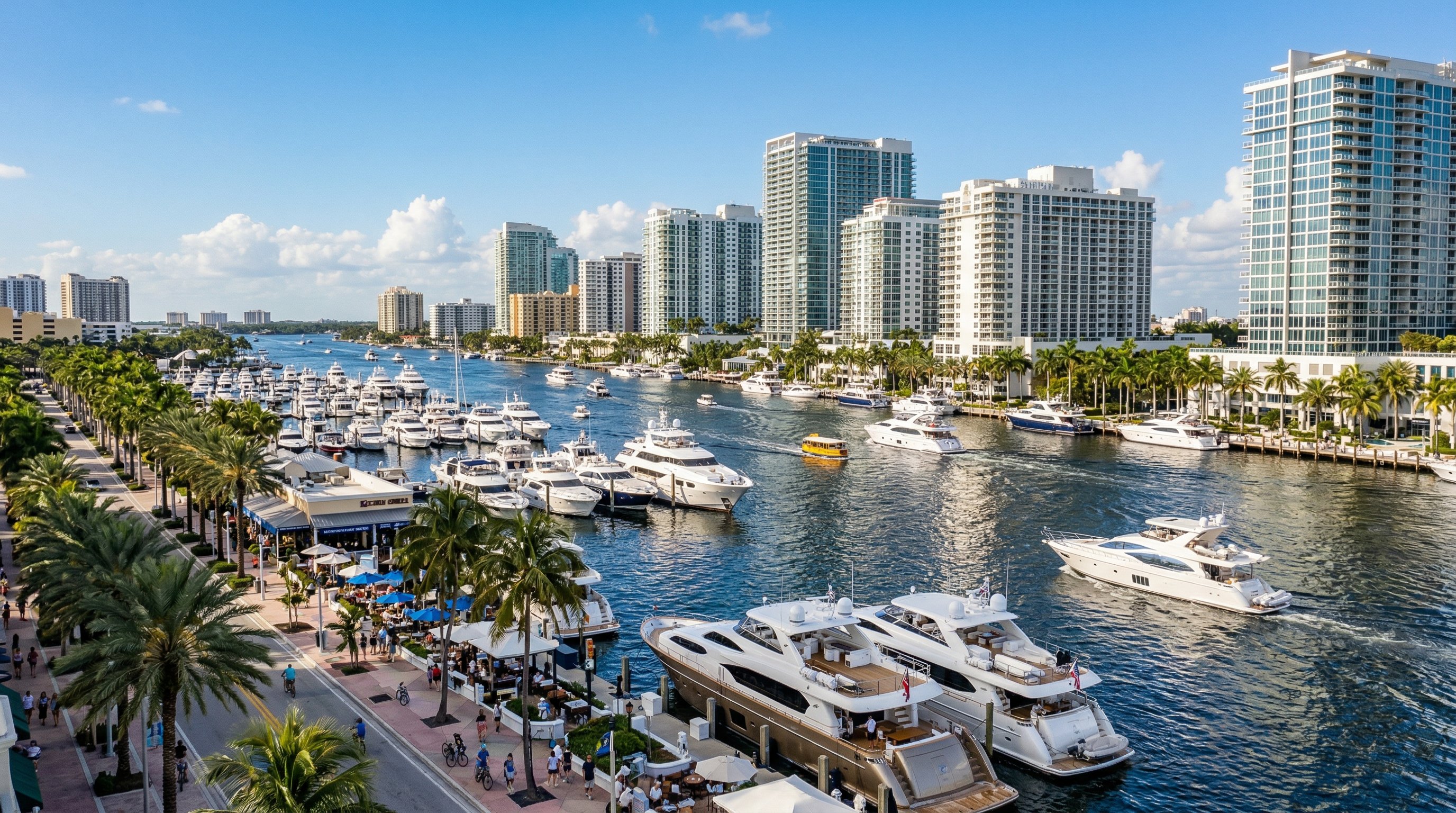
Fort Lauderdale's nickname — the Venice of America — refers to its 165 miles of inland waterways, and those waterways are central to the city's identity as a tourism destination. Fort Lauderdale–Hollywood International Airport handles over 36 million passengers annually, bringing visitors from across the country and internationally. The hospitality industry — hotels, restaurants, water taxis, boat tours, beach clubs, nightlife, and attractions — represents a significant share of Fort Lauderdale's economic activity and a major segment of its local search volume.
Tourism SEO in Fort Lauderdale requires a fundamentally different content calendar than service business SEO. Tourist search behavior is heavily seasonal, with peak demand in winter (snowbirds and northeastern visitors), during spring break, and around major events like the Boat Show and air shows at Fort Lauderdale Executive Airport. Content strategies that do not account for these seasonal cycles leave significant traffic on the table during peak periods when conversion rates are highest.
For hospitality businesses, local SEO in Fort Lauderdale must address the full research-to-booking journey. Early-stage travelers search for "things to do in Fort Lauderdale," "best restaurants Las Olas," and "Fort Lauderdale beach hotels." Mid-funnel searchers are comparing specific options: "Marriott vs Hilton Fort Lauderdale beach," "water taxi Fort Lauderdale reviews." Late-stage searchers are ready to act: "Fort Lauderdale hotel deals this weekend," "reserve Fort Lauderdale boat tour." An effective hospitality SEO strategy builds content addressing every stage of this journey, with appropriate calls to action at each conversion point.
Google Business Profile management is especially critical for hospitality businesses in Fort Lauderdale. Review velocity, recency, and response rate all directly influence local 3-pack rankings. Hotels and restaurants operating in a tourist market should have systematic review generation processes — not occasional requests but structured post-visit workflows that consistently produce fresh reviews with geographic and service-specific content. A review mentioning "waterfront dining on Las Olas" is a stronger local signal than a generic "great food" review, and encouraging guests to include specific location details in their reviews is a legitimate and effective local SEO practice.
Voice search optimization matters more in tourism-heavy markets than in most business categories. Visitors using mobile devices while exploring Fort Lauderdale frequently use voice queries: "Where's the best seafood restaurant near me?" or "What's there to do on the beach tonight?" Content structured with direct answers to these conversational queries — supported by AEO formatting and FAQ schema — captures the voice and AI overview traffic that conventional SEO content misses.
Multi-Language SEO for Fort Lauderdale's Diverse Population
Fort Lauderdale and Broward County are among the most linguistically diverse markets in the United States. Spanish is the most widely spoken non-English language in the county, with significant Spanish-speaking populations throughout Fort Lauderdale, Pembroke Pines, Miramar, and Hialeah's Broward border communities. Haitian Creole is the second most common non-English language, driven by large Haitian-American communities in areas including Fort Lauderdale's northwest neighborhoods. French, Portuguese, and other languages represent smaller but commercially significant audience segments.
For Fort Lauderdale businesses whose customers include Spanish-speaking residents and visitors, the absence of Spanish-language web content is a direct revenue loss. A potential customer who speaks Spanish as a primary language and searches "dentista Fort Lauderdale" or "abogado de familia Broward County" will not find your English-only website in those results. The Spanish-language local search landscape in Fort Lauderdale is significantly less competitive than the English-language market in most categories — meaning a business that builds genuine Spanish-language content can achieve first-page rankings with less effort than the equivalent English keywords require.
Technically correct multilingual SEO requires hreflang implementation — the HTML attribute that tells Google which language version of a page to serve to which audience. Without hreflang, Google may serve the wrong language version to searchers, or may treat your Spanish and English pages as duplicate content. A proper multilingual implementation means separate URLs for each language version, correctly implemented hreflang tags pointing between them, and distinct Spanish-language metadata — titles, descriptions, and schema markup — on every Spanish page.
Google Business Profile also supports multilingual optimization. A Fort Lauderdale business can add Spanish-language business descriptions, post Spanish-language updates, and respond to Spanish-language reviews in Spanish. These signals contribute to ranking visibility for Spanish-language near-me queries that a significant portion of the Fort Lauderdale market is making. For industries like healthcare, legal services, real estate, and financial services — where language trust is particularly important in the decision to contact a business — multilingual GBP optimization is one of the highest-ROI local SEO tactics available.
Content marketing in Spanish is not just translation. Effective Spanish-language SEO content for Fort Lauderdale speaks to the specific concerns and questions of Spanish-speaking local consumers — which may differ meaningfully from English-language search intent. A Spanish-speaking homebuyer in the Broward market has different questions and different information needs than a native English-speaking buyer, and content that addresses those specific needs demonstrates the cultural intelligence that builds trust and drives conversions among this audience.
Hyper-Local Content: Targeting Fort Lauderdale Zip Codes
Zip code-level targeting is one of the most underutilized local SEO tactics for Fort Lauderdale businesses. High-intent buyers — particularly in real estate, home services, legal, and medical categories — frequently include zip codes in their searches. "Plumber 33301," "real estate agent 33308," "dentist 33304" are not unusual query formats for searchers who live in specific Fort Lauderdale neighborhoods and want to find nearby providers. Pages optimized for these zip code queries capture a uniquely high-intent audience that city-level pages miss entirely.
The primary Fort Lauderdale zip codes and their associated neighborhoods create a map of micro-targeting opportunities. 33301 covers downtown Fort Lauderdale and the Rio Vista area — high-value searches for professional services, dining, and real estate. 33304 covers the Victoria Park and Coral Ridge areas — established residential with high demand for home services and local professionals. 33305 encompasses Oakland Park Boulevard and Wilton Manors adjacent areas. 33308 covers the Fort Lauderdale Beach and Lauderdale-by-the-Sea coastal area — heavy tourist and affluent residential search demand. 33316 covers the Port Everglades and 17th Street Causeway marine district — the heart of Fort Lauderdale's marine industry. 33334 covers the Oakland Park and Coral Ridge areas further north.
Effective zip code targeting does not mean creating thin doorway pages for every zip code your business could theoretically serve. Google penalizes thin location pages with no genuine content. Effective zip code content means building pages that genuinely describe the neighborhood associated with that zip code, reference local landmarks and streets correctly, contain service-specific information relevant to that area's demographics and needs, and demonstrate actual knowledge of the community. A page for "home remodeling 33304" that mentions Victoria Park's older housing stock, the neighborhood's architectural character, and local permitting considerations will consistently outperform a page that only inserts "33304" into generic home remodeling copy.
Internal linking between zip code pages, neighborhood pages, and service pages creates a topical authority structure that reinforces your Fort Lauderdale local signals across the entire site. A marine business with pages targeting 33316 (Port Everglades area), 33315 (Dania Beach marine strip), and 33317 (inland waterway access) — all internally linked to a central marine services hub page — tells Google that this business is a genuine Fort Lauderdale marine authority, not a generalist with a Fort Lauderdale keyword sprinkled into its content.
How to Beat Miami Agencies That Treat FTL as an Afterthought
Miami is the dominant media market in South Florida, and the digital marketing agencies that cluster there are built to serve Miami-Dade businesses. When Fort Lauderdale businesses hire Miami agencies, they typically become secondary clients — serviced with the same content templates, the same citation packages, and the same keyword strategies used for Miami clients, with Fort Lauderdale substituted for Miami in the copy. The results are predictably mediocre.
The specific ways Miami agencies underserve Fort Lauderdale clients are consistent enough to be predictable. Their keyword research is calibrated for Miami-Dade competition levels, which are higher than Broward — meaning they often overlook Fort Lauderdale-specific long-tail opportunities that are easier to rank for. Their citation building focuses on Miami-prominent directories rather than Broward County-specific directories. Their content writers are not familiar with Fort Lauderdale's specific neighborhoods, streets, and local institutions, producing content that includes Fort Lauderdale's name but lacks the geographic authenticity that resonates with local searchers and signals local expertise to Google's algorithms.
The strategic advantage available to Fort Lauderdale businesses that work with a genuinely local-focused agency is the authenticity gap. A Miami agency writing about Fort Lauderdale is writing about a city it understands secondhand. An agency with genuine Fort Lauderdale market knowledge — who understands the difference between Las Olas and Flagler Village, who knows that the Intracoastal drives search behavior differently than the beach, who understands that the marine industry has distinct SEO needs from the retail corridor — produces content with a local authenticity that search algorithms increasingly reward and that local customers immediately recognize.
Beating Miami agencies in Fort Lauderdale search also requires faster execution. Large Miami agencies move slowly — approval chains, account managers, and client portfolios measured in the hundreds mean your Fort Lauderdale business waits weeks for content that a smaller, focused agency can produce in days. In a competitive search environment, speed matters. A competitor who publishes ten neighborhood-specific pages before you publish one has a compounding advantage — their pages are aging, accumulating links, and building authority while yours are still in a content queue at a large agency that has not yet assigned your Fort Lauderdale account a dedicated writer. See our full breakdown on local SEO strategies for Miami businesses to understand how Miami-market dynamics differ from Broward.
The playbook for displacing Miami agency rankings in Fort Lauderdale is not complicated: build more specific, more authentic, more locally relevant content than your competitors have. Create neighborhood pages for every area you serve. Build Broward-specific citations. Optimize your Google Business Profile with Fort Lauderdale-specific content. Generate reviews that mention Fort Lauderdale neighborhoods and landmarks specifically. These steps, executed consistently, produce rankings that generic Miami agency work cannot match — because the authenticity signal is not reproducible at scale from a market-distant agency.
How Search Scale AI Approaches Fort Lauderdale SEO
Search Scale AI is headquartered in St. Augustine, Florida — not Miami. We are a Florida-based agency that understands the distinct character of each Florida market. We do not apply Miami SEO templates to Fort Lauderdale clients. We build Fort Lauderdale-specific strategies that account for the city's actual neighborhoods, its marine economy, its multilingual population, and the Broward County competitive dynamics that determine who ranks and who does not.
Our approach to Fort Lauderdale local SEO begins with genuine market research. Before we write a single piece of content for a Fort Lauderdale client, we map the competitive landscape at the neighborhood level — identifying which competitors are ranking for which neighborhood queries, where the content gaps are, and which zip code-level opportunities have the highest traffic potential with the lowest current competition. This analysis shapes every page we build, every keyword we target, and every internal link we create.
We build Fort Lauderdale clients on the same AI-accelerated static HTML platform we use across our Florida client base — sites that load in under one second, score 95+ on Google PageSpeed Insights, and have technical SEO baked into the architecture from the first line of code. We do not deliver WordPress sites that require months of performance optimization. We deliver sites that are technically competitive from the day they launch, allowing organic content and link building work to produce results immediately rather than waiting for technical improvements to compound.
Our content strategy for Fort Lauderdale businesses covers all of the areas this post has outlined: neighborhood landing pages for every relevant micro-market, marine industry content where applicable, multilingual pages for Spanish-speaking audiences, zip code-targeted service pages, and a tourism-aware content calendar for hospitality clients. We also build inter-city content strategies for Fort Lauderdale businesses that serve customers across South Florida — connecting Fort Lauderdale authority to Miami, West Palm Beach, and other South Florida markets where the same customer base searches.
The Fort Lauderdale businesses we work with are competing for customers in one of Florida's most commercially active markets. They need an agency that understands that market specifically — not one that has Fort Lauderdale as a checkbox on a South Florida territory map. We treat every Fort Lauderdale client as a Fort Lauderdale business first, building strategies calibrated to Broward County's specific competitive environment rather than recycling regional templates that serve no single market particularly well. If you are ready to build a genuine local SEO foundation for your Fort Lauderdale business, contact Search Scale AI at 772-267-1611 or through our Fort Lauderdale SEO page.
For a full breakdown of what a professional SEO engagement costs and what it should deliver, read our complete 2026 SEO pricing guide. For additional context on how local SEO strategies differ across Florida's major markets, our deep-dives on Tampa local SEO and Miami local SEO offer useful comparison points that Fort Lauderdale businesses can apply to their own market analysis.
Frequently Asked Questions
What makes local SEO in Fort Lauderdale different from other Florida markets?
Fort Lauderdale's local SEO landscape is shaped by factors unique to the city: a highly competitive marine and boating industry, a significant multilingual population requiring Spanish and Creole content strategies, distinct neighborhood identities — Las Olas, Flagler Village, Wilton Manors, Coral Ridge — that function as micro-markets, and a tourism-driven economy where seasonal search patterns shift demand significantly. Fort Lauderdale also sits in Broward County, sandwiched between Miami-Dade and Palm Beach County, creating a competitive environment where Miami-based agencies often treat FTL businesses as secondary accounts and miss hyper-local ranking opportunities that a market-focused agency captures. For comparison, see how the Miami local SEO landscape differs from Broward County's dynamics.
How should Fort Lauderdale businesses approach neighborhood-level SEO?
Fort Lauderdale businesses should build dedicated landing pages for every neighborhood they serve — Las Olas Boulevard, Victoria Park, Wilton Manors, Lauderdale-by-the-Sea, Coral Ridge, Flagler Village, and the Hollywood border area each have distinct search behavior and resident demographics. Generic city-level pages rarely capture neighborhood intent. Each neighborhood page should include genuine local context — nearby landmarks, zip codes, and content that demonstrates actual knowledge of that area. For a technical framework on how to structure these pages, our guide on how to show up on Google's first page covers the content architecture that supports neighborhood targeting effectively.
Why do generic SEO packages fail Fort Lauderdale businesses?
Generic SEO packages are built for generic markets. They treat Fort Lauderdale like any mid-size city — producing content that ignores the marine industry, the multilingual population, the seasonal tourism economy, and the Broward County-specific competitive landscape. A package designed for a Midwest market will not account for the fact that Fort Lauderdale businesses compete differently in summer versus winter, that marine-related keywords require completely different content strategies than retail keywords, or that a significant portion of the local search audience prefers Spanish-language content. Understanding what SEO should cost and what it should deliver helps Fort Lauderdale businesses evaluate whether their current package is genuinely tailored to their market.
How important is multi-language SEO for Fort Lauderdale businesses?
Very important. Fort Lauderdale and Broward County have a large and growing Spanish-speaking population, with significant Haitian Creole-speaking communities as well. Businesses that serve these communities exclusively in English are invisible to a substantial segment of local search demand. Spanish-language landing pages with proper hreflang attributes, Spanish-language Google Business Profile content, and Spanish-language reviews all contribute to visibility for searchers querying in Spanish. For industries like healthcare, legal services, real estate, and food service — where language and cultural trust are significant factors — multilingual SEO is a major competitive differentiator.
What is the most overlooked local SEO opportunity for Fort Lauderdale marine businesses?
Most marine businesses in Fort Lauderdale have severely underdeveloped local SEO. The most overlooked opportunities are: service-specific landing pages for long-tail marine queries (yacht detailing Fort Lauderdale, marine electronics Fort Lauderdale, mega yacht provisioning), AEO-formatted content targeting the research phase of marine service decisions, and seasonal content around the Fort Lauderdale International Boat Show. Marine businesses that invest in these specific content strategies will dominate local marine search within months — because most competitors have invested nothing in this area. An AI-accelerated content strategy can produce the volume of marine-specific pages needed to build topical authority quickly.
How can a Fort Lauderdale business compete against Miami agencies?
Fort Lauderdale businesses should work with an agency that understands the FTL market specifically — not a Miami agency that treats Broward County as a secondary market. Miami agencies apply Miami-centric strategies to Fort Lauderdale clients, targeting keywords and building content calibrated to Miami-Dade's competitive landscape rather than Broward's. A locally focused agency builds Broward County-specific citations, creates content that references Fort Lauderdale neighborhoods and landmarks correctly, and positions Fort Lauderdale businesses as local authorities in their specific communities. Contact Search Scale AI's Fort Lauderdale SEO team at 772-267-1611 to discuss a Broward-specific strategy for your business.