Google AI Overviews: What They Are and How to Get Your Business Featured
By Tim Francis · April 11, 2026 · 11 min read
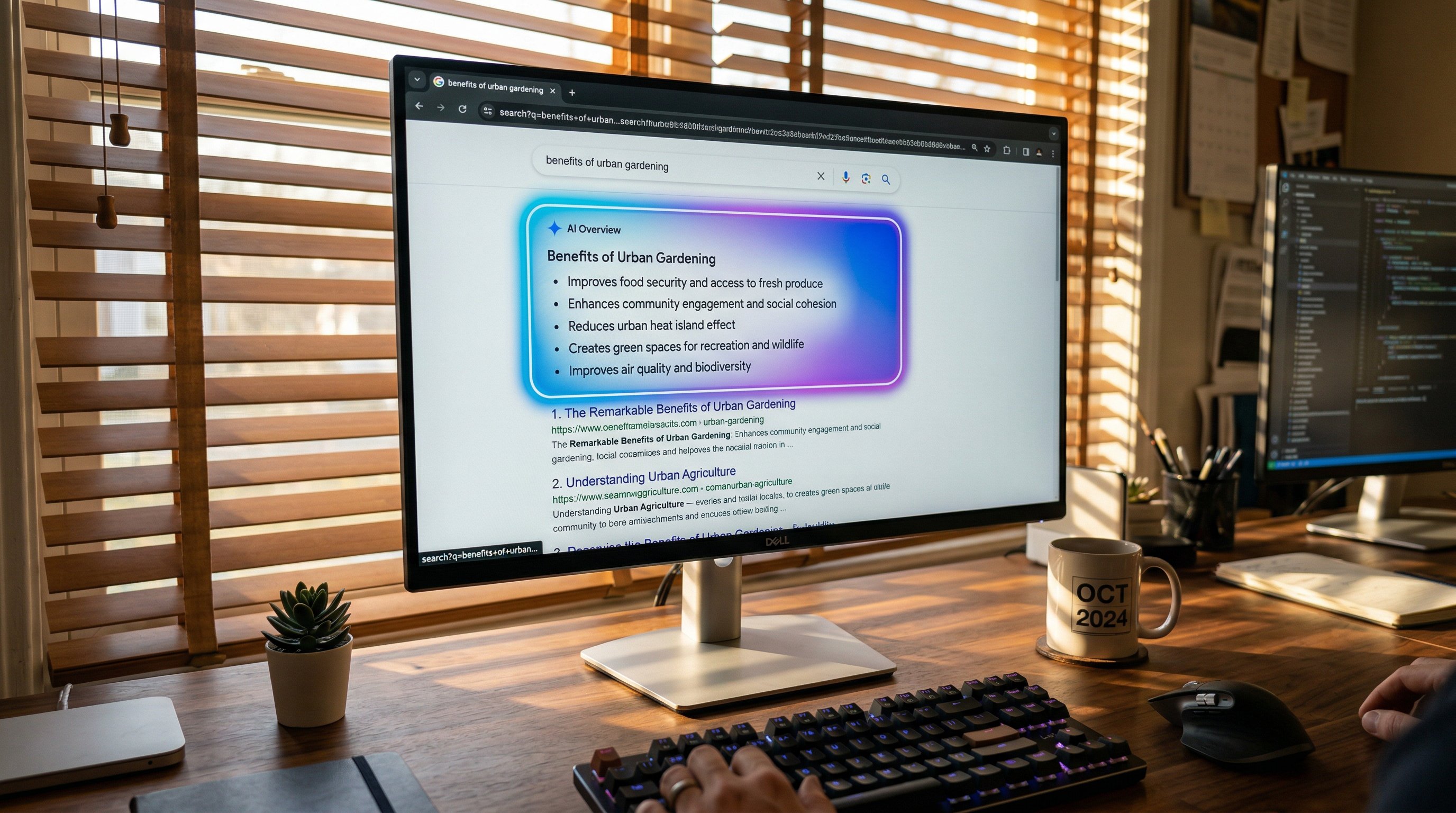
When I pull up a Google search today, the result that appears at the very top of the page — above every organic link — is increasingly not a website at all. It is a paragraph or two of AI-generated text that summarizes an answer, with source citations tucked to the side. That is Google's AI Overview, and it is now one of the most visible real estate on the internet.
For business owners and marketers, Google AI Overviews raise an obvious and urgent question: how do you appear in Google AI Overviews, and does being cited actually help your business? This guide answers both questions in depth. I will explain how AI Overviews work, what signals Google uses to select sources, what content formats consistently get cited, and the exact optimization steps you can take starting this week.
This is a core part of the AI SEO work we do at Search Scale AI, and it connects directly to the broader answer engine optimization and SEO foundations every competitive website needs in 2026.
What Is Google AI Overview?
Google AI Overview is an AI-generated summary displayed at the top of search results pages for many query types. It is powered by Google's Gemini model, which reads multiple high-ranking pages and synthesizes their content into a direct answer. Unlike a featured snippet — which quotes a specific passage from a single page — an AI Overview generates original text and cites the sources that informed it.
AI Overviews were rolled out broadly in 2024 under the name "Search Generative Experience" (SGE) and have expanded significantly since. By 2026, they appear on a wide range of informational, how-to, comparison, and local intent queries. Google has stated that AI Overviews help users get answers faster, and the data supports this — users spend more time on queries where an Overview is present, suggesting they find the format useful rather than disruptive.
For businesses, the key fact is this: the AI Overview sits above position one in organic results. It is the first thing users see. Being cited there is valuable brand positioning regardless of whether it drives immediate click-through traffic. And for many query types — particularly local service searches — it absolutely does drive traffic.
How Google Selects Sources for AI Overviews
Understanding how Google selects AI Overview sources is the prerequisite for optimizing toward them. Google has not published a complete technical specification, but research and observation over the past two years reveal a clear pattern.
You Must Already Rank Well Organically
The most consistent finding across independent analyses of AI Overview sources: pages that appear in AI Overviews are almost always ranking in the top five organic results for the same or closely related queries. If your page is not ranking organically, it is essentially invisible to the AI Overview selection process. This means AI Overview optimization is not a shortcut around traditional SEO — it requires a solid organic foundation first.
If you want to understand what it takes to build that foundation, our post on on-page SEO in 2026 covers the mechanics in detail.
Content Must Directly Answer the Query
Google's AI system is specifically trained to identify content that answers questions clearly and directly. A page that hedges, buries its answer, or requires significant reading before reaching the point is a weaker candidate than a page that states the answer in the first substantive paragraph.
I use a simple test when reviewing client content: can I read the first paragraph under each H2 heading and get a useful answer without reading the rest? If yes, the page is structured for AI citation. If the first paragraph is introductory context and the actual answer comes three paragraphs later, that content needs to be restructured.
E-E-A-T: Experience, Expertise, Authoritativeness, Trustworthiness
Google's quality evaluator guidelines emphasize E-E-A-T as a framework for assessing content quality. For AI Overview purposes, this translates to a specific set of signals:
- Experience: First-person accounts, case studies, and practical examples that demonstrate the author has actually done what they are writing about
- Expertise: Named authorship by credentialed or experienced individuals, with author bio pages that document their background
- Authoritativeness: Inbound links from reputable sources; mentions and citations from other authoritative sites in the industry
- Trustworthiness: Accurate, up-to-date information; clear business identity; consistent NAP (name, address, phone) data; transparent editorial standards
Pages that score well on all four dimensions are strongly preferred as AI Overview sources. Pages that are anonymous, lack backlinks, or contain outdated information are rarely selected.
Topical Authority
Google rewards sites that demonstrate deep expertise across a topic area, not just individual pages that target a single keyword. If your site covers a subject from multiple angles — foundational explainers, practical guides, case studies, FAQ content, and comparison posts — Google recognizes that depth and is more likely to trust your pages as authoritative sources.
This is why a content strategy matters as much as individual page optimization. A site with fifty well-structured, interlinked posts on AI SEO topics is a far stronger AI Overview candidate than a site with one excellent page surrounded by thin or unrelated content.
Content Formats That Get Featured in Google AI Overviews
Direct-Answer Opening Paragraphs
Every page targeting an AI Overview citation should begin its substantive content with a clear, self-contained answer to the page's primary question. This does not mean burying your expertise — it means leading with the point. Detailed explanation, supporting evidence, and nuance follow in subsequent paragraphs. This structure serves both human readers (who want answers first) and AI systems (which are trained to recognize and extract direct answers).
Question-Based Heading Structure
Pages that use H2 and H3 headings phrased as questions — "What is X?", "How does Y work?", "Why does Z happen?" — map directly onto the queries users type into Google. When a user's query matches your heading, Google's AI can efficiently locate and cite that section. Use the actual language your customers use, not industry jargon.
Bulleted and Numbered Lists
List formats are highly citeable because they present information in a structured, easily parseable form. Multi-step processes, ranked recommendations, feature comparisons, and "things to know" content all perform well in list format. Keep each list item substantive — a two-word label is less useful than a label plus a brief explanation.
FAQ Sections
A dedicated FAQ section with FAQPage schema is one of the clearest signals you can send to Google's AI systems. The question-answer format mirrors exactly how AI Overviews are structured. Questions should be phrased as natural language queries — not "Product Features" but "What features does [product] include?" Each answer should be complete and accurate on its own, without requiring the reader to have read the preceding content.
Our approach to answer engine optimization is built around this principle, and it applies with full force to Google AI Overview optimization.
Definitions and Explanatory Content
Queries that begin with "what is" are among the most common AI Overview triggers. A page that clearly defines a term or concept — and then explains its implications, use cases, and context — is a natural fit. If your industry has terminology that potential customers frequently search, create clean, authoritative definitional pages for each term.
Step-by-Step Guides
How-to content, especially with HowTo schema markup, performs extremely well. Google's AI can extract individual steps from a well-structured guide and present them in its summary. The key is genuine specificity — not "research your options" but "search for [X] using [Y] and filter results by [Z]." Vague steps are not cited; specific steps are.
Schema Markup for Google AI Overview Optimization
Schema markup does not guarantee an AI Overview citation, but it significantly improves the probability by making your content's structure machine-readable. The most important types for AI Overview optimization are:
FAQPage Schema
Implement FAQPage schema on every page with a question-and-answer section. The schema content must match the visible page content exactly — do not use the schema to add content that is not visible to users. Each question and answer should be complete, accurate, and written in natural language.
Article and BlogPosting Schema
Article schema carries headline, author, datePublished, dateModified, and publisher fields — all trust signals that Google's quality systems evaluate. A page without these signals is harder for the AI to vet. Always use an accurate publication date and update the dateModified field whenever you significantly update the content.
HowTo Schema
For instructional content, HowTo schema labels each step with name, text, and optionally an image. This makes the procedural structure of your content explicit and easily extractable by Google's AI. Use it on any page that walks users through a process.
LocalBusiness Schema
For local service queries — which are a significant and growing category of AI Overview results — LocalBusiness schema connects your content to your physical business identity. It includes your business name, address, phone number, service area, and hours. This is especially important for businesses serving specific Florida markets such as St. Augustine, Jacksonville, Orlando, Tampa, and Miami.
If you have not yet implemented comprehensive schema markup, our guide to AEO for Florida service businesses walks through the implementation steps relevant to local businesses specifically.
Does Google AI Overview Hurt Organic Traffic?
This is the question I hear most often from business owners who have just discovered that a Google AI Overview is sitting above their hard-earned position-one ranking. The honest answer is: it depends on the query type and your content strategy.
For purely informational queries — "what is photosynthesis," "how does compound interest work" — AI Overviews do reduce click-through rates, because users often find the answer in the summary without clicking through. If your traffic depends heavily on queries like these, you will feel the impact.
For commercial intent queries — "best [service] in [city]," "how much does [X] cost," "should I hire a [professional] for [task]" — the effect is more nuanced. Users researching these queries typically want more detail than a summary provides. They click through to evaluate the source, read full explanations, and ultimately make contact. Being cited in the AI Overview for these queries is brand-affirming and frequently drives higher-quality traffic than the equivalent organic position.
The strategic response is not to avoid AI Overview optimization — it is to produce content specifically designed to convert the users who do click through. A page cited in an AI Overview should have a clear next step: a call to action, a lead form, a phone number, or a compelling reason to keep reading.
Step-by-Step: How to Optimize for Google AI Overviews
Here is the exact process I follow when optimizing a client's site for AI Overview visibility. These steps apply whether you are starting from scratch or refining an existing content strategy.
Step 1: Identify Your Target Queries
Not all queries trigger AI Overviews. Transactional queries ("buy [product]") and pure navigational queries ("Facebook login") rarely produce them. Informational, how-to, comparison, and local intent queries are the most frequent triggers. Start by identifying the twenty to thirty queries most important to your business and testing which ones currently produce AI Overviews in Google. Those are your highest-priority optimization targets.
Step 2: Audit Existing Pages for Direct-Answer Structure
For each target query, find the page on your site most relevant to that topic. Read the first two paragraphs under each major heading. If those paragraphs do not contain a clear, direct answer to the heading's question, rewrite them so they do. Move explanatory context and background to later paragraphs. The answer comes first.
Step 3: Add or Improve FAQ Sections
Every service page, location page, and blog post should have a FAQ section of at least five to eight questions. Write questions in natural language — exactly as users would phrase them. Keep answers between one hundred and two hundred words each: long enough to be complete, short enough to be scannable. Implement FAQPage schema on every FAQ section.
Step 4: Implement Schema Markup Comprehensively
Audit your existing schema markup. At minimum, every page should have either Article, BlogPosting, or WebPage schema with accurate author and publication data. Service pages need LocalBusiness schema. FAQ sections need FAQPage schema. How-to content needs HowTo schema. Use Google's Rich Results Test to validate your markup after implementation.
Step 5: Strengthen E-E-A-T Signals
Ensure every piece of content has a named author. Create or update author bio pages with genuine credentials and experience. Add an About page that clearly describes your business, its history, and its qualifications. If you have customer reviews, case studies, or third-party mentions — reference them. Link to authoritative external sources when citing data or making factual claims.
Step 6: Build Topical Authority
Map out the full topic cluster around your core service or expertise. Create supporting content that covers related questions, subtopics, and use cases. Interlink these pages thoroughly so Google can see the breadth and depth of your coverage. A site that answers thirty related questions about a topic is a far more trusted source than a site with one page on the subject.
Step 7: Keep Content Fresh
Google's AI systems favor current information. Set a quarterly review schedule for your most important pages. Update statistics, add new examples, revise any sections that reference practices or tools that have changed. Update the dateModified in your schema every time you make a meaningful update. Freshness is a signal you can control with relatively low effort.
Step 8: Monitor and Iterate
Use Google Search Console to track impressions and clicks for your target queries. Monitor whether AI Overviews appear for those queries using regular manual checks or a rank tracking tool that captures AI Overview presence. When you see a competitor being cited instead of you, study their content structure and identify what they are doing differently. AI Overview optimization is an ongoing process, not a one-time task.
AI Overview Optimization for Local Service Businesses
For local service businesses in Florida, Google AI Overviews represent a particularly valuable opportunity. When someone searches "best HVAC company in St. Augustine" or "SEO agency in Jacksonville," Google increasingly produces an AI Overview that names specific businesses. Being the named business in that overview is the equivalent of a personal recommendation at massive scale.
The factors that drive local AI Overview citations are an extension of standard local SEO: a complete and accurate Google Business Profile, consistent NAP data across directories, genuine customer reviews, and location-specific content on your website. Service pages that mention your service area explicitly — not just your city, but the neighborhoods, counties, and surrounding areas you serve — help Google understand your geographic relevance.
We cover the local dimension of AI search extensively in our post on AEO for Florida service businesses, and our SGE optimization service addresses the full scope of search generative experience for local markets.
AI Overviews and the Broader AI Search Landscape
Google AI Overviews are the most important single AI search feature to optimize for right now — but they are not the only one. ChatGPT Search, Perplexity AI, and other AI-powered interfaces are collectively handling a growing share of search queries. The good news is that the optimization principles are largely shared: clear content structure, strong E-E-A-T, comprehensive schema markup, and direct-answer formatting work across every AI platform.
Our guide on how to optimize your website for ChatGPT, Perplexity, and Google AI Search covers the platform-specific nuances and the llms.txt standard that signals AI-readiness to every crawler visiting your domain.
The businesses that treat AI Overview optimization as a discrete tactic — separate from their broader SEO strategy — will always be playing catch-up. The ones that build genuine topical authority, publish well-structured content consistently, and maintain strong technical and schema foundations will earn AI citations across every platform as a natural byproduct.
What This Means for Your Business in 2026
Google AI Overviews are not going away. If anything, they are expanding — covering more query types, appearing in more markets, and generating more user engagement over time. Every month you wait to optimize for them is a month your competitors have the opportunity to own that space.
The businesses I work with that have invested in AI Overview optimization consistently report two things: more branded searches (users searching specifically for their business name after seeing it cited) and higher-quality lead inquiries (because users who click through an AI Overview citation have already been pre-qualified by the summary they read). Those are not small benefits.
If you are serious about appearing in Google AI Overviews, the place to start is your content structure. Audit your top pages this week. Look at how each section is written. Ask: does this section lead with a clear answer? If not, rewrite it so it does. That single change — applied consistently across your site — will move the needle faster than almost any other optimization you can make.
For businesses that want expert help accelerating this process, Search Scale AI offers AI SEO services that cover everything from technical schema implementation to full content strategy and topical authority development. We serve businesses across Florida, from St. Augustine and Daytona Beach to Sarasota, Fort Lauderdale, and West Palm Beach.
Ready to get your business featured in Google AI Overviews? Call us at 772-267-1611 or explore our AEO service page to learn how we approach AI search visibility for businesses like yours.
Frequently Asked Questions
What is Google AI Overview and how does it work?
Google AI Overview is an AI-generated summary that appears at the top of certain Google search results pages. It is produced by Google's Gemini AI model, which reads and synthesizes multiple high-ranking web pages to generate a direct answer to the user's query. The overview cites the sources it draws from, displaying them as expandable links next to the generated text. AI Overviews appear on a growing range of queries — particularly informational, how-to, and comparison searches — and are designed to give users a fast answer without requiring them to click through to individual websites.
Does being in Google's AI Overview mean I get more traffic?
Not necessarily more traffic, but a different kind of visibility. Studies show that click-through rates on AI Overview citations are lower than traditional position-one rankings because many users find their answer within the AI-generated summary. However, appearing in an AI Overview has significant brand authority value — users see your business as a trusted, expert source. For local service queries and high-intent commercial searches, AI Overview citations often correlate with increased branded searches and direct website visits.
How do I get my business mentioned in Google AI Overviews?
To get your business mentioned in Google AI Overviews, your pages need to rank in the top organic results for the target query, provide clear and accurate direct-answer content, and be marked up with appropriate schema (FAQPage, Article, LocalBusiness). Content structured around specific questions — with a concise answer followed by supporting detail — is the format Google's AI most consistently pulls from. Strong E-E-A-T signals (named authorship, About pages, cited sources) and topical authority built through a network of related, high-quality content are also critical. Our AI SEO service can accelerate this process considerably.
Does Google AI Overview hurt organic search rankings?
Google AI Overviews do not directly affect your organic ranking position — the ranking and the AI Overview are separate systems. However, AI Overviews do reduce the click-through rate for some queries by satisfying user intent before they scroll to organic results. The pages most protected from this effect are those covering complex, high-intent, or transactional queries where users need more than a summary answer. Local service searches — where users want to contact a specific business — are also relatively protected, as AI Overviews for those queries frequently prompt users to visit the cited site directly.
What content format gets picked up by Google AI Overviews?
Google AI Overviews consistently favor content that opens with a direct, clear answer to the page's main question (rather than a lengthy preamble), uses H2 and H3 headers organized around specific subtopics, includes bulleted or numbered lists for multi-step or multi-part answers, and is supported by FAQPage or HowTo schema. Content at approximately 1,500 to 2,500 words that covers a topic thoroughly while remaining clearly organized tends to perform better than either very short pages or extremely long, dense articles.
Is Google AI Overview the same as featured snippets?
No. Featured snippets extract a specific passage or table from a single page and display it verbatim above organic results. Google AI Overviews synthesize content from multiple sources to generate an original response, citing those sources alongside the generated text. AI Overviews are longer, more conversational, and draw from multiple pages simultaneously. That said, many of the content optimization tactics that earn featured snippets — direct answers, structured formatting, schema markup — also improve your chances of being cited in an AI Overview.