People Also Ask Optimization: Capturing PAA Boxes
By Tim Francis · May 10, 2026 · 11 min read
Quick Answer
To capture People Also Ask visibility, create pages that answer related questions with clear H2/H3 headings and short, direct paragraphs. Build a question map, add concise answers first, and interlink supporting pages so Google sees strong topical coverage.
Key Takeaways
- Build a question map from PAA, autosuggest, and customer support logs.
- Answer each question in 2-3 sentences before expanding with examples.
- Use H2s for primary questions and H3s for follow-up questions.
- Create 6+ FAQ entries that mirror real PAA wording.
- Interlink cluster pages so Google sees depth, not isolated posts.
- Refresh quarterly; PAA questions rotate with seasonality and trends.
- Measure wins by query-level impressions and SERP feature tracking.
People Also Ask (PAA) boxes are one of the most efficient ways to multiply your organic visibility without ranking number one. In 2026, PAAs show up for almost every informational query, and one well-structured page can earn placements for dozens of related questions.
Consider also SEO as you build your visibility system. A strong PAA strategy also improves user experience because it forces you to answer what prospects actually want to know.
This guide shows you how to research PAA questions, structure content so Google can extract answers, and build a topic cluster that keeps winning as the questions rotate. You will also get a copy-ready content template you can hand to a writer.
What People Also Ask is and why it is a growth lever
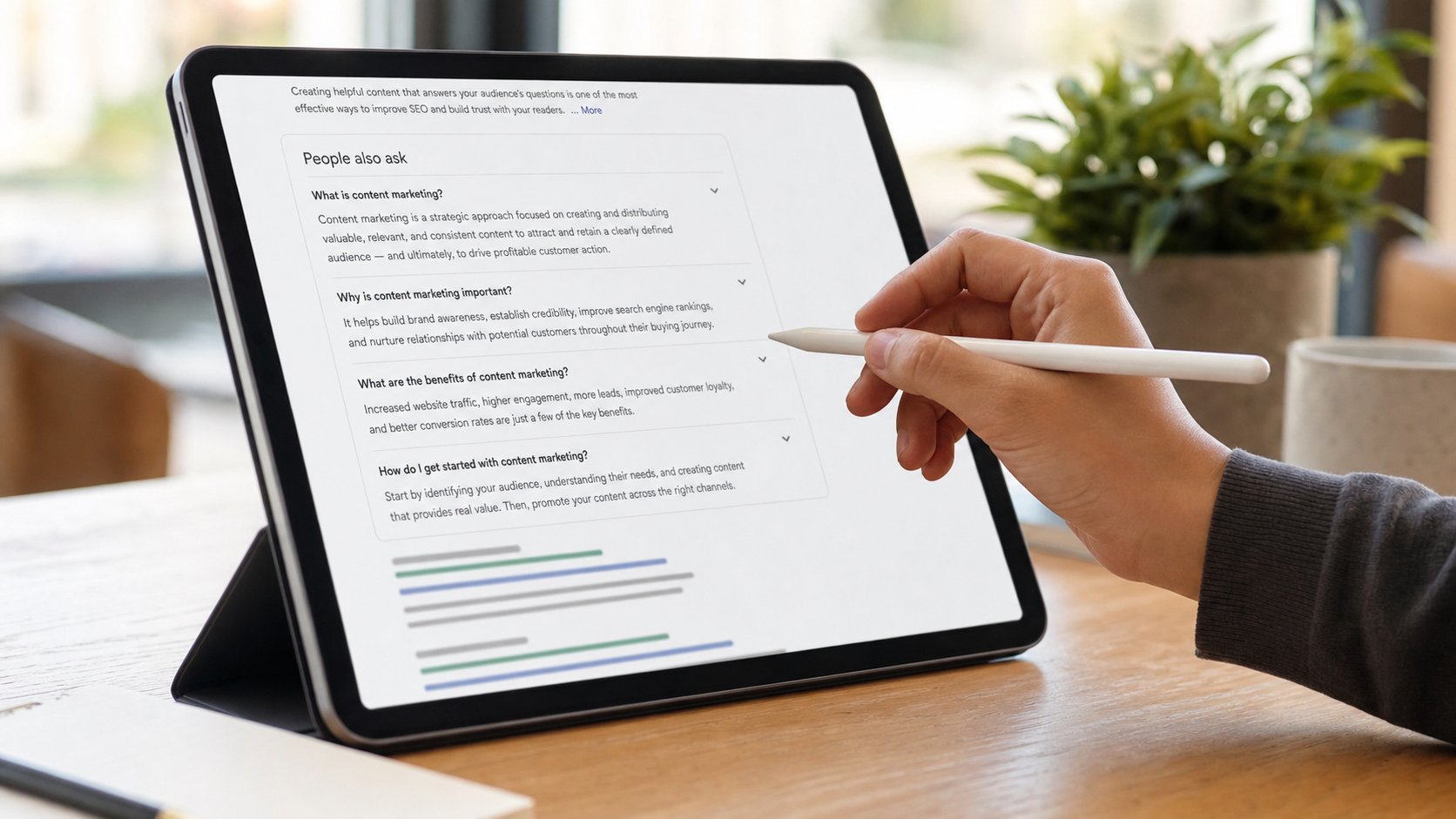
People Also Ask is an expandable set of questions Google shows inside the search results. Each time a user expands a question, more questions appear, which means the box can grow into a long chain of related queries.
For businesses, PAA visibility is powerful because it lets you appear multiple times on one SERP, even if you are not the top organic result. It is especially valuable for service businesses, where the questions often map directly to objections, pricing, timelines, and comparisons.
The hidden benefit: PAA forces content alignment. If your page answers the real questions, it tends to convert better because it reduces uncertainty. That is why PAA work often lifts leads even when rankings barely move.
How PAA selections work behind the scenes
Google typically pulls PAA answers from pages that already rank in the top 20-30 for the broader topic. Then it selects sections that are clearly labeled with question-like headings and concise answers that fit the PAA card.
The core principle is extractability. If your answer requires reading three paragraphs to find the point, you will lose. If you answer in two sentences and then expand below, you are giving Google what it needs and giving users a reason to click.
Google also tests different sources over time. If your answer is clearer than the winner, you can rotate in. If your answer is stale, you can rotate out. Treat PAA as an ongoing optimization loop rather than a one-time project.
Step 1: Build a PAA question map (not just a keyword list)
A question map is a structured list of the questions people ask, grouped by intent. Instead of one keyword per page, you build a cluster where each page targets a primary theme and includes many related questions.
- Search your main topic and expand 10-15 PAA questions.
- Repeat with 5 variations of the query (cost, best, near me, vs, how long).
- Add questions from customer calls, chat logs, and sales objections.
- Group questions into 6-10 themes you could reasonably cover on one page.
- Map each theme to a URL so you do not cannibalize yourself.
Anecdote: for a local SEO agency, we built a 112-question map in one afternoon. We turned it into 9 cluster pages, and within a month the site started showing up in PAAs for queries it never ranked for before.
When building the map, add a column for "decision stage." Some questions are early-stage (definitions), while others are late-stage (cost, best provider, timeline). Late-stage questions tend to drive leads faster even with lower search volume.
Step 2: Write PAA-friendly answers (2-3 sentences first)
The easiest way to win PAA is to answer like a human who is trying to be helpful quickly. Lead with the direct answer, then add context and examples underneath.
Answer formula: Sentence 1 states the conclusion. Sentence 2 gives the main reason. Sentence 3 (optional) adds a qualifier or example.
Example: "PAA optimization works best when you use question headings and short answers because Google needs a clean excerpt to display. If you answer in 2-3 sentences and then expand below, you can win the PAA placement and still earn the click."
Do not be afraid of being specific. If the question is "How much does SEO cost?" give a range and what affects it. If you are too vague, Google can find another source that provides a clearer excerpt.
Step 3: Use headings that mirror real PAA wording
Your headings should look like the questions users see in the SERP. Avoid clever phrasing. If the PAA question is "How long does local SEO take?" then your heading should be exactly that or extremely close.
- Use H2s for primary questions tied to core intent.
- Use H3s for follow-ups that support the H2 topic.
- Keep each answer self-contained so it can stand alone as an excerpt.
- Prefer consistent structure across the page so extraction is reliable.
Consider also AEO as you build your visibility system. Consistent structure also makes your content easier to maintain when PAA questions shift.
Step 4: Build topic clusters that reinforce PAA authority
PAA wins compound when your site demonstrates depth. That means multiple related pages that link to each other and cover the topic from different angles: beginner guides, pricing pages, service pages, and local variants.
Cluster strategy: create one hub page that answers the big question, then publish 6-12 supporting pages that each answer a narrower set of questions. Link them together with descriptive anchor text so Google sees a connected topical network.
A simple way to decide cluster boundaries is to group questions by the primary thing the reader wants next. If they want steps, keep it a process page. If they want cost, keep it a pricing page. If they want a provider, keep it a comparison page.
Step 5: Add lists, steps, and mini-tables to match PAA formats
Many PAA answers are pulled from short lists, especially for "how to" and "what are the best" style questions. Add at least two list sections per page so you are eligible for different extraction patterns.
- Checklist snippet: 7-10 bullets that summarize the section.
- Step list: 5-8 steps for a process.
- Comparison mini-table: tool, cost, best for, downside.
We often include real tool pricing to keep content concrete: Semrush Pro at $139.95/mo, Ahrefs Lite at $129/mo, and Surfer SEO at $99/mo. Even if prices change, the specificity makes the advice actionable and believable.
Mini-table example:
| Tool | Best for | Typical use in PAA work |
|---|---|---|
| Search Console | Real queries | Find question queries that already get impressions |
| Semrush | SERP features | See which questions trigger PAA and track competitors |
| Screaming Frog | Site audits | Find thin pages and internal link gaps in your cluster |
Step 6: Optimize for follow-up clicks (not just impressions)
PAA placement is visibility, but you still want traffic and leads. The trick is to give a complete answer in the excerpt while hinting that the page contains a deeper walkthrough, examples, and templates.
For example, if the question is about cost, give the range in the first answer, then add a breakdown by tier, timeline, and what is included. Readers click because they want the details, not just the range.
We also recommend placing a short CTA after every 2-3 question sections. Keep it relevant and low-friction, like "Download the checklist" or "Request a quick audit." This converts information seekers into leads without disrupting the Q-and-A flow.
Step 7: Repurpose PAA questions into sales enablement
One of the best ways to justify content investment is to reuse the same questions in sales. Build a shared question library so your team uses consistent language across the website, proposals, and calls.
Anecdote: a home services company built a 20-question PAA library and turned it into call scripts. Close rate improved from 18% to 24% over two months because reps answered objections more consistently and prospects felt more confident.
Measurement: how to know you are winning PAA consistently
PAA is harder to measure than rankings because it is dynamic. We recommend a simple measurement stack: Search Console query tracking, weekly SERP feature tracking, and a monthly review of which questions changed.
- Track target questions in a spreadsheet with URL mapping.
- Check the SERP weekly for the top 20 questions to see which sources rotate in.
- Watch Search Console for new queries that start generating impressions.
- Update answers when the winning source uses a different format or length.
- Track assisted conversions to see whether PAA traffic contributes to leads later.
Anecdote: one B2B site saw only a modest ranking lift, but impressions tripled because PAA placements started showing for dozens of mid-tail questions. Leads increased 18% in the next quarter because the traffic skewed toward decision-stage questions.
Internal links that strengthen your question cluster
Consider also AI SEO as you build your visibility system.
Consider also SGE Optimization as you build your visibility system.
Consider also Web Design as you build your visibility system.
Consider also Social Media as you build your visibility system.
Consider also PPC Management as you build your visibility system.
Consider also AI Automation as you build your visibility system.
Consider also Go High Level as you build your visibility system.
Consider also Orlando as you build your visibility system.
Consider also Tampa as you build your visibility system.
Consider also Miami as you build your visibility system.
Consider also Jacksonville as you build your visibility system.
Consider also Daytona Beach as you build your visibility system.
Consider also Fort Lauderdale as you build your visibility system.
When you link from your core service pages into your question-driven content, you create a feedback loop: your services rank better because they are supported by informational content, and your informational pages win more PAAs because they are reinforced by authoritative service pages.
Copy-ready PAA content template (paste into your doc)
H1: Primary topic
Intro: 2 paragraphs that define the problem and promise the outcome.
H2: Primary question (2-3 sentence direct answer)
Expand: 2-3 paragraphs with examples, tools, and caveats.
H3: Follow-up question (2-3 sentence direct answer)
Repeat: 8-15 questions on the page, plus an FAQ section.
Step 8: Create one dedicated PAA landing page per core service
One mistake we see is putting all questions into blog posts and leaving service pages thin. If you want PAA visibility that turns into revenue, each core service should have its own question-rich landing page with 8-12 tightly related questions.
For example, an SEO service page can include questions about pricing, timelines, what is included, and what results look like. When that page starts winning PAA placements, the click lands on a page that is already designed to convert, not on a generic article.
A practical structure is to place the most commercial questions higher on the page, then the educational questions lower. That way, a prospect who is ready to buy finds the answer and the CTA quickly.
Step 9: Build an internal linking plan that mirrors your question map
Internal linking is how you make your question cluster discoverable and coherent. Instead of adding random links, map links to the same themes you used in your question map: cost, process, comparisons, and troubleshooting.
Create a simple rule: every new question-focused page must link to one service page, one location page (if relevant), and two related blog posts. Over 30 days, this creates a strong network without needing a complex architecture change.
Anecdote: a small business in Orlando added a basic internal linking rule and saw average pages per session increase from 1.3 to 2.1. Leads improved because users read multiple answers before contacting the team.
Frequently Asked Questions
How many questions should one page answer for PAA?
A strong page usually answers 8 to 15 tightly related questions. If the questions require very different intent, split them into separate pages and link them as a cluster.
Do I need schema for People Also Ask?
Schema is not required to appear in PAA, but clean on-page structure and clear question headings matter more. FAQ schema can still help you present content clearly.
How do I find PAA questions without manual searching?
You can start manually for accuracy, then scale with SEO tools that collect SERP questions. The key is to validate the questions by checking the live SERP and grouping by intent.
Why do my PAA placements come and go?
PAA results rotate as Google tests different sources and as user behavior changes. Updating answers, improving internal links, and expanding topical depth helps you stabilize.
Can product or e-commerce sites win PAA?
Yes. E-commerce sites can win PAA for product comparisons, sizing, materials, shipping, returns, and buying guides, especially when they publish helpful informational content.
What is the best way to convert PAA traffic?
Match the page to the next step in the journey by adding a clear CTA after the answer sections, offering a checklist or template, and linking to relevant service pages.
How often should I refresh PAA content?
A practical cadence is quarterly for core pages and monthly for competitive questions. Refresh when the SERP winner uses a different format or introduces a clearer answer.