Why Most St. Augustine SEO Campaigns Fail and How to Fix Yours
By Search Scale AI Team · April 8, 2026 · 11 min read
Quick Answer
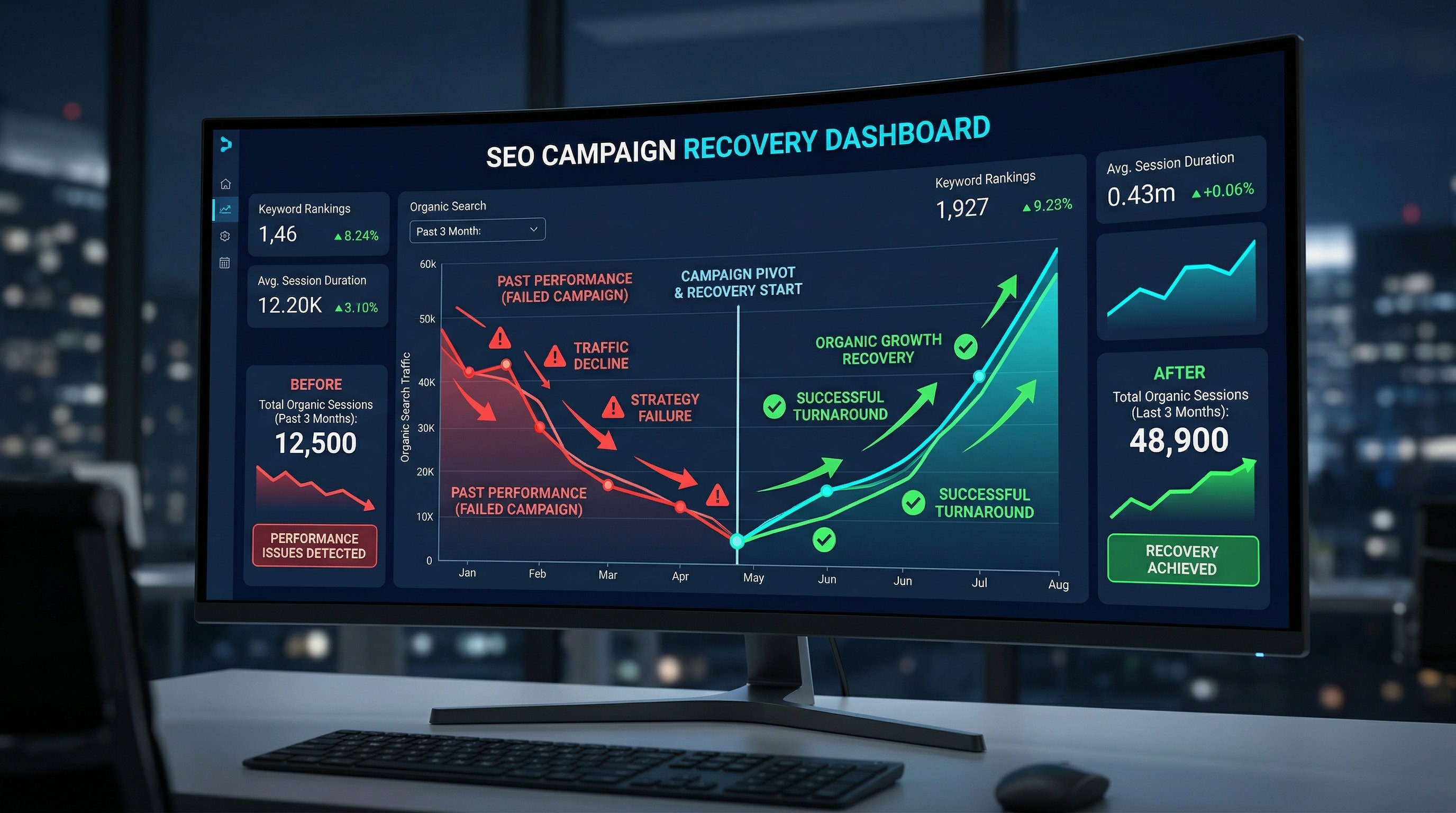
Most St. Augustine SEO campaigns fail because of a predictable set of mistakes: no genuine local keyword targeting, a website with technical problems that block Google from ranking it, complete neglect of the Google Business Profile, no systematic review generation process, and no backlinks from locally relevant sources. The good news is that each of these failures is fixable with a structured approach — and because so many St. Johns County competitors are making these same mistakes, a properly executed search engine optimization strategy can achieve competitive rankings faster than most business owners expect.
Key Takeaways
- Targeting the wrong keywords — too broad, too generic, or too competitive — is the most common reason St. Augustine SEO campaigns stall.
- A slow, mobile-unfriendly website undermines every other SEO effort by preventing Google from ranking your pages.
- Neglecting the Google Business Profile means missing the Google Maps 3-pack, where 40 to 60 percent of local clicks happen.
- No review generation system means competitors with systematic processes consistently outrank you regardless of other optimizations.
- Generic, non-local content fails to signal geographic relevance to Google and fails to convert St. Johns County visitors into customers.
- Expecting results in 30 days and quitting at 60 is one of the most expensive SEO mistakes a St. Augustine business can make.
- Measuring the wrong metrics — vanity rankings rather than GBP calls, direction requests, and organic lead generation — masks real campaign performance.
Table of Contents
- Failure #1: Targeting the Wrong Keywords
- Failure #2: A Website That Blocks Rankings
- Failure #3: Neglecting the Google Business Profile
- Failure #4: No Systematic Review Generation
- Failure #5: Generic Content Without Local Relevance
- Failure #6: No Local Backlink Strategy
- Failure #7: Unrealistic Timeline Expectations
- Failure #8: Measuring the Wrong Metrics
- Frequently Asked Questions
Failure #1: Targeting the Wrong Keywords
The most common foundational failure in St. Augustine SEO campaigns is targeting keywords that are either too broad to win or too narrow to matter. A plumbing company targeting "plumber" statewide is competing against thousands of pages from national directories, home improvement media sites, and large regional companies — an unwinnable battle for a local business. The same company targeting "plumber St. Augustine" misses the neighborhood-level specificity that captures high-intent local searches: "plumber Nocatee," "emergency plumber Ponte Vedra Beach," "plumbing repair Vilano Beach." The gap between "plumber" (100,000+ monthly searches nationally, nearly zero conversions for a local company) and "plumber Nocatee FL" (200 monthly searches, very high conversion rate) is the gap between wasted SEO investment and sustainable lead generation.
Keyword research for St. Augustine businesses must account for the market's geographic complexity. St. Johns County spans roughly 600 square miles and includes communities with distinct identities and search behaviors: the tourism-heavy Historic Downtown, the family-oriented Nocatee master-planned community, the affluent Ponte Vedra Beach area, the beach communities of Vilano Beach and St. Augustine Beach, the agricultural southern county communities of Hastings and Elkton, and the northwesterly growth corridors around SR-16 and World Golf Village. A business serving multiple zones needs keyword research that maps each zone's distinct search vocabulary.
The fix is structured keyword research using tools like Semrush, Ahrefs, or Google Keyword Planner to identify the specific phrases St. Johns County residents and visitors use to find your service category, sorted by search volume and competition level. Prioritize keywords where you have a genuine geographic advantage — specific neighborhoods, nearby landmarks, local community names — over keywords where you are competing against nationally optimized sites. Then validate your keyword list against actual Google Search Console data to see what people are already using to find your site, and optimize your content to better capture those queries. Implementing AI-powered SEO keyword analysis tools can surface hyperlocal keyword opportunities that traditional research methods miss entirely.
- Map your service area geographically before beginning keyword research — identify the 10 to 15 specific communities you want to rank for.
- Prioritize long-tail, location-specific keywords ("emergency electrician Nocatee FL") over generic service keywords that attract no local traffic.
- Research competitor keywords using Semrush or Ahrefs to identify which St. Augustine-specific phrases competitors are ranking for that you are not.
- Include seasonal keyword variations — "hurricane prep St. Augustine" peaks in late spring — in your content calendar for timed publication.
- Validate keyword choices against Google Business Profile data showing which search queries are already triggering your GBP listing.
Failure #2: A Website That Blocks Rankings
A website with serious technical problems is the silent saboteur of countless St. Augustine SEO campaigns. Business owners invest months in content creation, link building, and GBP optimization — only to discover that Google has been struggling to crawl and index their website the entire time due to unresolved technical issues. The frustrating part is that these technical problems often produce no visible errors for a human visitor browsing the site, which is why they go undetected for months while consuming the SEO budget.
The most common technical failures in St. Augustine business websites are: page load speeds exceeding 3 seconds on mobile (often caused by unoptimized images, excessive plugin load, or cheap shared hosting), missing SSL certificates causing Google to flag the site as insecure, duplicate content across service pages (especially in multi-location businesses that copied the same page and only changed the city name), broken internal links that prevent Google from discovering important pages, and crawl errors that block Google's bot from accessing significant portions of the site. A technical SEO audit using Google Search Console, Screaming Frog, or Semrush Site Audit will surface all of these issues with specific pages and line-by-line recommendations.
Mobile speed deserves particular attention for St. Augustine businesses because Google's mobile-first indexing means your site's mobile experience determines your rankings, regardless of how well the desktop version performs. A restaurant on St. George Street with a beautiful desktop website that loads in 8 seconds on mobile is invisible to Google for all practical purposes — tourists searching for dining options on their phones will never see it in organic search. The technical foundation of professional web design that loads quickly on mobile devices is not optional for competitive St. Augustine SEO; it is the prerequisite for every other optimization to function. Technical SEO failures compound over time — a site that was borderline functional two years ago may now be significantly penalized as Google's Core Web Vitals standards have tightened and mobile-first requirements have strengthened.
What technical score should my St. Augustine business website achieve?
Target a Google PageSpeed Insights score of 80 or above on mobile and 90 or above on desktop. For Core Web Vitals, aim for Largest Contentful Paint under 2.5 seconds, Cumulative Layout Shift under 0.1, and Interaction to Next Paint under 200 milliseconds. These thresholds are not arbitrary — they reflect the performance standards that Google uses to evaluate whether a website provides a satisfactory user experience on mobile devices, which is the primary device type for the majority of St. Johns County local searches.
Failure #3: Neglecting the Google Business Profile
The Google Business Profile is the most powerful free SEO tool available to St. Augustine businesses, and it is the most neglected. Many St. Johns County businesses claimed their GBP years ago, filled in the basics, and have not touched it since. Meanwhile, competitors with actively managed GBP listings — weekly posts, regular photo uploads, Q&A management, category optimization — are capturing the Google Maps 3-pack positions that generate the majority of local search clicks. A neglected GBP is not neutral; it actively signals to Google that your business is less active and less trustworthy than competitors maintaining their profiles.
GBP optimization failures fall into two categories: completeness failures and activity failures. Completeness failures include missing or inaccurate business hours (especially special holiday hours), no business description, an incomplete list of services and products, missing secondary categories, and no Google Business Profile website URL. Activity failures include no Google Posts in the past 90 days, no new photos uploaded in the past 30 days, unanswered customer reviews and Q&A submissions, and no use of the booking or messaging features. Each of these gaps is an opportunity for a competitor to differentiate their GBP listing from yours in Google's eyes.
The fix is a structured GBP maintenance routine: publish two Google Posts per week (one highlighting a service or offer, one featuring completed work or a community event), upload 3 to 5 new photos weekly, respond to every review within 24 hours, review the Q&A section monthly and add new proactive questions and answers, and update business hours for any holidays or seasonal changes immediately. This maintenance takes approximately 2 to 3 hours per week and is the highest-ROI time investment in local SEO for most St. Augustine businesses. Automating GBP management workflows through a Go High Level CRM platform reduces the time investment while maintaining the consistency that Google rewards.
- Audit your GBP completeness monthly using Google's own "Profile completeness" indicator and fill every available field.
- Schedule GBP posts two weeks in advance to maintain posting consistency even during busy periods.
- Upload exterior, interior, team, and project photos weekly — businesses with 100+ photos rank measurably higher than those with under 20.
- Add 10 to 15 proactive Q&A entries addressing the most common questions your potential customers ask before contacting you.
- Review your GBP insights monthly to identify which search queries are generating the most impressions and clicks, then optimize content accordingly.
Failure #4: No Systematic Review Generation
Review velocity — the consistent, ongoing generation of new five-star Google reviews — is the single most impactful ranking factor that most St. Augustine businesses completely neglect. The typical St. Augustine service business generates 2 to 5 Google reviews per month passively, waiting for customers who feel strongly enough to leave feedback unprompted. Meanwhile, a competitor with an automated review request system following every transaction generates 20 to 40 reviews per month from the same customer volume. After six months, the first business has 12 to 30 reviews; the competitor has 120 to 240. The ranking gap this review differential creates is essentially impossible to overcome with any other SEO tactic.
The review generation system that works for St. Augustine businesses is simple in concept and powerful in execution: trigger a review request automatically 24 to 48 hours after every completed transaction or service. Send it via SMS (which has significantly higher open rates than email) with a direct link to your Google review page — not your website homepage, not your GBP profile, but the direct review submission URL. The message should be brief and personal: "[Business owner name] here — thank you for choosing us for your [service]. If you have a moment, we would love to hear about your experience: [direct review link]." This frictionless process converts satisfied customers into reviewers at rates of 15 to 25 percent, versus under 3 percent for passive approaches. Our digital marketing services include review automation setup and management.
Responding to reviews — positive and negative — is as important as generating them. Google explicitly confirms that responding to reviews is a positive signal for local rankings. Beyond the ranking signal, responses demonstrate to prospective customers that your business is attentive and customer-focused, which directly improves conversion rates from GBP profile views to contact form submissions and phone calls. Negative reviews handled professionally and promptly often convert skeptical readers into actual customers — a thoughtful response to a complaint is evidence of a business that cares about getting things right, which is exactly what a prospective customer wants to see before hiring a St. Augustine service provider they have never used before.
Failure #5: Generic Content Without Local Relevance
Generic, non-local content is the invisible anchor dragging down thousands of St. Augustine SEO campaigns. A home services company with a service page that reads "We provide professional HVAC services for residential and commercial customers. Our experienced technicians are here to help with all your heating and cooling needs" has told Google nothing about where they operate, which communities they serve, or why they are the right choice for a homeowner in Nocatee or a business owner on the US-1 corridor. Google has no geographic signal to work with and no reason to show this page to a St. Johns County searcher over a generic national directory.
Local content relevance is built through specificity: naming the communities you serve (Nocatee, Ponte Vedra, World Golf Village, Vilano Beach, Palm Coast), referencing local landmarks and geography (proximity to the Intracoastal Waterway, service area within 10 miles of Flagler Hospital, serving businesses along the US-1 corridor), addressing local environmental conditions (Florida's high humidity, coastal salt air corrosion, St. Johns County's hurricane vulnerability), and including genuine local testimonials with neighborhood references. A service page that says "Serving Nocatee homeowners since 2019 — we know the unique challenges of keeping homes comfortable in St. Johns County's humid coastal climate" has given Google multiple geographic relevance signals that the generic version entirely lacks. Combining locally specific website content with comprehensive answer engine optimization schema markup ensures your content surfaces for both traditional searches and AI-driven queries about St. Augustine services.
The solution is a content audit followed by a rewrite plan. Identify every service page on your website that fails to name specific St. Johns County communities and lacks local environmental or contextual references. Prioritize them by their current traffic potential (keyword search volume) and rewrite the highest-priority pages first. Add a neighborhood-specific page for each major community you serve, with genuinely unique content about that specific area. Establish a blog publishing schedule focused on locally relevant topics that answer the specific questions your St. Augustine target audience is searching. This content infrastructure, once built, requires only maintenance — not constant rebuilding — making it the most cost-efficient long-term SEO investment available to St. Johns County businesses.
- Audit every service page for geographic specificity — if you could delete the city name and the content still reads the same, it needs local relevance work.
- Create individual location pages for Nocatee, Ponte Vedra Beach, World Golf Village, Palm Coast, Vilano Beach, and any other major service areas.
- Include at least three specific St. Johns County or St. Augustine geographic references in every piece of content you publish.
- Feature client testimonials with specific neighborhood or community references to reinforce local relevance on service pages.
- Publish local FAQ content addressing the specific questions St. Augustine and St. Johns County residents ask about your service category.
Failure #6: No Local Backlink Strategy
Many St. Augustine businesses invest heavily in on-site SEO — well-optimized pages, local content, GBP management — and then hit a ranking ceiling they cannot break through despite continued effort. The missing piece is almost always a local backlink strategy. Backlinks from geographically relevant, authoritative local sources are the trust signal Google uses to confirm that your business is an established, legitimate member of the St. Augustine business community. Without them, even excellent on-site optimization cannot overcome the authority gap between your domain and competitors who have earned local links over years of business operation.
The core of a St. Augustine local backlink strategy is straightforward: join the St. Augustine Chamber of Commerce for a directory listing, secure presence in the Visit St. Augustine tourism authority listings, earn mentions in the St. Augustine Record through newsworthy community activities, sponsor local events in Nocatee and Ponte Vedra Beach that list sponsors on their event websites, and partner with complementary local businesses for mutual referral links. Each of these sources provides a geographically specific, authoritative backlink that directly signals to Google that your business is embedded in the St. Augustine community. Businesses that execute this strategy consistently over 12 months build a backlink profile that provides a durable, long-term competitive advantage over competitors who have not invested in local link building. We cover the full local backlink playbook for St. Johns County businesses in our guide to building local backlinks in St. Augustine. Amplify your community visibility further through social media marketing that extends your reach into the Nocatee, Ponte Vedra, and World Golf Village community groups where potential customers are already active.
For Orlando, Tampa, Miami, and Jacksonville businesses facing similar challenges, the same principles apply: locally relevant links from community organizations, local press, and geographic-specific directories consistently outperform generic national links. The local search landscape rewards businesses that are genuinely embedded in their communities, and backlinks are the primary signal of that embeddedness that Google can measure objectively. Combining a local link-building strategy with pay-per-click advertising provides immediate coverage while organic authority builds over time.
Failure #7: Unrealistic Timeline Expectations
One of the most expensive SEO mistakes St. Augustine business owners make is quitting a well-structured campaign before it has time to produce results. SEO is not an overnight channel — it is a medium-term investment where results compound significantly over time. Most St. Johns County businesses see initial movements in GBP impressions and some keyword ranking improvements within 60 to 90 days of a properly executed campaign. Meaningful lead generation from organic search typically begins at the 4 to 6 month mark. Full competitive local search dominance in contested niches like HVAC, legal services, and dental often takes 8 to 12 months of consistent effort.
The timeline mismatch creates a painful pattern: a St. Augustine business invests in SEO for 60 to 90 days, sees no dramatic results yet, concludes the campaign is failing, and cancels — just before the compounding effects of their work would have become visible. Then they try paid advertising, get immediate but expensive traffic, see the cost per lead and decide it is unsustainable, and cycle back to SEO — only to start the clock over again. The businesses that consistently dominate St. Augustine search results are the ones that committed to a 12-month SEO program and maintained that commitment through the slow early phase, allowing the compounding effects of content, links, and reviews to develop into sustainable ranking dominance.
Setting realistic expectations is the responsibility of both the agency and the business owner. A good SEO partner will establish clear leading indicators that demonstrate campaign progress before conversions materialize: GBP impressions trending upward, new keyword rankings appearing in Search Console, new backlinks being acquired monthly, review count growing consistently. These leading indicators confirm that the campaign is on track even before the phone starts ringing with organic leads. If your St. Augustine SEO agency cannot provide these leading indicators — or provides only vague reports of "content published" and "links built" without specific data — that is a performance problem worth addressing directly. Schedule a free strategy consultation with our team to get an honest assessment of what a realistic timeline looks like for your specific competitive situation.
Failure #8: Measuring the Wrong Metrics
Measuring vanity metrics instead of business impact metrics is the final common failure that prevents St. Augustine businesses from accurately evaluating their SEO campaigns. Many business owners focus on keyword rankings — "we moved from position 9 to position 6 for 'plumber St. Augustine'" — as the primary measure of SEO success, while ignoring the metrics that actually connect to business outcomes. A position-6 organic ranking for most local searches generates almost no clicks because Google Maps 3-pack results occupy the top of the page, followed by local services ads, before organic results even appear. Moving from position 9 to position 6 in organic while remaining outside the Maps 3-pack typically produces no measurable increase in leads.
The metrics that actually matter for St. Augustine local SEO success are: Google Business Profile calls (how many people are calling your business directly from Maps listings), GBP direction requests (indicating purchase intent from local searchers), GBP website clicks from Maps (showing profile-to-site conversion behavior), organic website traffic from Google Search Console, and most importantly, phone calls and form submissions from organic sources tracked through a call tracking and analytics system. These metrics connect SEO performance directly to business outcomes — leads generated, calls received, directions requested — rather than ranking positions that may or may not translate into actual customer inquiries.
Implementing a measurement system that captures these business-impact metrics is straightforward with tools available to any St. Augustine business. Google Analytics 4 tracks organic traffic and conversion events (form submissions, phone number clicks). Google Search Console shows keyword impressions and clicks. GBP Insights provides Maps-specific performance data. CallRail or a similar call tracking tool attributes phone calls to their digital source. Connecting all of these through a unified marketing automation dashboard allows you to see, at a glance, how much organic traffic your site is receiving, how many of those visitors are contacting you, and which content and keywords are driving the most valuable inquiries. This complete measurement picture is the foundation for intelligent SEO investment decisions that maximize your return on every dollar invested in St. Johns County digital marketing.
Ready to Fix Your St. Augustine SEO Campaign?
Get a Free SEO Audit and Strategy Session
Our Florida SEO specialists will identify exactly what is holding your St. Augustine rankings back and build a clear plan to fix it.
For a complete overview of our SEO services in St. Augustine, visit our dedicated SEO Agency in St. Augustine, FL page.
Frequently Asked Questions
Common questions about SEO campaign performance from St. Augustine and St. Johns County business owners.
How long should I give an SEO campaign before deciding it is failing?
Most St. Augustine businesses should see measurable movement in Google Business Profile impressions and some keyword ranking improvements within 60 to 90 days of a properly executed SEO campaign. If you see no movement after 90 days, something is wrong. Full competitive local search dominance typically takes 6 to 12 months of consistent effort. Giving up at 60 days is the most common mistake; no leading indicators of progress after 6 months is a legitimate red flag requiring strategy reassessment.
What are the signs that my St. Augustine SEO agency is not performing?
Signs of an underperforming agency include: no monthly reporting with specific data, inability to explain what specific tasks were completed each month, no measurable movement in Google Business Profile metrics after 90 days, no improvement in organic website traffic after 6 months, and guaranteed ranking promises. A performing agency provides transparent data, clear explanations of completed work, and demonstrates a consistent upward trend in local visibility metrics.
Is my website hurting my SEO in St. Augustine?
Your website may be hurting your SEO if it loads in more than 3 seconds on mobile, lacks SSL, has duplicate content across service pages, or was built on a platform that blocks search engine crawling. Run your website through Google's PageSpeed Insights tool and Google Search Console to identify technical issues. Many St. Augustine businesses invest heavily in off-page SEO while their website has fundamental technical problems preventing proper indexing.
Why did my St. Augustine rankings suddenly drop?
Sudden ranking drops typically have one of these causes: a Google algorithm update penalized thin or duplicate content, a competitor significantly increased their review count or backlink profile, a technical issue caused de-indexing, or a Google Business Profile policy violation. Log into Google Search Console to check for manual penalties and coverage errors, check your GBP for any policy flags, and compare your backlink profile before and after the drop.
Can I do SEO for my St. Augustine business myself?
Some aspects of St. Augustine local SEO are manageable as DIY — Google Business Profile optimization, review requests, and basic content publishing are achievable for business owners willing to invest 4 to 6 hours per week. However, technical SEO, competitive backlink building, and advanced content strategy benefit significantly from professional expertise. Many businesses achieve the best results with a hybrid approach: handling GBP management in-house while partnering with an SEO agency for technical optimization and content strategy.
What is the most overlooked SEO factor for St. Augustine businesses?
The most overlooked SEO factor is consistent, systematic review generation. Most businesses generate 3 to 5 reviews per month passively. Competitors with an automated review request process following every transaction generate 20 to 40 reviews per month from the same customer volume. Review velocity — consistently adding new five-star reviews every week — is the factor that most clearly separates top-ranked St. Augustine businesses from those on page two.
Related Posts
Start Growing Today
Your Competitors Are Getting It Right.
Time to Fix Yours.
Search Scale AI delivers measurable results for Florida businesses. Let's audit your SEO, fix the failures, and start driving consistent leads within 90 days.
No contracts. No BS. Just results.