SEO for Orlando Medical Practices: Attract More Patients Online
By Search Scale AI Team · April 8, 2026 · 14 min read
Quick Answer
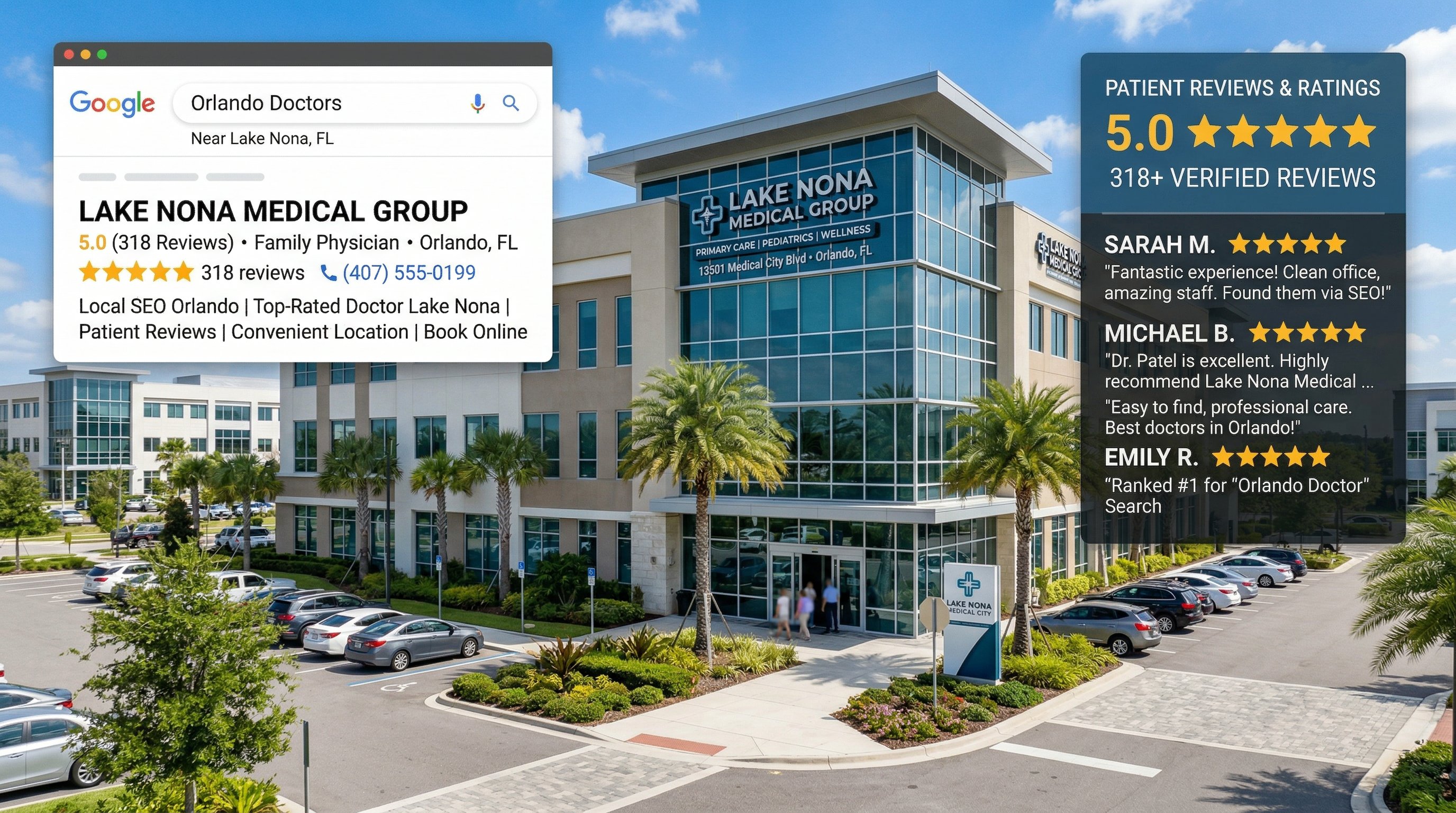
SEO for Orlando medical practices requires a specialized approach that addresses both standard local SEO fundamentals — Google Business Profile, local citations, patient reviews — and the unique demands of healthcare's YMYL (Your Money or Your Life) content standards. Orlando's healthcare market spans Health Village, Lake Nona Medical City, AdventHealth's network, and dozens of independent specialist practices across Dr. Phillips, Winter Park, and Kissimmee. The practices consistently attracting new patients from search share three traits: a medically credentialed content strategy that satisfies Google's E-E-A-T requirements, aggressive reputation management on healthcare-specific review platforms, and location pages targeting every neighborhood and suburb where their ideal patients live.
Key Takeaways
- Medical content is YMYL — Google holds healthcare websites to the highest E-E-A-T standards, and thin or uncredentialed content can suppress your entire site's rankings.
- Healthgrades, Zocdoc, and WebMD physician directory listings are as important as Google Business Profile for medical practice visibility in Orlando.
- Patient reviews on Google and Healthgrades are the primary trust signal new Orlando patients use when choosing a healthcare provider — a systematic review strategy is non-negotiable.
- Lake Nona Medical City's growth has created a concentrated patient population that searches in high volumes for specialty care providers nearby.
- Physician bio pages with complete credentials, publication history, and patient-friendly descriptions are among the highest-ranking pages on medical practice websites.
- HIPAA compliance shapes how you respond to reviews and use patient tracking data — compliance is essential before any marketing activity begins.
- Online appointment scheduling integration with your SEO strategy converts search visibility directly into booked appointments without staff intervention.
Table of Contents
- Orlando's Healthcare Market: What Medical Practices Are Competing For
- YMYL, E-E-A-T, and Why Medical SEO Is Different
- Google Business Profile Optimization for Medical Practices
- Patient Reviews: Your Most Powerful Ranking and Trust Signal
- Medical Directory Listings and Healthcare Citations
- Medical Content Strategy: Conditions, Treatments, and Physician Bios
- Location Pages for Orlando Neighborhoods and Suburbs
- Technical SEO and HIPAA-Compliant Website Architecture
- Integrating Paid Ads with Organic SEO for Faster Patient Growth
- Frequently Asked Questions
Orlando's Healthcare Market: What Medical Practices Are Competing For
Orlando's healthcare market has undergone a structural transformation over the past decade, driven primarily by the development of Lake Nona Medical City — a 650-acre planned medical and research campus that houses the UCF College of Medicine, Nemours Children's Hospital, and the VA Medical Center alongside numerous private specialty practices. This concentration of healthcare infrastructure has created a dense local patient population that searches online for specialist care at unusually high rates. A specialist practice in Lake Nona competing for patients searching "orthopedic surgeon near me" faces a fundamentally different competitive landscape than a practice in suburban Kissimmee.
Health Village in downtown Orlando, anchored by Orlando Health's flagship hospital, generates enormous search volume for every specialty imaginable. AdventHealth's network of hospitals across Orange and Seminole Counties has a sophisticated digital presence that independent practices must compete against. Dr. Phillips and Winter Park are high-income residential communities where patients routinely search for concierge-style primary care, elective procedures, and specialty services. Understanding where your patients live — and targeting those specific neighborhoods through local SEO strategies — is as important as targeting the generic "Orlando" keyword.
The scale of opportunity is significant. The greater Orlando metro has 2.94 million residents and ranks among the fastest-growing major metros in the United States. Population growth means a continuously expanding patient base of newly arrived residents who have no established physician relationships and are actively searching for local healthcare providers. New residents in Lake Nona, Horizon West, and Avalon Park are searching for primary care physicians, pediatricians, dentists, and specialists at the same time they establish utilities and bank accounts. Practices that rank prominently for these neighborhood-level healthcare searches capture a disproportionate share of new patient acquisition. Our digital marketing services team has worked with healthcare practices across Central Florida and understands the nuanced search behavior of each community.
- Lake Nona's professional and young family demographic creates particularly high demand for pediatrics, sports medicine, and family medicine within a short drive.
- The Dr. Phillips and Bay Hill community's affluence drives above-average demand for elective procedures, aesthetic medicine, and concierge primary care.
- Winter Park's older and wealthier residential population searches heavily for geriatric care, cardiology, orthopedics, and high-end dental and vision services.
- Kissimmee's diverse Hispanic population creates demand for bilingual primary care, OB/GYN, and dental practices that serve Spanish-speaking patients.
- The international drive and tourist corridor sees significant urgent care search volume from visitors who need non-emergency medical attention during their stays.
YMYL, E-E-A-T, and Why Medical SEO Is Different
Medical websites fall squarely in Google's YMYL (Your Money or Your Life) category, which means they receive heightened scrutiny from Google's quality evaluation systems. A poorly written blog post on a home services website might cost some rankings; similar thin content on a medical practice website can suppress the entire domain's rankings because Google's systems detect a mismatch between the site's claims of medical expertise and the actual quality of its content. This is not a theoretical risk — medical practices with low-quality content across their service pages and blogs consistently rank below competitors with fewer but higher-quality pages.
E-E-A-T stands for Experience, Expertise, Authoritativeness, and Trustworthiness — the four qualities Google's quality raters assess when evaluating medical content. Experience means content written or reviewed by someone with firsthand clinical experience in the topic. Expertise means demonstrated professional credentials: board certifications, medical school affiliations, peer-reviewed publications, and specialty society memberships. Authoritativeness means your practice and its physicians are recognized as authorities by other trusted sources — medical associations, hospital affiliations, media citations. Trustworthiness means your website is technically secure, your content is factually accurate, your citations come from authoritative sources, and your patient policies are transparent.
Implementing E-E-A-T for your Orlando medical practice website means: every condition and treatment page should be authored or reviewed by a named, credentialed physician on your staff; author bylines should link to comprehensive physician bio pages with credential details; medical content should cite peer-reviewed sources and major medical organizations (CDC, AHA, NIH); your about page should document your practice's history, accreditations, and hospital affiliations; and your site should carry clearly visible privacy policy and terms of service pages. The answer engine optimization dimension is equally important: AI-powered search engines like ChatGPT Search and Perplexity apply similar quality filters when selecting healthcare providers to recommend in direct answers. Structured data markup with MedicalOrganization and Physician schema types explicitly communicates your credentials to both Google and AI answer engines. Businesses in Miami with multilingual medical content face additional E-E-A-T requirements for non-English pages.
Do all pages on my Orlando medical website need physician authorship to rank?
Not every page, but all medically informational content — condition pages, treatment descriptions, health topic blog posts — should carry a physician author or reviewer credit to satisfy YMYL E-E-A-T requirements. Administrative pages (contact, appointments, insurance accepted) don't require medical authorship. The key test: would a patient or Google's quality rater expect this content to be written by a medical professional? If yes, it needs physician attribution. If no, standard web best practices apply.
- Build comprehensive physician bio pages for every provider in your practice — these are among the highest-ranking and most-clicked pages on medical practice websites.
- Include medical school graduation, residency, fellowship, board certification, and professional memberships on each physician's bio page for maximum E-E-A-T signal.
- Link physician bios to their Google Scholar profiles, PubMed publications, or hospital staff profiles where available — these external authority links reinforce E-E-A-T.
- Display any Joint Commission accreditation, AAAHC certification, or hospital affiliation prominently on your homepage and about page.
- Date-stamp all medical content and keep it current — outdated statistics or superseded treatment recommendations harm E-E-A-T significantly.
Google Business Profile Optimization for Medical Practices
Google Business Profile is the single most important digital property for attracting new patients through local search. When someone in Lake Nona searches "family doctor near me" or "urgent care Lake Nona," the three practices in the Google Maps Local Pack capture the overwhelming majority of clicks and calls. Being in that top three is determined primarily by GBP optimization quality, review profile, and proximity — and of those three, GBP optimization is the variable most entirely within your control.
Medical practices have unique GBP features that standard businesses don't. Healthcare booking integration via Zocdoc, Healow, or practice management software allows patients to book appointments directly from your Google Maps listing — a massive conversion enhancement that eliminates friction between search and appointment. If your practice management system supports GBP health booking integration, enable it immediately. This single feature can increase appointment bookings from Google Maps listings by 30-50% compared to practices that require phone calls for all scheduling.
For multi-provider practices, each physician can have their own GBP listing alongside the practice's main listing. A practice with five physicians in Winter Park can have six GBP listings — one for the practice and one for each named physician. Each physician profile appears in relevant searches for their specialties, dramatically expanding your practice's total Google Maps visibility. This multi-listing strategy is particularly effective for specialists: a cardiologist in Health Village appearing in their own GBP searches plus the practice listing doubles their Maps exposure for relevant patient searches. Managing multiple profiles requires consistency in NAP data, regular photo updates, and systematic review generation for each profile — a task well-suited to marketing automation tools that can distribute review requests and content updates across multiple profiles simultaneously.
- Select the most specific medical specialty GBP category available — "Cardiologist" ranks better than "Physician" for cardiology searches in Orlando.
- Upload at least 50 photos including practice exterior, waiting room, exam rooms, staff headshots, and any specialized equipment — practices with more photos rank higher.
- Post to GBP twice weekly: health tip posts, seasonal wellness reminders, new provider introductions, or service announcements relevant to your Orlando patient community.
- Enable and monitor the Q&A section — proactively post and answer the 10 most common patient questions (hours, insurance accepted, new patient process, parking).
- Ensure your GBP service area accurately reflects every neighborhood and city your practice serves, from Kissimmee to Sanford, so you appear in relevant searches across the metro.
Patient Reviews: Your Most Powerful Ranking and Trust Signal
Patient reviews are the primary factor that converts a search visibility impression into an actual appointment for Orlando medical practices. When a new Lake Nona resident compares three nearby pediatric practices in Google Maps, they will choose the practice with more, more recent, and more detailed positive reviews — almost regardless of other factors like website quality or proximity. A practice with 300 reviews averaging 4.9 stars will consistently win patients over a competitor with 30 reviews averaging 5.0 stars, because volume signals established patient base trust while perfect scores with few reviews appear statistically unreliable.
Building a systematic review generation process is essential, and it must comply with both Google's guidelines and any applicable healthcare regulations. The approved approach: after each completed appointment, send patients a text message or email with a direct link to your Google review page (not a pre-screened landing page that filters negative reviews — Google prohibits this). Train front desk staff to verbally remind patients at checkout that online reviews help their neighbors find quality care. For practices using electronic health record (EHR) systems, many integrate with patient communication platforms that can automate post-visit review requests while maintaining HIPAA compliance by not including PHI in the communication.
Google reviews are the highest priority, but Healthgrades carries nearly equal weight in healthcare-specific searches. Patients searching for doctors in Orlando frequently use Healthgrades as a primary research platform, and your Healthgrades rating appears in Google's Knowledge Panel for your practice. Zocdoc reviews are visible to the platform's substantial user base of appointment-seekers. A multi-platform review strategy that generates 5-10 new reviews per month across Google, Healthgrades, and Zocdoc creates a reputation fortress that new competitors and established ones alike cannot easily overcome. Using a CRM platform with automated patient communication workflows makes managing multi-platform review generation manageable even for busy practices without dedicated marketing staff. Practices in Tampa and Jacksonville face similarly competitive healthcare review environments and benefit from the same systematic approach.
- Respond to every Google review within 48 hours — responses signal practice engagement to both Google's algorithms and prospective patients reading reviews.
- For negative reviews, respond professionally without confirming patient status or details — acknowledge their concern and invite them to call your patient relations department.
- Include a review request in your appointment reminder sequence (day-of reminder and 48-hour post-appointment follow-up) for maximum response rates.
- Display your aggregate review rating prominently on your website homepage and contact page — social proof that converts website visitors into appointment bookings.
- For practices with Zocdoc integration, ensure your Zocdoc profile is complete and accurate — Zocdoc reviews feed into broader healthcare search ecosystems.
Medical Directory Listings and Healthcare Citations
Healthcare has a richer ecosystem of specialized online directories than almost any other industry, and each directory listing is a citation and potential backlink that reinforces your practice's local SEO authority. The challenge for Orlando medical practices is ensuring NAP consistency across all of these directories — a task made complex by the fact that many healthcare directories auto-populate physician data from insurance company credentialing databases, which may contain outdated or incorrect information.
The priority directories for Orlando medical practices: Google Business Profile (first priority), Healthgrades (second priority, claim your profile and update it completely), Zocdoc (enables online booking and drives high-intent patient traffic), WebMD Find a Doctor, US News Health, Vitals.com, RateMDs, Castle Connolly (for physicians seeking "Top Doctor" recognition), and your specialty's national association finder. For Florida-specific authority, list on the Florida Medical Association directory and Florida Hospital Association's provider directory. The Blue Cross Blue Shield, UnitedHealthcare, and Aetna "Find a Doctor" portals are also important because they generate patient referrals directly but also function as citations and authority signals.
Conduct a comprehensive citation audit by searching your practice name and each physician's name on Google and noting every directory where you appear. Claim each listing that you haven't already claimed and update it with accurate, complete information. The goal is 100% NAP consistency across every platform: your practice name, address, and phone number must be absolutely identical in format across Google, Healthgrades, WebMD, insurance directories, and your website. A practice that is "Dr. Jane Smith MD, PA" on Google but "Jane Smith Medical Practice" on Healthgrades and "Smith Family Medicine" on WebMD is signaling data inconsistency to Google's algorithms. The schema markup on your website should use your legally registered business name to establish the canonical version of your practice identity across all online platforms. Pair this citation strategy with a comprehensive SEO services program for the most effective patient acquisition results.
- Claim your NPI (National Provider Identifier) listing on NPPES.hhs.gov and verify all information is accurate — this is a foundational healthcare data source.
- Verify your practice appears correctly in the directories of all insurance networks you participate with — patients use these as starting points for finding in-network providers.
- Claim and optimize your practice on Yelp — while Yelp is less dominant in healthcare than Healthgrades, it still drives significant patient traffic in Orlando's urban neighborhoods.
- Check that your practice appears on Apple Maps and Bing Places, not just Google — these platforms serve patients using Siri and Microsoft search products.
- List on Nextdoor's Business page for your Orlando neighborhoods — word-of-mouth physician recommendations on Nextdoor are highly influential and drive appointment bookings.
Ready to Attract More Orlando Patients?
Get a Free Medical SEO Strategy Session
Our Florida healthcare marketing specialists will audit your practice's online presence and build a patient acquisition plan tailored to your specialty and location.
Medical Content Strategy: Conditions, Treatments, and Physician Bios
The most impactful content investment for Orlando medical practices is a comprehensive library of condition and treatment pages covering every service your practice provides. Each page should target a specific patient search query — "type 2 diabetes treatment Orlando," "knee replacement surgeon Lake Nona," "anxiety therapy Winter Park" — and provide genuinely informative, medically accurate content that helps patients understand their options. These pages attract patients at the research stage of their healthcare journey: people who are evaluating their condition and considering their treatment options before choosing a provider.
Physician bio pages deserve special attention. Data from healthcare SEO studies consistently shows that physician bio pages are among the most visited and highest-converting pages on medical practice websites. Patients want to know who will be treating them before they book an appointment, and a comprehensive bio page — including photo, training background, areas of special interest, research publications, patient philosophy, and insurance acceptance — converts research visitors into booked appointments at significantly higher rates than a brief one-paragraph bio. Write each physician's bio in first person where possible, with authentic language that reflects their actual patient communication style.
Health topic blog content serves both SEO and patient education purposes. An Orlando orthopedics practice that publishes monthly content about sports injury prevention (relevant to the area's active outdoor population), knee and hip replacement recovery expectations, and winter sports safety creates a library of content that ranks for informational searches, attracts links from local health and wellness websites, and establishes the practice as a trusted community health resource, while an active social media marketing strategy distributes that content to Orlando patients and amplifies its organic search impact. For practices with busy physicians, using AI-powered SEO tools to generate first-draft content that physicians then review and approve accelerates content production without compromising E-E-A-T requirements. AI automation can also handle content publishing schedules, internal linking updates, and metadata optimization once the core content is approved by clinical staff. A professional web design ensures your medical content is presented in a format that communicates credibility and trust to both patients and Google's quality evaluators.
- Create condition pages for every diagnosis your practice treats — these capture patients who are researching their diagnosis before selecting a provider.
- Build procedure explanation pages that answer the questions patients ask before agreeing to treatment — costs, recovery time, what to expect, risks and benefits.
- Publish seasonal health content tied to Orlando's climate and lifestyle — allergy season in Central Florida, summer sports injury prevention, hurricane season emergency preparedness.
- Create FAQ pages for your most common patient questions — insurance acceptance, new patient process, after-hours care, telehealth availability — using FAQPage schema markup.
- Feature patient success stories (with proper consent) that address the specific conditions and outcomes your ideal new patients are searching for.
Location Pages for Orlando Neighborhoods and Suburbs
Orlando medical practices that serve patients from multiple neighborhoods and suburbs should create dedicated location pages for each major service area. A cardiology practice based in Health Village that also serves patients from Winter Park, Maitland, Altamonte Springs, and Lake Nona should have individual pages for each of these communities — not just a generic "serving all of Central Florida" statement on the homepage. Each location page targets patients searching for cardiology care in their specific neighborhood and provides geographic signals that boost the practice's visibility in Google Maps for those areas.
Effective medical location pages do more than simply substitute a city name into a template. A genuine Winter Park internal medicine page should reference the area's demographics, the proximity to Winter Park Memorial Hospital, the types of health concerns common to the community (the area's older demographic has specific chronic disease management needs), and specific transportation and parking information for patients driving from Park Avenue or Maitland Boulevard. This neighborhood-specific content is what differentiates a genuine location page from thin duplicate content that Google's algorithms identify and demote.
Lake Nona deserves particular attention given its explosive growth and high concentration of medical institutions. A standalone page targeting Lake Nona patients should reference the Medical City campus, the area's young family demographic, and any specific health programs or screenings your practice offers that are particularly relevant to Lake Nona's community. Linking these location pages from your main services pages and from relevant blog content about each area creates a coherent local site architecture that distributes your domain's authority to all location pages equally. Practices in St. Augustine and Jacksonville use the same neighborhood-page strategy for their respective metropolitan areas.
- Create individual location landing pages for every suburb and neighborhood generating significant patient inquiries: Lake Nona, Dr. Phillips, Winter Park, Celebration, Kissimmee, Sanford, and Oviedo.
- Include driving directions and parking information on each location page — this locally specific content differentiates location pages from each other and from the homepage.
- Embed a Google Map on each location page showing your practice's location relative to major landmarks in that neighborhood.
- Add location-specific patient testimonials to each neighborhood page where consent permits — these reinforce geographic relevance and social proof simultaneously.
- Link each location page from the main services pages and from blog content mentioning that neighborhood to ensure Google crawls and indexes them regularly.
Technical SEO and HIPAA-Compliant Website Architecture
Medical practice websites must satisfy both standard technical SEO requirements and healthcare-specific compliance considerations simultaneously. The foundational technical SEO requirements — HTTPS, fast Core Web Vitals, mobile-first design, clean URL structure, comprehensive schema markup — apply with equal or greater urgency to medical websites because Google's YMYL evaluation includes site trustworthiness signals like security and technical quality as part of its assessment of a healthcare website's credibility.
HIPAA compliance intersects with your website's technical architecture in specific ways. Online appointment request forms that collect patient information must be processed through HIPAA-compliant form processors and hosted on HIPAA Business Associate Agreements (BAA)-covered infrastructure. Standard Google Analytics 4 configurations may collect data that, when combined with health-related URL paths (e.g., /services/hiv-treatment/), could constitute PHI — consult with a HIPAA compliance advisor about configuring analytics tools to exclude potentially sensitive URL data. The use of Meta Pixel (Facebook tracking) on medical practice websites has been the subject of significant legal scrutiny in 2024-2025; many practices have removed it pending clearer regulatory guidance.
MedicalOrganization schema and Physician schema types from Schema.org allow medical practices to communicate structured information directly to Google and AI search engines: practice type, medical specialties offered, physician credentials, accepted insurance, service area, and booking options. This structured data is the technical foundation of effective answer engine optimization for healthcare — it's how AI answer engines know to include your practice in responses to patient queries like "find a cardiologist near Lake Nona who accepts Medicare." A professional web design that integrates technical SEO, schema markup, and HIPAA-compliant form processing from the ground up prevents the expensive technical debt that accumulates when these requirements are retrofitted onto existing sites. Our team offers a free strategy consultation to assess your current technical SEO and HIPAA compliance posture.
- Verify your SSL certificate is valid and covers all subdomains — an expired or invalid certificate triggers browser security warnings that destroy patient trust instantly.
- Test your website's Core Web Vitals in Google Search Console — medical practices with poor LCP scores lose patients to faster-loading competitor sites.
- Implement MedicalOrganization and Physician schema markup on all relevant pages and validate using Google's Rich Results Test tool.
- Conduct a HIPAA-focused review of all tracking pixels, analytics configurations, and form processors before launching any new digital marketing campaigns.
- Ensure your website's contact forms, appointment schedulers, and patient intake forms are processed by vendors with signed Business Associate Agreements.
Integrating Paid Ads with Organic SEO for Faster Patient Growth
Organic SEO and paid advertising are not competing strategies for Orlando medical practices — they are complementary channels that reinforce each other when properly coordinated. A new practice or a specialty adding a new service line needs patient volume immediately, and organic SEO alone takes 3-6 months to produce significant results. PPC management through Google Ads fills this gap by generating immediate first-page visibility for high-intent patient searches while organic rankings are being built.
Google Ads for medical practices in Orlando must navigate both standard campaign best practices and healthcare-specific advertising policies. Google restricts certain medical ad categories including personalized health promotion, medical procedures for specific conditions, and some pharmaceutical products. Ensure your campaigns comply with Google's healthcare and medicine advertising policies before investing heavily in paid search. The highest-performing medical practice PPC campaigns use tightly themed ad groups around specific patient intents: "new patient appointment" campaigns separate from "urgent care" campaigns separate from "specific procedure" campaigns, each with tightly matched keywords, ads, and landing pages.
The data integration between paid and organic performance is especially valuable for medical practices. When your Google Ads campaigns reveal which search queries generate appointment bookings at the lowest cost per acquisition, those keywords become priority targets for your organic content strategy. If "pediatric urgent care Lake Nona" consistently converts at high rates in paid search, it should be the target of a dedicated organic landing page and GBP content strategy. This paid-to-organic insight loop accelerates your organic ranking strategy by identifying the highest-value keywords based on actual patient behavior rather than estimated search volumes. Our team integrates paid and organic strategy as part of our comprehensive digital marketing services for healthcare practices across Central Florida.
- Use Google Ads' healthcare and medicine ad policies as a checklist when creating both paid and organic medical content — what you can advertise reflects what Google considers acceptable to promote.
- Set up conversion tracking in Google Ads that fires on appointment bookings, not just form submissions — optimize toward actual patients, not form completions.
- Use Patient Match lists in Google Ads to exclude existing patients from new patient acquisition campaigns and to target former patients for reactivation campaigns.
- Run remarketing campaigns to re-engage website visitors who viewed a specific service page but didn't book an appointment — these visitors are high-intent and close to a decision.
- Integrate Google Ads keyword data with your Google Search Console organic keyword data to identify gaps where you have neither paid nor organic coverage for high-value patient searches.
Frequently Asked Questions
Common questions about medical practice SEO from Orlando healthcare providers.
How long does medical SEO take to generate new patients in Orlando?
Most Orlando medical practices see measurable increases in new patient inquiries from organic search within 90-120 days of implementing a comprehensive SEO strategy. Google Business Profile improvements and review generation can produce results in 30-60 days. Ranking for competitive specialty keywords like "cardiologist Orlando" or "orthopedic surgeon Lake Nona" typically takes 4-8 months of sustained content and link building work. The timeline depends heavily on how much authority your website currently has versus your competitors.
What is YMYL and how does it affect medical SEO in Orlando?
YMYL stands for Your Money or Your Life — Google's designation for content that could significantly impact a person's health, safety, or financial wellbeing. Medical website content is explicitly YMYL, which means Google applies heightened quality standards when evaluating it. YMYL medical content must demonstrate E-E-A-T: Experience, Expertise, Authoritativeness, and Trustworthiness. Practically, this means your medical content must be written or reviewed by credentialed healthcare professionals, must cite authoritative medical sources, and must be kept current and accurate.
Should Orlando medical practices use Google Ads in addition to SEO?
Yes, especially in the first 6-12 months while organic SEO is building momentum. Google Ads for medical practices in Orlando allows you to capture patient demand immediately while your organic rankings develop. Search ads for high-intent keywords like "urgent care near me Orlando" or "dermatologist accepting new patients Lake Nona" can generate new patient bookings within days of launching. Once organic rankings are established, you can reduce ad spend on terms where you rank organically while continuing ads for the most competitive keywords where top organic rankings are hardest to maintain.
Are there HIPAA compliance issues with medical practice SEO?
HIPAA compliance primarily governs Protected Health Information (PHI) — patient data — not marketing activities. Your SEO content itself is not HIPAA-regulated as long as it doesn't contain patient identifiers. However, HIPAA requirements become relevant in how you respond to online reviews (never confirm a patient's status in a review response), how you handle online appointment forms (must use HIPAA-compliant form processors), and how you use retargeting advertising (must use HIPAA-compliant tracking tools that exclude PHI from ad platforms). When in doubt, consult with a healthcare attorney about specific compliance requirements for your practice type.
What online directories are most important for Orlando medical practices?
The highest-priority online directories for Orlando medical practices are: Google Business Profile (critical for Map Pack rankings), Healthgrades (the most-visited physician review platform), Zocdoc (drives appointment bookings directly), WebMD's physician directory, US News Health doctor finder, Vitals.com, RateMDs, and your specialty's national association finder. Additionally, Florida-specific directories through the Florida Medical Association and Florida Hospital Association matter for local search authority. Each directory listing should have perfectly consistent NAP data.
How do I handle negative reviews for my Orlando medical practice?
Respond to every negative review professionally and without confirming or denying the reviewer's patient status (HIPAA compliance). Acknowledge their concern, express that patient experience matters to your practice, and invite them to contact your office directly to resolve the issue. Never be defensive or argue with the reviewer publicly. Negative reviews that violate Google's policies (fake reviews, competitor spam) can be flagged for removal through Google Business Profile's report function. A consistent 5-star review generation program ensures that negative reviews represent a small fraction of your overall rating.
Related Posts
Start Growing Today
Your Practice's Next 100 Patients Are Searching Online.
Are They Finding You?
Search Scale AI delivers measurable patient acquisition results for Florida medical practices. Let's build your custom strategy and start driving new appointments within 90 days.
No contracts. No BS. Just results.