SEO for Orlando Restaurants: Fill More Tables with Search in 2026
By Search Scale AI Team · April 8, 2026 · 13 min read
Quick Answer
SEO for Orlando restaurants in 2026 requires a strategy that captures two fundamentally different audiences: local residents searching for neighborhood dining options and the millions of tourists visiting Orlando who search for restaurants near their hotel or theme park. The highest-ROI tactics for most Orlando restaurants are Google Business Profile optimization with food-specific categories, a high-velocity review generation system across Google, Yelp, and TripAdvisor, menu SEO with searchable dish descriptions on your website, and local link building through food publications and dining guides. Our SEO services include specialized restaurant packages designed around the unique dual-audience challenge that Orlando's market presents.
Key Takeaways
- Orlando restaurants must optimize for two distinct audiences: local residents and tourists — each uses different search behavior and different platforms.
- Google Business Profile with specific cuisine categories, complete menus, and weekly photo uploads is the foundation of restaurant Maps visibility.
- Menu SEO — text-based, keyword-rich dish descriptions indexed by Google — captures high-converting specific dish searches that most competitors miss.
- Review velocity across Google, Yelp, and TripAdvisor simultaneously is the fastest path to Maps 3-pack dominance for Orlando restaurants.
- Food photography quality in your GBP and on your website directly affects click-through rate from Maps results — low-quality photos suppress conversions even when you rank highly.
- Local food press coverage from Orlando Weekly, Orlando Sentinel dining section, and local food bloggers provides high-authority backlinks that significantly boost Maps prominence.
- Structured data markup for restaurants — including menu, cuisine, price range, and hours — helps AI assistants and Google surface your restaurant for voice and AI search queries.
Table of Contents
- Understanding Orlando's Unique Restaurant Search Market
- Google Business Profile Optimization for Orlando Restaurants
- Menu SEO: The Secret Weapon Most Restaurants Miss
- Building a Multi-Platform Review Strategy for Orlando Restaurants
- Restaurant Website SEO: Converting Search Traffic into Reservations
- Local Links and Food Press: Building Restaurant Authority in Orlando
- Social Media and Its Impact on Restaurant Search Visibility
- AI and Voice Search Optimization for Orlando Restaurants
- Neighborhood-Specific SEO for Orlando's Dining Districts
- Frequently Asked Questions
Understanding Orlando's Unique Restaurant Search Market
Orlando's restaurant market is unlike almost any other city in the United States because it simultaneously serves two entirely distinct audiences: a permanent resident population of nearly 2 million people with neighborhood dining habits, and 75-plus million annual visitors who arrive with little advance knowledge of the local dining landscape and rely almost entirely on search to find every meal. This dual-audience dynamic means that SEO for Orlando restaurants must be architected differently than restaurant SEO in most other markets.
Local residents search with neighborhood context. A resident of Thornton Park searching for dinner types queries like "restaurants Thornton Park," "date night spots near Lake Eola," or "brunch Mills 50." They have geographic anchors and often already know the neighborhood names. They rely on Google Maps, Yelp, and trusted local food bloggers. They also tend to have brand loyalty — once a neighborhood restaurant earns their trust, they return repeatedly and leave reviews organically. Winning in the local resident segment requires strong Maps presence in specific neighborhoods, consistent review generation, and engagement with the local food community.
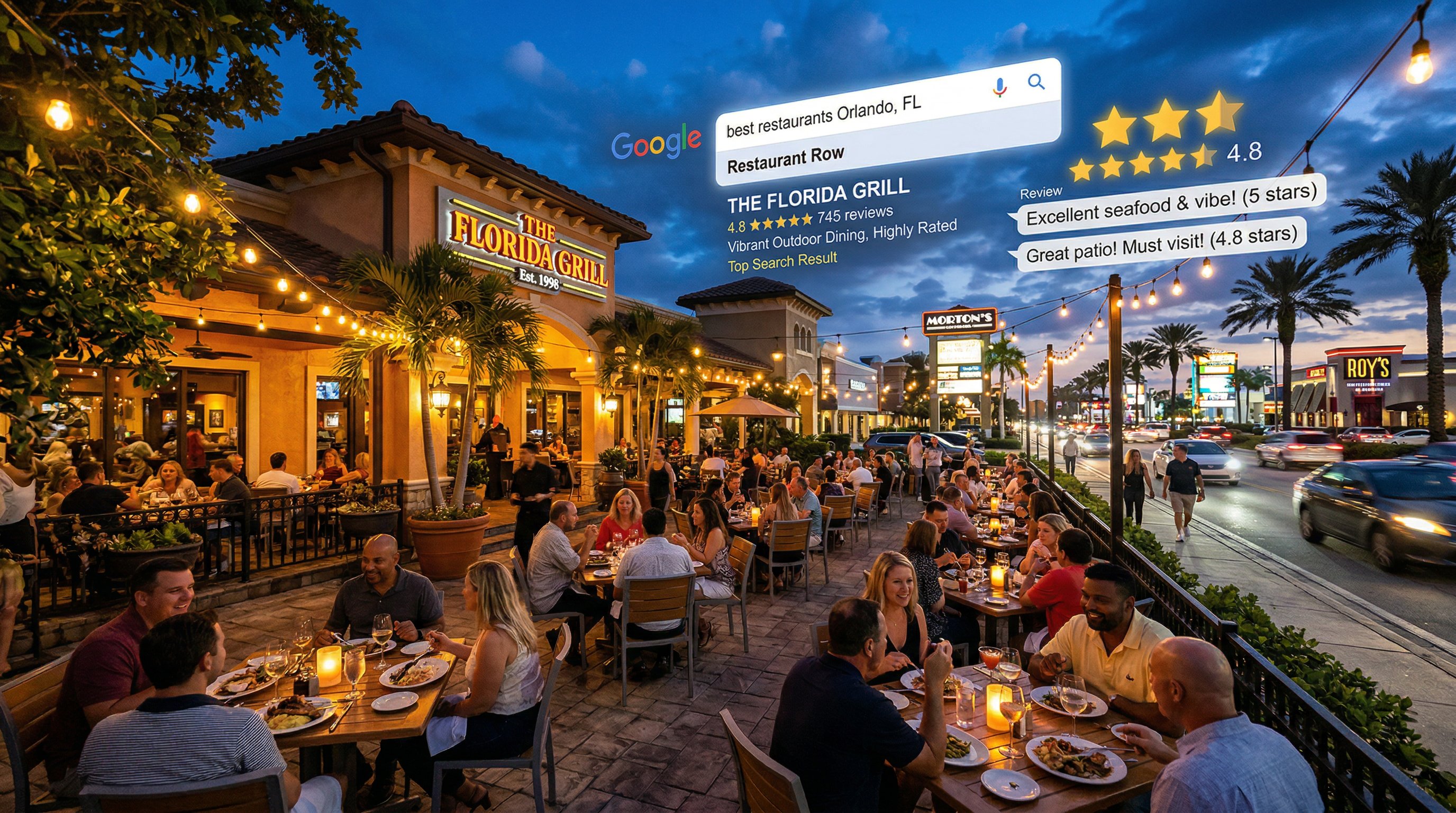
Tourists search very differently. A family staying near Universal Studios searches "family restaurants near Universal Orlando" or "best seafood I-Drive." A business traveler at the Marriott downtown searches "restaurants near me" without any neighborhood knowledge. Tourists rely heavily on star ratings, photo quality, and the number of reviews because they have no existing frame of reference for the restaurant. They are disproportionately represented on TripAdvisor and Yelp, and they make faster decisions — a restaurant that appears in the top 3 Maps results for their search at dinnertime gets the booking. This tourist-search dynamic explains why Restaurant Row on Sand Lake, International Drive, and Downtown Orlando restaurants emphasize review volume more aggressively than neighborhood restaurants in Mills 50 or Lake Nona. Our team has experience applying these same dual-audience frameworks for clients in Miami and Tampa as well.
- Restaurant Row (Sand Lake Road and Dr. Phillips area) businesses compete for both affluent local residents and the convention center and tourism corridor audience simultaneously.
- International Drive restaurants primarily target tourists and benefit most from TripAdvisor optimization and hotel concierge partnership programs.
- Winter Park Park Avenue restaurants serve an affluent local demographic with strong Yelp usage and benefit heavily from local food press coverage.
- Mills 50 and Thornton Park restaurants serve a mix of young urban professionals and local culture enthusiasts who research heavily before dining decisions.
- Lake Nona restaurant businesses serve a newer, tech-savvy community that searches mobile-first and places high weight on both Google ratings and Instagram presence.
Google Business Profile Optimization for Orlando Restaurants
For Orlando restaurants, a fully optimized Google Business Profile is the single most impactful investment available in local search marketing. The GBP is the first thing a potential diner sees when they search for dining options in Maps — your photos, star rating, hours, cuisine type, price range, and menu all display directly in the Maps result before the customer ever visits your website. Restaurants with compelling, complete GBP listings consistently convert at dramatically higher rates than those with sparse or incomplete profiles.
Cuisine-specific category selection is the starting point. Use the most specific cuisine type available as your primary category: "Italian Restaurant," "Korean Restaurant," "Southern Food Restaurant," "Tapas Restaurant" rather than the generic "Restaurant." Specific cuisine categories make you eligible for the high-intent, cuisine-specific searches — "Korean BBQ Orlando," "Italian restaurant Winter Park" — that convert at substantially higher rates than generic "restaurants near me" queries because the searcher already knows what they want. Add dining-format secondary categories as well: "Fine Dining Restaurant," "Casual Restaurant," "Bar and Grill," "Family Restaurant," "Brunch Restaurant," "Seafood Restaurant." Each applicable secondary category expands your Maps eligibility for relevant searches.
Photo quality and volume are more critical for restaurants than for almost any other business category. Restaurants competing on Google Maps in Orlando's high-density dining corridors need a minimum of 100 photos on their GBP, with ongoing additions of 5 to 10 new photos per week. Prioritize professional food photography — the thumbnail photo that appears in Maps search results is the primary driver of click-through rate. A professional food photo against a clean background outperforms a blurry phone photo every time, even if the food itself is identical. Upload exterior photos (from multiple angles and lighting conditions), interior ambiance photos, bar and special event photos, and behind-the-scenes kitchen content. Enable the Menu section of your GBP and sync it with your current menu, including photos for each major menu category. Our AI automation tools can help schedule and manage your GBP content calendar consistently without daily manual effort.
Should I enable online ordering and reservations through my Google Business Profile?
Yes. Enabling both online ordering and reservation links directly in your GBP is a significant competitive advantage. Google now displays "Order" and "Reserve a Table" action buttons prominently in Maps listings for restaurants that have connected compatible platforms. These direct-action buttons dramatically improve conversion from Maps impressions to actual bookings without requiring the customer to navigate to your website first. Connect OpenTable, Resy, or Toast directly to your GBP. For delivery orders, connecting DoorDash, Uber Eats, or your own online ordering platform to GBP keeps all customer action options visible and accessible from your Maps listing.
- Post weekly to your GBP about your specials, seasonal menu changes, upcoming events, and new dishes — restaurants with active posting history rank higher in Maps.
- Update your GBP hours immediately for any holiday schedule changes — incorrect hours cause a significant number of negative reviews from customers who arrive to find you closed.
- Use the Products/Menu feature in GBP to highlight your signature dishes with individual photos and descriptions — these display prominently in your Maps panel.
- Set up and actively monitor the GBP Messaging feature to answer customer questions about reservations, dietary accommodations, and group dining before they call or visit.
- Enable the Q&A section proactively — add 10 to 15 questions covering cuisine type, dietary options (vegetarian, vegan, gluten-free), parking, reservations, and private dining availability.
Building a Multi-Platform Review Strategy for Orlando Restaurants
Restaurant reviews in Orlando carry more weight than in almost any other business category because dining decisions are almost entirely review-driven for first-time customers. A restaurant with 800 Google reviews averaging 4.6 stars will fill tables on a Tuesday night that its 150-review competitor cannot. Reviews drive Maps rankings, drive click-through rate from Maps results, and drive conversion once a potential customer views your profile. They are simultaneously a ranking factor, a trust signal, and a sales conversion tool.
The multi-platform requirement is unique to restaurants. While most service businesses can focus their review energy on Google alone, Orlando restaurants need strong review presence on Google, Yelp, TripAdvisor, and OpenTable simultaneously. Google drives the largest share of local resident traffic. Yelp is heavily used by tourists and has strong algorithmic influence on Google's knowledge graph for restaurants. TripAdvisor is near-mandatory for any restaurant in the tourist corridors — a restaurant with 50 TripAdvisor reviews competing against one with 2,000 is invisible to the international visitor population that uses TripAdvisor as a primary dining guide. OpenTable reviews influence both reservation platform rankings and feed into Google's restaurant knowledge graph.
The most effective review generation process for restaurants differs from service businesses because the interaction model is different. Train your front-of-house staff to provide a brief, natural review request at the close of every positive dining experience: "We'd really appreciate a Google review — it means a lot to independent restaurants like ours." Follow this with a tabletop card or receipt insert showing a QR code that links directly to your Google review page. For reservation-based dining, send a post-visit email through your reservation platform (OpenTable, Resy) with a review link 24 hours after the visit. For frequent customers and known regulars, a personalized text message from the owner or manager generates exceptional review rates. Using Go High Level as your CRM platform allows automation of the review request workflow across all contact channels. Our broader digital marketing services for restaurants include end-to-end review management and response workflows.
Review responses are particularly important for restaurants because prospective diners read them closely. A thoughtful, specific response to a negative review — acknowledging the issue, explaining what changed, and inviting the reviewer back — converts many undecided readers into customers who respect the restaurant's professionalism. Never argue publicly with a negative reviewer. Never offer free meals as compensation in a public response. Respond within four hours to negative reviews and within 24 hours to positive ones. Volume and speed of responses are both tracked by Google as engagement signals that modestly influence Maps rankings. For high-volume restaurants generating dozens of reviews weekly, a social media marketing partner who manages responses at scale is worth considering.
Restaurant Website SEO: Converting Search Traffic into Reservations
A restaurant's website is not just a digital brochure — it is the conversion endpoint for all of your SEO efforts. When a potential customer finds you in Google Maps, reads your reviews, and decides to learn more, they visit your website. The website's job is to convert that intent into a reservation or walk-in visit. A slow, hard-to-navigate, or uninformative website throws away the SEO investment that delivered the visitor in the first place.
Mobile optimization is the most critical technical requirement for restaurant websites in Orlando. Over 80 percent of restaurant searches happen on mobile devices, and a significant portion happen while the searcher is physically near the restaurant deciding where to eat. A website that loads in more than 3 seconds on mobile loses a substantial percentage of these high-intent visitors immediately. Core Web Vitals — Google's page experience metrics — directly affect your organic search rankings, meaning a slow mobile site suppresses both your website rankings and, indirectly, your Maps rankings. Investing in a fast, mobile-first professional web design is one of the highest ROI infrastructure investments a restaurant can make.
On-page SEO structure for restaurant websites should include: your cuisine type and city name in the homepage title tag ("Italian Restaurant in Winter Park, FL | Bella Cucina"), a dedicated Reservations page with prominent booking widget, a mobile-optimized text-based Menu page, an About page that tells your restaurant's story with natural keyword inclusion, and separate landing pages for private dining, catering, and special events. Add Restaurant schema markup — a specific structured data type for restaurants — to your homepage to help Google's AI systems and AI Overviews accurately describe your restaurant to searchers asking for dining recommendations. Adding schema markup for your menu items, price range, cuisine type, and opening hours makes your restaurant data machine-readable across all AI-driven search interfaces. Businesses investing in a complete website rebuild should request free strategy consultation to map out the full SEO architecture before development begins.
- Include a prominent clickable phone number in your mobile website header — make it as easy as possible for mobile users to call and make a reservation.
- Add a Google Map embed to your Contact/Directions page showing your exact location relative to major landmarks (theme parks, convention center, major hotels).
- Create a "Parking" section on your website — Orlando diners frequently search for restaurants with easy parking, and addressing this concern on your site reduces friction in the decision process.
- Build a Press or Awards page showcasing any media coverage, food critic reviews, or dining awards — this content earns natural backlinks and builds authority.
- Publish a blog covering food events, seasonal ingredient spotlights, chef profiles, and Orlando dining guides — this content drives long-tail search traffic and earns links from food bloggers.
Local Links and Food Press: Building Restaurant Authority in Orlando
Local backlinks are a powerful but underinvested SEO channel for most Orlando restaurants. Links from trusted local sources — Orlando Weekly restaurant reviews, Orlando Sentinel dining coverage, local food blogs, hotel concierge pages, and Visit Orlando business listings — signal to Google that your restaurant is a legitimate, established part of Orlando's dining scene. These geographically relevant links build Maps prominence faster than any amount of generic directory citation building.
Earning food press coverage in Orlando requires proactive media outreach, not passive waiting. The Orlando food press ecosystem includes: Orlando Weekly's dining section, the Orlando Sentinel food and dining coverage, Eater Orlando (part of the Vox Media network), local food Instagram accounts with large followings, and regional food blogs. Pitch journalists and food bloggers with newsworthy angles: grand opening stories, chef background narratives, unique ingredients or preparation methods, farm-to-table sourcing stories, or community involvement. A review placement in Eater Orlando or the Sentinel dining section provides both a high-authority backlink and thousands of readers who actively follow restaurant recommendations.
Hotel partnerships are a restaurant-specific link building opportunity unique to Orlando's tourism-heavy market. Many Orlando hotels maintain dining recommendation pages on their websites and in their guest app — getting listed on a Marriott or Hilton hotel page as a recommended nearby dining option provides both a quality backlink and a direct source of referral visitors. Approach hotel concierge teams with complimentary dining invitations for staff — concierges who have personally experienced your restaurant recommend it to guests consistently. Convention center catering partnerships create similar authority-building opportunities for restaurants capable of handling large groups. The same link-building principles that apply to Orlando restaurants also power our work in Jacksonville and St. Augustine, where tourism and local dining overlap significantly.
- Submit your restaurant to Visit Orlando's official dining guide — this is a free, authoritative local link that many restaurants overlook.
- Participate in Orlando dining events like Magical Dining Month, Orlando Restaurant Week, and neighborhood food festivals to earn event website listings and press coverage.
- Partner with Orlando food influencers for hosted dining experiences that generate social media content, blog posts, and natural link building.
- Maintain an active presence in the Orlando Restaurant Association and Greater Orlando Chamber of Commerce for directory listings and community networking links.
- Create shareable "Best of" guides for your neighborhood's dining scene — these attract links from local publications and bloggers who find the curated content valuable for their readers.
AI and Voice Search Optimization for Orlando Restaurants
AI-powered search and voice assistants have become significant restaurant discovery channels for Orlando's tourist population in particular. Visitors to Orlando hotels ask their room's Alexa or Google Nest speaker "what are the best seafood restaurants near the convention center?" Families at theme parks ask Siri "find a kid-friendly restaurant near Universal Orlando." These voice and AI queries are fundamentally different from typed searches — they are conversational, context-dependent, and answered with a single recommendation rather than a list of results.
Optimizing for voice and AI restaurant search requires applying answer engine optimization principles to your restaurant's content. This means creating clear, conversational FAQ content on your website that directly answers the questions voice users ask: "Is [Restaurant Name] good for families?", "Does [Restaurant Name] take reservations?", "What type of food does [Restaurant Name] serve?" These FAQ pages, combined with properly implemented Restaurant schema markup, give AI assistants the structured data they need to confidently recommend your restaurant in response to voice queries.
Restaurant schema markup — a specific implementation of structured data for food service businesses — communicates cuisine type, price range, hours, reservation availability, dietary options, and geographic coordinates in machine-readable format. When AI systems process "best fine dining restaurants in Winter Park, FL," they rely on structured data to compare and rank candidates. Restaurants without schema markup are invisible to the AI disambiguation process that determines which business to recommend. Implementing Restaurant schema correctly is a one-time technical task that provides ongoing benefits across all AI-driven search channels. Our AI-powered SEO services include schema implementation as a core deliverable, and our AI automation platform monitors your AI search mentions and alerts you to inaccurate descriptions that need correction.
Neighborhood-Specific SEO for Orlando's Dining Districts
Orlando's dining culture is distributed across distinctly different neighborhoods, each with its own character, demographic, and search behavior. A restaurant SEO strategy that treats all of Orlando as a single market will systematically underperform compared to one that recognizes and exploits the neighborhood-specific search patterns that drive dining decisions in each corridor.
Restaurant Row (Sand Lake Road in Dr. Phillips) is Orlando's most concentrated high-end dining corridor. Restaurants here compete for affluent local diners and the convention center and International Drive visitor overflow. The dominant search terms include "fine dining Orlando," "best steakhouse Orlando," "anniversary dinner Orlando," and "private dining Orlando." SEO for Restaurant Row establishments requires building authority as a premium destination — food press coverage, OpenTable ratings, and a website that communicates the elevated dining experience clearly through photography and description copy.
Mills 50 and the Milk District have become Orlando's destination for independent, culturally diverse dining. Searches here tend toward the specific and the adventurous: "authentic Vietnamese Orlando," "Korean BBQ Mills 50," "natural wine bar Orlando." Diners in this corridor do more research before visiting — they read multiple review platforms, follow food Instagram accounts, and check menu details carefully. SEO for Mills 50 restaurants benefits from detailed menu content, strong Instagram presence, coverage in independent local food media, and connection with the neighborhood's food community through events and collaborations. Schedule a free strategy consultation with our team to identify exactly which neighborhood-specific tactics will drive the most reservations for your specific restaurant concept. For website design that effectively communicates neighborhood identity through visual design and content architecture, we build restaurant sites that convert consistently across both local and tourist audiences.
- Thornton Park and Downtown Orlando restaurants compete for the urban professional and special occasion dining demographic — position content around date nights, business dining, and waterfront views.
- Winter Park Park Avenue restaurants should invest heavily in Yelp optimization given the demographic's high Yelp usage relative to other Orlando neighborhoods.
- Lake Nona restaurant businesses benefit from connecting with the medical and technology community through corporate dining packages and event catering — these relationships generate both revenue and review volume.
- International Drive restaurants should create specific landing pages targeting the major hotels within walking or rideshare distance to capture hotel-near-me dining searches.
- Kissimmee and the theme park corridor restaurants benefit from creating "near [theme park name]" landing pages — the search volume for "restaurants near Walt Disney World" is enormous and highly targeted.
Ready to Fill More Tables?
Get a Free Restaurant SEO Strategy
Our Florida marketing experts will audit your restaurant's online presence and build a custom growth plan — no obligation, no fluff.
Frequently Asked Questions
Common questions about restaurant SEO from Orlando business owners.
How long does SEO take to work for an Orlando restaurant?
Most Orlando restaurants begin seeing measurable improvement in Google Maps visibility within 60 to 90 days of consistent SEO work. Full competitive dominance in high-traffic corridors like Restaurant Row, International Drive, or Winter Park's Park Avenue typically takes 4 to 6 months of sustained effort. The fastest gains come from optimizing the Google Business Profile first — restaurants with incomplete profiles, few photos, or sparse reviews often see significant ranking jumps within 30 to 45 days of fixing those gaps.
Should Orlando restaurants invest in Yelp or just focus on Google?
Orlando restaurants should maintain a strong presence on both platforms, but Google should be the primary priority because Google Maps drives significantly more reservation and walk-in traffic for most restaurants. Yelp is particularly important for restaurants in tourist-heavy areas like International Drive and Downtown Orlando where visitors rely heavily on Yelp for dining decisions. TripAdvisor is also essential for I-Drive and theme park corridor restaurants catering to domestic and international visitors.
What is the best Google Business Profile category for a restaurant?
Use the most specific cuisine category available as your primary GBP category — 'Italian Restaurant,' 'Seafood Restaurant,' 'Mexican Restaurant' — rather than the generic 'Restaurant.' Specific cuisine categories make you eligible for high-intent searches where diners are specifically searching for your food type, which convert at significantly higher rates. Add secondary categories for your dining format: 'Fine Dining Restaurant,' 'Casual Restaurant,' 'Bar and Grill,' 'Family Restaurant.'
How important is menu SEO for Orlando restaurants?
Menu SEO is extremely important and frequently overlooked. A searchable, text-based online menu allows Google to index your specific dishes, ingredients, and cuisine descriptions. Restaurants that appear for 'best wood-fired pizza Orlando' or 'Cuban sandwich Thornton Park' are capturing specific dish searches with very high conversion intent. Include descriptive, keyword-rich dish names and descriptions in your online menu embedded on your website — not just on third-party delivery platforms.
Do social media posts help with restaurant SEO in Orlando?
Social media posts do not directly improve restaurant SEO rankings, but they have significant indirect effects. Strong social media engagement signals to Google that your restaurant is active and relevant. Food photography on Instagram and TikTok generates unsolicited user-generated content and tags that build brand awareness, driving branded searches on Google. A viral post of a signature dish can generate thousands of branded Google searches, dramatically boosting your branded search authority.
How do I get my Orlando restaurant to rank for 'best restaurants near me' searches?
Ranking for 'best restaurants near me' in Orlando requires strong Google Business Profile optimization, high review volume and ratings, consistent citation accuracy, and website authority. Focus on generating a high volume of positive reviews with strong recency, maintain a GBP posting cadence of at least twice weekly, and ensure your website has strong on-page local SEO signals. Earning coverage in local food publications like Orlando Weekly and the Sentinel dining section provides authority links that significantly boost Maps prominence.
Related Posts
Start Growing Today
Your Competitors Are Investing in SEO.
Are You?
Search Scale AI delivers measurable results for Florida businesses. Let's build your custom strategy and start driving real leads within 90 days.
No contracts. No BS. Just results.
Social Media and Its Impact on Restaurant Search Visibility
Social media does not directly determine search rankings for Orlando restaurants, but its indirect influence on local SEO is substantial and measurable. Strong social media engagement drives branded search volume (people searching for your restaurant name directly on Google), signals brand vitality to Google's algorithm, earns natural backlinks from food bloggers and media outlets who discover you through Instagram, and generates user-generated content that builds the restaurant's overall online footprint.
Instagram remains the most impactful social platform for Orlando restaurants because food photography is inherently visual and the platform's discovery algorithms surface restaurant content to users actively searching for dining inspiration. A viral Instagram post of a signature dish — say, an over-the-top dessert or a beautifully presented seafood tower — can drive thousands of branded Google searches within 48 hours of posting. Each person who searches your restaurant name after seeing your Instagram becomes a branded search signal that improves your local search authority. TikTok is following a similar trajectory with Orlando's Gen-Z and millennial dining demographic, and restaurants in the Mills 50 and Milk District neighborhoods that have invested in TikTok content have seen direct search volume increases.
The connection between social media and search engine optimization is reinforced through consistent brand messaging across both channels. Using the same name, photos, and key messaging in your social profiles as in your GBP and website creates brand coherence that strengthens Google's understanding of your restaurant. Geo-tagging every social post with your exact restaurant location reinforces the geographic signals that influence local search. For restaurants investing in a comprehensive digital presence, combining social media marketing with SEO creates a flywheel — social drives branded searches, branded searches improve domain authority, improved domain authority boosts local rankings, higher rankings generate more organic discovery, and more discovery feeds social following growth. Our marketing automation tools connect these channels into a unified workflow that removes the manual burden of managing multiple platforms simultaneously.