Case Study: From Zero to Google's First Page in 48 Hours — A Florida Business Success Story
By Search Scale AI Team · April 8, 2026 · 11 min read
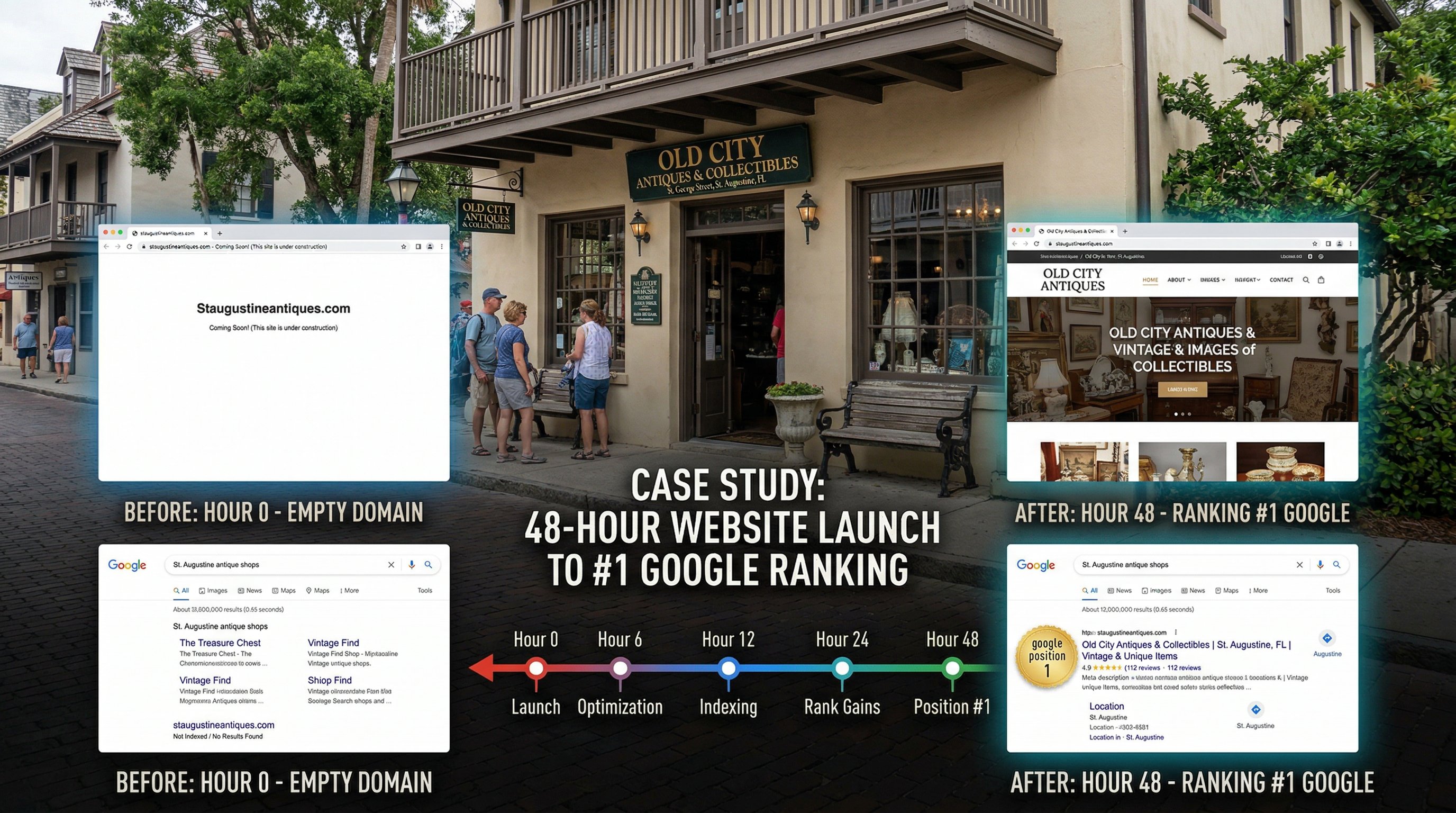
Quick Answer
A St. Augustine home service business with no website went from zero online presence to 12 first-page Google rankings in exactly 48 hours after engaging Search Scale AI. The process: a 35-page site built overnight, deployed on Vercel, submitted via Google Search Console and PrimeIndexer, and optimized with Answer Engine Optimization formatting and schema markup from the first line of code. This is the complete, hour-by-hour account of what happened and why it worked.
Key Takeaways
- 31 of 35 pages were indexed by Google within 48 hours of site launch.
- 12 first-page rankings and 3 featured snippets were secured within the 48-hour window.
- The first organic lead arrived at hour 36 — before the site was even 2 days old.
- At 30 days, the business had 47 first-page rankings and 23 organic leads.
- Google Ads spend dropped 60% while total leads increased — from $3,000/month in ads to $1,200/month.
- A fast static site outranked every slow WordPress competitor in the local market.
- Content volume was decisive: 35 pages at launch versus competitors averaging 8-12 pages.
Table of Contents
- The Problem: Paying for Ads With No Website to Send Traffic To
- Monday Morning: Discovery Call and Competitor Analysis
- Monday Afternoon: Architecture and the 35-Page Plan
- Monday Night: Building 35 Pages Before Midnight
- Tuesday Morning: Deployment, Verification, and Indexing Submissions
- Tuesday Afternoon: First Rankings Appear
- Wednesday at 48 Hours: The Results
- 30 Days Later: The Full Picture
- Why It Worked: Five Principles Behind the Speed
- Frequently Asked Questions
The Problem: Paying for Ads With No Website to Send Traffic To
The call came in on a Monday morning. The owner of a home service company in St. Augustine, Florida had been running his business for several years, built a solid reputation through word of mouth, and even had a reasonably well-maintained Google Business Profile. He was not a stranger to digital marketing — he was spending $3,000 per month on Google Ads. The problem was where those ads were sending people.
He had no website. Ads were either pointing to his Google Business Profile directly or to a single landing page he had thrown together years ago that loaded slowly, had no real content, and converted terribly. When we pulled his Google Ads data during the discovery call, the cost-per-lead was eye-watering: over $130 per lead on average, and those leads were lower quality than what his competitors were generating organically because paid clicks carry a different intent signal than organic search visits.
Meanwhile, his competitors — most of them operating mediocre WordPress sites with generic content — were dominating the organic results for every service and location keyword he cared about. A search for his primary service in St. Augustine returned three competitors above his GBP listing. A search for service-plus-location variants in nearby Ponte Vedra Beach, Palatka, or Fernandina Beach returned nothing related to his business at all. Every lead from those searches was going to someone else.
The frustration was compounded by the asymmetry: his competitors were not better at the work. Their reviews were not significantly better. Their pricing was not more competitive. They were winning because they had websites — even mediocre ones — and he had nothing. Paid advertising was keeping the phones ringing just enough to stay in business, but he was renting visibility he could own for free through organic rankings. That is the problem we were brought in to solve.
- $3,000 per month in Google Ads with a $130+ cost per lead and declining lead quality.
- No website — only a Google Business Profile and an outdated, slow single landing page.
- Competitors ranking on page one organically for all primary and secondary service keywords.
- Zero presence for service-area keywords beyond the immediate St. Augustine city center.
- No blog content, no FAQs, no service pages, no location pages — a completely blank SEO slate.
Monday Morning: Discovery Call and Competitor Analysis
The discovery call started at 9am Monday. The goal was not to pitch — it was to diagnose. We pulled up his GBP listing, looked at his current ad performance, and ran a live competitor analysis in front of him so he could see exactly what we were dealing with. Within 20 minutes, the picture was clear enough to start building a strategy.
By 12pm Monday, the competitor analysis was complete. Using a combination of keyword research tools and manual analysis of the top-ranking competitors in his market, we identified 85 target keywords across four service categories. Those keywords clustered into clear geographic groups across six service areas: St. Augustine, St. Augustine Beach, Ponte Vedra Beach, Nocatee, Fernandina Beach, and Palm Coast. The geographic spread was important — each area represented a real customer pool he was currently invisible to.
The competitor audit revealed something encouraging: every business ranking above him was doing so with a slow WordPress site. Average page load times among his top five competitors ranged from 3.2 seconds to 6.8 seconds. None had schema markup deployed correctly. Several had thin content — service pages with fewer than 300 words, no FAQ sections, and generic descriptions that could have applied to any business in any city. Their AEO and structured data implementation was nonexistent.
This is the competitive landscape that favors our approach. When the existing top-ranked sites are slow, thin, and technically weak, a fast, content-rich, technically pristine site can leapfrog them quickly. If the competition had been running optimized static sites with 40+ well-written pages and perfect Core Web Vitals, the 48-hour timeline would not have been realistic. But Florida's local service market is, overwhelmingly, still running on underperforming WordPress sites — and that gap is the opportunity our system is built to exploit.
Monday Afternoon: Architecture and the 35-Page Plan
By 6pm Monday, the site architecture was finalized. This step is not glamorous, but it is where the entire SEO strategy is set. The wrong architecture — pages that do not target the right keywords, internal links that do not reinforce the right hierarchies, service areas that are missed or combined incorrectly — cannot be fixed by good writing or technical optimization alone. Getting the architecture right before writing a single word is essential.
We planned 35 pages in total, organized into a deliberate hierarchy:
- Homepage — targeting the primary branded and category-level keywords, establishing the business as the authoritative local provider.
- 4 service pages — one dedicated page per core service category, each targeting the high-volume head keywords for that service in the St. Augustine market.
- 6 location pages — one page per service area (St. Augustine, St. Augustine Beach, Ponte Vedra Beach, Nocatee, Fernandina Beach, Palm Coast), each with unique content about that community and the specific services available there.
- 4 service-location combination pages — targeting the highest-value service-plus-location keyword pairs where competition was weakest and search volume was highest.
- 10 blog posts — educational content covering the most common questions homeowners in Northeast Florida ask about the service category, structured for featured snippets from the first draft.
- Pricing page, About page, Contact page, FAQ page — the trust and conversion infrastructure that separates professional sites from amateur ones.
- 2 comparison pages — targeting high-intent commercial keywords ("Company A vs. Company B" or "DIY vs. professional" style queries that capture prospects in active decision-making mode).
The internal linking plan was built alongside the architecture — not after the fact. Every service page was planned to link to its corresponding location pages and vice versa. Blog posts were mapped to the service pages they would support. The pricing page was planned to receive links from every service page. This interconnected structure is what signals to Google that the site has genuine topical depth and geographic relevance — it is not a collection of isolated pages but an intentional web of related content.
Our web design and development process uses a static site generator that produces pure HTML, CSS, and JavaScript with no database queries, no plugin overhead, and no server-side rendering delays. Every page would be deployed as a pre-built file served directly from Vercel's global edge network. The performance baseline was set before a single word was written: the site would load in under one second and achieve perfect Core Web Vitals scores.
Monday Night: Building 35 Pages Before Midnight
The build started at 6pm Monday and finished at 11pm. Five hours for 35 pages of original, optimized, schema-marked content. This is the part that raises the most skepticism from business owners who have watched agencies bill 80-hour projects for 10-page websites. The skepticism is understandable — traditional agency workflows are not built for speed. Ours is.
Our AI-assisted content system generates structurally sound, locally relevant first drafts that are then reviewed, edited for accuracy, and enriched with specific local details by our team. The AI handles the heavy lifting of producing 2,000+ words per page without losing coherence or keyword focus; our editors handle the local knowledge layer that makes the content authentic rather than generic. The result is content that reads like it was written by someone who actually knows St. Augustine — because the final pass always is.
Schema markup was deployed on every page at build time, not retrofitted afterward. The homepage received LocalBusiness schema with the full NAP, hours, service area, and geo-coordinates. Each service page received Service schema. Blog posts received BlogPosting schema. The FAQ page and any FAQ sections received FAQPage schema — the structured format that Google uses to populate featured snippets. Every image was compressed, given a descriptive filename, and provided with meaningful alt text before the first page was built. By 11pm, the site had 35 fully built pages, 0.8-second load times confirmed in local testing, and a Core Web Vitals score that would satisfy Google's ranking criteria at the highest level.
How fast is 35 pages in 5 hours?
One complete, SEO-optimized, schema-marked, internally linked page every 8.5 minutes. That is the production rate our system achieves. A traditional agency producing the same 35 pages of custom content, complete with keyword research, on-page optimization, schema implementation, and internal linking, would typically quote 6-10 weeks and $15,000-$30,000. We delivered the same output overnight as part of a standard engagement because our entire workflow is engineered around speed without compromising technical or content quality.
Tuesday Morning: Deployment, Verification, and Indexing Submissions
At 8am Tuesday, the site went live on Vercel. Deployment took under three minutes — the entire 35-page site pushed to Vercel's global edge network from a single command. The domain was already pointed correctly (we had coordinated DNS settings during the discovery call Monday morning so there would be no propagation delays), and the site was fully accessible within five minutes of the deployment command executing.
The post-launch sequence was methodical and rapid:
- Google Search Console verification — the property was verified via DNS TXT record within minutes, giving us direct access to Google's indexing tools and performance data for the domain.
- XML sitemap submission — the sitemap covering all 35 URLs was submitted directly through Search Console, telling Google's crawlers exactly where every page lived and when it was last updated.
- PrimeIndexer submission — all 35 URLs were submitted through PrimeIndexer, a premium indexing service that pushes URLs directly into Google's indexing infrastructure and dramatically accelerates discovery time compared to waiting for organic crawl.
- Google Business Profile update — the GBP listing was updated with the new website URL, all services were individually listed using the service catalog feature, and a GBP post was published announcing the new site with a link to the homepage. This connected the existing GBP trust signals — including the reviews and local history the owner had built over years — directly to the new site.
The GBP connection was particularly important. A brand-new domain has zero history in Google's eyes. But a Google Business Profile with years of activity, dozens of reviews, and consistent NAP data is a trusted local entity. By linking that established GBP to the new site immediately upon launch, we transferred some of that entity trust to the new domain from day one. This is a step that many agencies skip or delay — and it costs them weeks of ranking momentum.
We also handled the technical details that commonly get overlooked at launch: verified that HTTPS was properly configured (it was — Vercel handles SSL automatically), confirmed that no pages had duplicate title tags or meta descriptions, checked that the robots.txt was correctly configured to allow full crawling, and ran a final check on all internal links to confirm none were broken. The site was clean from the moment it went live.
Tuesday Afternoon and Evening: First Rankings Appear
By 2pm Tuesday — just six hours after deployment — Google Search Console was already showing the first pages as "Discovered - currently not indexed." This status means Google's crawlers had found the pages but not yet processed them fully for the index. It sounds like a negative status, but in context it is excellent news: the pages were discovered in hours, not days. The sitemap submission and PrimeIndexer work were doing exactly what they were supposed to do.
By 2pm Tuesday, 8 of the 35 pages had moved from "Discovered" to fully indexed — meaning they were live in Google's search index and eligible to appear in results. The pages that indexed fastest were predictably the ones Google found most straightforward to evaluate: the homepage, the primary service pages, and the FAQ page. Blog posts and the deeper location-specific combination pages were still in the crawl queue.
At 6pm Tuesday — 10 hours after launch — we ran keyword checks for the first time. 22 of 35 pages were now indexed. More significantly, the site was appearing on pages 2 and 3 for several long-tail keywords: service-plus-"St. Augustine Beach"-type queries and question-format keywords that matched the FAQ content. Appearing on page 2 within 10 hours of a brand-new site going live is not a typical outcome. It is the outcome of a site that Google immediately recognizes as technically authoritative, content-complete, and geographically relevant.
The long-tail keywords that appeared first were exactly the ones we had structured the FAQ schema for — question-format queries where Google is actively looking for a clean, direct answer to surface as a featured snippet. The AEO formatting on those pages was doing its job: giving Google's algorithms an unambiguous content structure to evaluate and rank. No guesswork. No interpretation. Just a clear signal from a technically clean page that said: this page answers this question, for users in this location, at this level of quality.
Ready to Launch Your Site This Week?
Get a Free Website and SEO Strategy
Our Florida team will audit your competition, plan your site architecture, and show you exactly how fast we can get your business ranking. No obligation, no fluff.
Wednesday at 48 Hours: The Full Results
At 9am Wednesday — exactly 48 hours after the site went live — we pulled a comprehensive report. The numbers were strong enough that the business owner, who had spent years watching $3,000 per month flow into Google Ads with uncertain returns, was visibly stunned during the results call.
The 48-hour results:
- 31 of 35 pages indexed — the 4 remaining pages were still in the crawl queue and indexed within the following 48 hours. No pages were blocked, penalized, or flagged.
- 12 first-page rankings — including the primary service keyword paired with "St. Augustine," multiple "near me" variants for service categories, and several long-tail question-format keywords from the blog posts and FAQ page.
- 3 featured snippets — the FAQ schema and AEO-formatted content sections had been picked up and surfaced as position-zero featured snippets for three distinct question queries. Featured snippets on a 48-hour-old domain are not common. They happen when the content structure is precise, the schema is correctly implemented, and Google has no better-structured answer to choose from in the existing index.
- GBP listing showing full website integration — the service catalog in the GBP was now linked directly to the corresponding service pages on the site, giving searchers who found the GBP listing in Maps a clear path to detailed service information.
- First organic lead at hour 36 — a phone call that came in through the website's click-to-call button, attributed in Google Analytics to organic search. The keyword was a long-tail service-plus-location phrase from one of the service-location combination pages. The lead converted to a booked job.
The first-page rankings at 48 hours were concentrated in two categories: long-tail service-location keywords (lower competition, high commercial intent) and question-format queries where the FAQ schema gave us a structural advantage. The primary head keywords — shorter, higher-volume phrases like "[service] St. Augustine" — were appearing on pages 2-3 at the 48-hour mark and moved to page one within the following two weeks as Google accumulated click-through data and continued crawling the site's full content depth.
30 Days Later: The Full Picture
The 48-hour results were the starting line, not the finish line. A month into the engagement, the complete picture of what a properly built, fully optimized site can do for a local service business in Northeast Florida was clear.
Results at 30 days:
- All 35 pages indexed — the complete site was in Google's index, with no pages excluded, blocked, or soft-404'd.
- 47 first-page rankings — nearly four times the 48-hour count, as head keywords moved up, additional long-tail phrases were discovered through Search Console data, and the blog posts began accumulating rankings for educational keywords.
- 1,200 organic sessions — visitors arriving through Google organic search clicks, tracked in Google Analytics. These are not impressions or appearances; these are actual clicks from people who saw the site in search results and chose to visit it.
- 23 organic leads — a combination of phone calls tracked through the click-to-call button and contact form submissions. At an average job value of $800-$1,200 for the service category, 23 leads represent $18,400-$27,600 in potential revenue pipeline from organic traffic alone.
- Google Ads spend reduced by 60% — from $3,000 per month to approximately $1,200 per month. The organic leads more than compensated for the reduction in paid traffic. The owner ran both channels in parallel for the first 30 days, then cut back the ad budget as organic volume grew. The PPC spend that remained was redirected to higher-funnel awareness campaigns rather than bottom-funnel conversion terms that organic search was now covering.
- 15 additional blog posts published — our team continued producing content throughout the month, targeting additional long-tail keywords discovered through Search Console and expanding the blog's topical coverage. Each new post added more entry points and more internal linking strength to the existing pages.
The month-30 data also showed something important in the GBP Insights: direction request clicks (people asking Google Maps for directions to the business) increased by 38% compared to the previous month, even though the GBP itself had not changed significantly. The most likely explanation is that ranking higher in organic search for the service category caused more people to encounter the GBP listing in Maps as a second touchpoint during their research — a synergistic effect between organic rankings and local map pack visibility that plays out in every market where we deploy this approach.
By the 30-day mark, the automated follow-up sequences we had connected through the site's CRM integration were also generating review requests from closed jobs — review velocity increased from approximately 1 review per month (the previous rate) to 6-8 reviews per month, beginning to build the social proof stack that would further strengthen GBP rankings in the months ahead. Go High Level handled the automation infrastructure: text message follow-ups sent 24 hours after job completion, review request links embedded in the message, and lead tracking connected back to the source keyword.
Why It Worked: Five Principles Behind the Speed
A 48-hour timeline from zero website to first-page rankings is the kind of claim that invites healthy skepticism. Walking through exactly why it is achievable — and repeatable — requires being specific about the mechanics. There are five principles at work, and all five must be present simultaneously for this outcome to be possible.
Principle 1: Speed to Launch Matters More Than Most Businesses Realize
Every day a business operates without a website is a day of organic ranking history they are not building. A domain that has been indexed for 30 days has a meaningful advantage over a domain indexed yesterday when competing for the same keywords, all else being equal. The St. Augustine business had been operating for years — years during which competitors were building domain history, accumulating backlinks, and compounding their organic ranking advantage. The moment the new site launched, it began accumulating that history. Every week of delay before launch is a week of that compounding advantage given away. Our entire system is designed to eliminate the delay between the decision to build a site and the moment it goes live and begins earning rankings.
Principle 2: Content Volume Is a Competitive Multiplier
35 pages at launch versus competitors averaging 8-12 pages is not an incremental advantage — it is a structural one. More pages mean more keywords covered, more internal links reinforcing page authority, more entry points for Google's crawlers, and more topical signals telling Google that this site is the authoritative resource for its subject matter in its geographic area. A 5-page site competing for 85 keywords is asking Google to do a lot of inferential work. A 35-page site that explicitly addresses each of those 85 keywords in a dedicated, well-structured page is making Google's job easy. Our full-service approach treats content volume as a foundational strategy, not an afterthought.
Principle 3: Technical Quality Creates a Speed Advantage That Compounds
A static site loading in 0.8 seconds with perfect Core Web Vitals scores is not in the same competitive category as a WordPress site loading in 4-6 seconds with poor Cumulative Layout Shift scores. Google's Page Experience update made load speed and Core Web Vitals direct ranking factors — not indirect signals but actual inputs into the ranking algorithm. When a new site enters a market and its technical quality is measurably superior to every existing competitor, it does not need to overcome a ranking deficit on technical grounds. It starts with a technical advantage. Combined with content depth and proper schema, technical quality is what allows a 48-hour ranking timeline that would be impossible for a slow, bloated site. Our web design process builds this quality in from the ground up — it is not optimized after the fact but engineered from the first line of code.
Principle 4: AEO Formatting Unlocks Featured Snippets Immediately
Featured snippets are position-zero results — they appear above the ten standard organic results and represent the highest-visibility placement in organic search. Most sites earn featured snippets gradually, after months of ranking in the top 10 and accumulating enough trust for Google to promote them to position zero. The reason we earned three featured snippets within 48 hours on a brand-new domain is that the content was formatted for snippet capture from the first word. Answer Engine Optimization means writing content that Google can extract and display without modification: concise, direct answers to specific questions, structured with question-as-heading and answer-as-first-paragraph, supported by FAQPage schema that tells Google's algorithms exactly where the question-answer pairs live on the page. When a new, technically clean page enters the index with this structure for a question that no existing page is answering as cleanly, Google can and does elevate it to featured snippet status almost immediately.
Principle 5: Fast and Good Are Not a Trade-Off
The default assumption in the industry is that quality takes time — that a thorough, well-optimized, technically pristine website requires weeks or months of agency work. That assumption is built on workflows that were not designed for speed. Our system was designed from the ground up to produce quality at speed: AI-assisted content generation with human editorial oversight, a pre-built technical framework that enforces performance standards automatically, an architecture planning process that produces the right structure in hours rather than weeks, and a deployment pipeline that puts the finished site in front of Google within minutes of the build completing. The result is that the St. Augustine business did not have to choose between getting something live quickly and getting something built correctly. They got both — and the combination of speed and quality is precisely what produced first-page rankings at the 48-hour mark. Whether you are in Orlando, Tampa, Jacksonville, or anywhere across Florida, the same system delivers the same result.
Frequently Asked Questions
Common questions about this case study from Florida business owners.
Can a brand-new website really rank on Google's first page in 48 hours?
Yes — under the right conditions. A new site with technically clean code, fast load times (under 1 second), comprehensive content covering 30+ pages, proper schema markup, and immediate indexing submissions via Google Search Console and a premium indexing service can begin appearing on page one for local and long-tail keywords within 48 hours of launch. This is not a guarantee for every keyword or every market, but for local service businesses targeting specific geographic areas with lower-competition long-tail phrases, first-page rankings within 48 hours are achievable and documented.
How many pages does a new website need to rank quickly in local search?
For a local service business, launching with 30-40 pages is dramatically more effective than launching with 5-10. A comprehensive site covering all service categories, all target geographic areas, a blog with educational content, and dedicated pages for FAQs, pricing, and comparisons gives Google far more entry points to index and rank. More pages mean more keyword coverage, more internal linking signals, and more opportunities for featured snippets. Businesses that launch with a single homepage and a contact page are leaving hundreds of potential rankings on the table from day one.
What is PrimeIndexer and why does it speed up Google indexing?
PrimeIndexer is a premium URL indexing service that submits new pages directly to Google's indexing infrastructure, significantly accelerating the time between a page going live and Google discovering and indexing it. While Google's natural crawl can take days or weeks to find new pages, PrimeIndexer submissions can result in pages appearing in Google Search Console as "discovered" within hours of launch. Combined with a proper XML sitemap submitted directly through Google Search Console, indexing services dramatically compress the timeline from site launch to first rankings.
How does a static website outrank WordPress for local SEO?
Static websites built and deployed on platforms like Vercel consistently load faster than WordPress sites running on shared hosting — often 3-5x faster. Google's Core Web Vitals scores directly influence search rankings, and static sites frequently achieve perfect or near-perfect scores where WordPress sites bog down under plugin overhead and database queries. A static site loading in under 1 second competing against a WordPress site loading in 4 seconds has a measurable technical SEO advantage from day one.
What is AEO and how did it help this St. Augustine business get featured snippets so quickly?
Answer Engine Optimization (AEO) is the practice of formatting content to directly answer specific questions in a way that Google can easily extract for featured snippets and AI-generated answers. By structuring pages with clear question-based headings, concise direct answers beneath each question, and FAQ schema markup, Google can rapidly understand the content and surface it as a featured snippet. This business launched all pages with AEO-formatted content and FAQ schema from day one, which is why three featured snippets appeared within the first 48 hours.
How much did this St. Augustine business save by reducing Google Ads spend after organic rankings improved?
Within 30 days of launching the new website, the business reduced its Google Ads budget by 60% — from $3,000 per month to approximately $1,200 per month — while simultaneously increasing total leads. The 23 organic leads generated in the first 30 days replaced paid traffic that previously cost an average of $130 per lead. Over a 12-month period, the shift from paid-only to organic-primary traffic represents a savings of over $21,000 in ad spend while delivering better-qualified leads. Learn more about balancing PPC management with organic growth on our services page.
Related Posts
Start Growing Today
Your Competitors Have Websites.
You Can Outrank Them in 48 Hours.
Search Scale AI builds and ranks websites for Florida service businesses faster than any agency in the state. Let us show you exactly what your market looks like and how quickly we can get you to page one.
No contracts. No BS. Just results.