How Long Does SEO Take to Work? A Realistic Month-by-Month Timeline
By Search Scale AI Team · April 9, 2026 · 11 min read
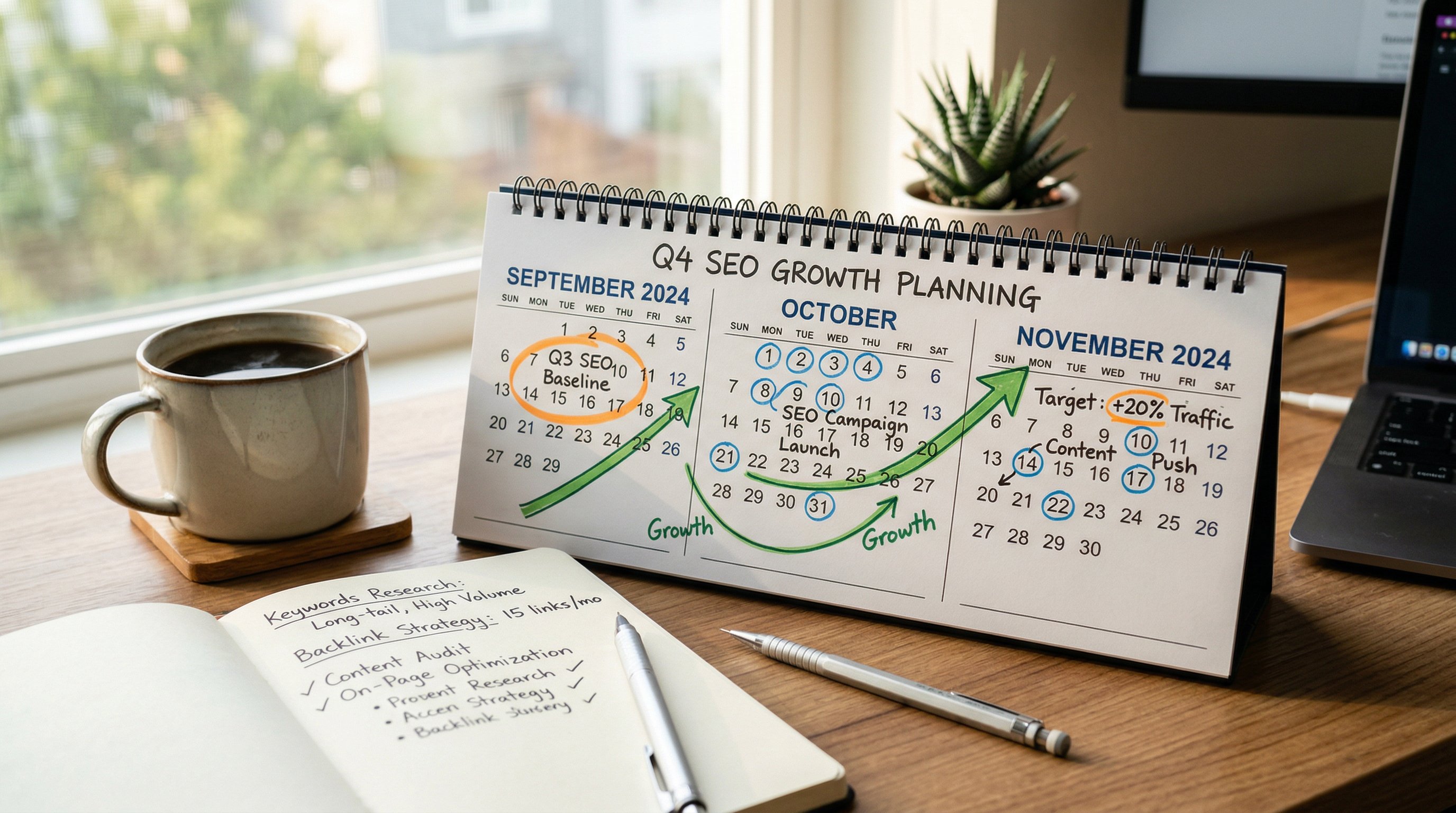
Quick Answer
Google has officially stated that SEO typically takes 4 months to a year to produce significant results. In practice, the timeline varies considerably: long-tail and local keywords can generate first-page rankings within 30-90 days, while competitive head terms in major markets may take 6-18 months. This guide breaks down exactly what happens month by month in a standard SEO campaign — what milestones to expect, why progress accelerates or stalls, and how AI-powered SEO from Search Scale AI compresses the traditional timeline by deploying content and technical infrastructure in 48 hours rather than 6 months.
Key Takeaways
- Google's own guidance states new websites take 4 months to a year before SEO efforts produce significant results — this is the benchmark, not a pessimistic estimate.
- Months 1-2 are foundation work: technical fixes, content creation, and indexing — no rankings expected yet for most campaigns.
- Months 3-4 produce early signals: long-tail keyword movement, impressions climbing in Google Search Console, and first leads from organic search.
- Months 4-6 represent the traction phase: mid-funnel keywords begin ranking, monthly lead volume from organic becomes measurable and consistent.
- Months 6-9 show significant progress: primary service keywords enter top 10, organic traffic becomes a meaningful channel, and cost per lead drops sharply.
- Months 9-12 enter compounding growth: authority accumulated from early work accelerates new content rankings, organic search may become the top traffic source.
- Search Scale AI's 48-hour deployment system collapses months 1-3 of traditional timeline into the first 48 hours — producing early ranking signals weeks ahead of conventional campaigns.
Table of Contents
- Why SEO Takes Time: The Honest Explanation
- Months 1-2: Foundation and Technical Fixes
- Months 3-4: Early Signals and Long-Tail Movement
- Months 4-6: Traction Phase
- Months 6-9: Significant Progress
- Months 9-12: Compounding Growth
- Factors That Speed Up or Slow Down Results
- How Search Scale AI Collapses the Traditional Timeline
- Frequently Asked Questions
Why SEO Takes Time: The Honest Explanation
The most common frustration with SEO is its apparent slowness relative to paid advertising. A Google Ads campaign generates clicks on day one. An organic SEO campaign may not show meaningful traffic movement for 90-120 days. Understanding why this gap exists — not just accepting "SEO is slow" as an article of faith — helps set accurate expectations and enables smarter decisions about when to invest in SEO versus other channels.
Google's ranking systems work by evaluating hundreds of signals over time to determine which pages deserve to rank for which queries. These signals include: how long a domain has existed and accumulated behavioral data, how many authoritative external sites link to the domain as a trust signal, whether the content on the site has been consistent and substantive over time, how real users behave when they land on the site (do they stay and read, or bounce immediately?), and how well the technical infrastructure supports fast, reliable crawling and rendering. None of these signals can be instantiated immediately. They are earned and accumulated over weeks and months of consistent work.
Google itself addressed this directly in its official documentation and public statements. Google Search Advocate John Mueller has stated that new websites typically need to be patient for 4 months to a year before seeing significant SEO results — not because Google is being deliberately slow, but because the trust and relevance signals that drive rankings require time to accumulate and validate. A new site publishing excellent content on day one still has zero backlink history, zero behavioral data, zero track record of consistent quality — all of which Google weighs heavily. The system is designed to resist manipulation by requiring demonstrated consistency over time.
Ahrefs conducted a large-scale analysis of their keyword database and found that the average top-10 ranking page is over 2 years old. Only 5.7% of newly published pages reach the top 10 within a year of publication. Search Engine Land and Moz's correlation studies consistently show domain age and link authority as among the strongest predictors of ranking velocity for new content. These are not discouraging statistics — they are accurate baselines for planning. The good news is that local SEO for small businesses operates on a faster timeline than the national keyword data suggests, because local competition is typically weaker and geographic keyword specificity reduces the field of competitors significantly.
- New domains face the longest timelines: 6-12 months before significant organic traffic, regardless of content quality.
- Established domains with existing authority can rank new content within days to weeks for relevant keywords.
- Local SEO timelines are faster than national SEO — local keywords have fewer strong competitors, making first-page rankings achievable in 30-90 days for well-optimized pages.
- Long-tail keywords (3+ word phrases with specific intent) rank faster than short, competitive head terms.
- Technical SEO problems — slow site speed, crawl errors, duplicate content — extend every phase of the timeline until they are corrected.
Months 1-2: Foundation and Technical Fixes
The first two months of an SEO campaign are primarily infrastructure work. For most small businesses beginning a serious SEO investment for the first time, this phase involves correcting pre-existing technical problems, building the content architecture that will support rankings, and establishing the tracking and measurement systems needed to evaluate progress accurately. Very few organic rankings change during this phase — which is expected and normal, not a sign that the campaign is failing.
The technical audit in month 1 typically uncovers a predictable set of issues on small business websites that were built without SEO as a priority. Core Web Vitals failures are common: many small business sites built on generic WordPress themes load in 4-8 seconds, creating massive Largest Contentful Paint scores that signal poor user experience. Crawl errors — pages that return 404 errors, broken internal links, orphaned pages with no internal links pointing to them — are frequent. Missing or malformed schema markup means Google cannot understand what the business offers or where it is located. Duplicate content from URL parameter variations, HTTP/HTTPS redirect issues, or print-friendly page versions creates confusing signals about which version of a page should rank. Each of these issues suppresses rankings until corrected.
The technical SEO audit also establishes baseline metrics: current organic traffic volume, current keyword rankings (if any), Google Search Console impression data, Core Web Vitals scores, and site speed benchmarks. These baselines are critical for demonstrating progress in later months — without them, month 6 improvements are difficult to quantify and report accurately. Google Search Console and Google Analytics 4 setup, if not already configured, happens in month 1.
Content work in months 1-2 focuses on the highest-priority pages: the homepage, primary service pages, and the most important location pages. For a local SEO campaign, this means ensuring that every core service page is fully optimized with a clear target keyword, proper header structure, schema markup, internal links to related pages, and content that genuinely answers the questions a potential customer would have before calling. For businesses with no existing content infrastructure, this phase may involve building 10-20 pages from scratch.
One metric does typically improve during months 1-2: impressions in Google Search Console. As pages get indexed and Google begins processing content, impression counts climb even before pages achieve strong click-through rates. Seeing impressions grow from zero to hundreds or thousands per week during months 1-2 is a reliable leading indicator that the campaign is moving in the right direction and that ranking movement will follow in months 3-4.
What should I expect to see from SEO in the first two months?
In months 1-2, expect technical fixes to be completed, baseline content to be published or optimized, Google Search Console to show growing impressions, and a small number of long-tail keyword rankings to begin appearing. Do not expect significant traffic increases or lead flow during this phase — these are foundation months. The work done here determines whether months 3-6 produce strong results or mediocre ones. Campaigns that cut corners on technical work in months 1-2 consistently underperform in every subsequent phase.
Months 3-4: Early Signals and Long-Tail Movement
Months 3 and 4 are where an SEO campaign begins producing its first visible results — and where the trajectory of the entire campaign becomes clearer. For most small business campaigns targeting local and long-tail keywords, this is the phase where initial first-page rankings appear, impressions in Google Search Console climb meaningfully, and the first organic search leads begin arriving. It is also the phase where tracking and patience pay off: if you have been measuring consistently since month 1, month 3 data shows clear directional momentum.
Long-tail keywords — specific, multi-word queries like "emergency AC repair [city name]" or "family dentist accepting new patients [neighborhood]" — typically produce the earliest ranking wins. These terms have lower competition than short-tail head terms, clearer intent that well-structured content can satisfy directly, and fewer authoritative competitors defending the top positions. A well-optimized page targeting a specific long-tail query can achieve a first-page ranking within 30-90 days on a site that is technically sound and has even modest domain authority. By months 3-4, a well-executed campaign in a typical small business category should have 5-20 keywords appearing in Google Search Console's top 10-20 positions.
Google Search Console data in months 3-4 typically shows: impressions growing week-over-week as more pages get indexed and processed; average position improving as pages move from position 30-50 to position 10-20 for their target keywords; and click-through rates climbing as pages enter the top 10 where CTR rises sharply. The standard CTR curve in Google Search Console shows position 1 generating approximately 27% CTR, position 3 generating 10%, position 5 generating 5%, and position 10 generating 2-3%. Moving from position 20 to position 8 may double or triple organic traffic from a single keyword even before reaching the first page.
For businesses in Florida's competitive local markets — Orlando, Tampa, Miami — months 3-4 may feel slower than for businesses in smaller markets like St. Augustine or Daytona Beach. Market competitiveness directly affects ranking velocity: a well-optimized page for "plumber Gainesville FL" will typically outperform the equivalent page targeting "plumber Tampa FL" in the same timeframe because Gainesville has fewer established SEO competitors in the home services space. This is why keyword and market research at the campaign's start matters so much for setting realistic timeline expectations.
Link building work typically begins in months 3-4. Early-stage link acquisition targets easily achievable placements: local business directories, Google Business Profile optimization, local chamber of commerce listings, and relevant industry directories. These citations build the local authority signals that help location pages rank faster. More substantive link building — guest posts, PR-based coverage, local media mentions — produces results at months 6-9 rather than immediately, but the outreach work must begin now to produce those later-stage results.
Months 4-6: Traction Phase
Months 4 through 6 represent the first period where most small business SEO campaigns generate consistent, measurable lead flow from organic search. The long-tail rankings established in months 3-4 begin converting visitors to leads, primary service keywords move into positions 5-15 and begin generating meaningful click volume, and Google's trust signals for the domain accumulate enough to accelerate ranking movement for new content published in this phase. This is often when the business owner notices that "something is working" — calls from people who found the business through Google search without using a referral or seeing an ad.
The content strategy typically expands in months 4-6. With the technical foundation in place and early rankings providing validation of keyword targeting, this phase often involves publishing blog content targeting informational queries — the questions potential customers ask before they are ready to buy. For an HVAC company, this means content like "how often should I replace my AC filter" or "signs your air conditioner needs replacement." These informational posts attract upper-funnel traffic, build topical authority, and generate internal linking opportunities that strengthen the service pages targeting transactional queries. Ahrefs research has found that sites with strong informational content around their core topic rank their transactional pages faster and at higher positions than sites with only service-page content.
For local businesses, Google Business Profile rankings — the map pack results that appear above organic listings for local searches — also tend to solidify during months 4-6 when GBP optimization is part of the campaign. The map pack captures significant click share for local service queries: for "plumber near me" or "dentist open now," the map pack receives 30-45% of all clicks. A campaign that is only targeting organic rankings without simultaneously optimizing the GBP listing is leaving a substantial portion of available local search traffic uncaptured.
The traction phase is also when the compounding mechanics of SEO become tangible. A piece of content published in month 2 that ranked at position 18 in month 3 may improve to position 9 by month 4 and position 5 by month 6 — without any additional optimization work. This passive improvement happens as Google accumulates more behavioral data from searchers who click on the page and find it useful, as new links are earned organically from the content being discovered, and as the overall domain authority grows from the accumulated effect of all campaign work. SEO's compounding nature is its greatest long-term economic advantage — results improve without proportional cost increases.
When will I start getting leads from SEO?
Most small business SEO campaigns generate their first organic search leads between months 2 and 4, with consistent, meaningful lead flow beginning around months 4-6 for local and long-tail keywords. By month 6, a well-managed campaign should be generating 20-60 qualified organic leads per month for a typical local service business, depending on search volume in the market and keyword competitiveness. Businesses in highly competitive metropolitan markets may see this volume delayed by 1-2 months relative to businesses in smaller, less competitive markets.
Months 6-9: Significant Progress
Months 6 through 9 represent what most experienced SEO practitioners would call the "significant progress" phase — the period where results become undeniable and where organic search typically becomes one of the top two or three traffic sources for the site. Primary service keywords that have been targeted since month 1 begin appearing in positions 1-5 for many campaigns, driving click-through rates of 10-30% and producing consistent lead volume. The ROI calculation, which was negative or marginal in months 1-4, usually turns definitively positive during this phase.
For a local business in a market like Jacksonville or St. Augustine, month 6-9 typically shows: 50-150 organic visitors per day (up from 5-20 at the campaign's start), 30-80 keyword rankings in top-10 positions, 15-50 organic leads per month, and an organic search share of total traffic between 40-60%. These are not exceptional outcomes — they are consistent with competently managed local SEO campaigns in markets with normal competitive density. Campaigns targeting major metros like Miami or Orlando may show similar keyword counts but lower raw traffic numbers due to higher competition in those markets.
The link profile becomes meaningfully stronger during months 6-9 as link building outreach begun in months 3-4 produces results. Guest post placements, local media mentions, industry directory inclusions, and earned citations collectively elevate domain authority scores — and higher domain authority directly correlates with faster ranking velocity for new content. A site that required 90 days to rank a new page in month 2 may rank similar pages within 2-3 weeks by month 9. This shortening of the ranking timeline for new content is one of the clearest indicators that the campaign's foundation work is paying off at a structural level.
Competitive analysis during months 6-9 typically reveals that the campaign has captured keyword positions previously held by weaker competitors — pages with thin content, slow load speeds, or missing schema markup that could not defend their rankings against a technically stronger, content-rich challenger. Understanding why rankings are won in this phase informs where to press the advantage in months 9-12: identifying which remaining competitors have exploitable weaknesses in content depth, technical quality, or geographic coverage.
- By month 9, organic traffic typically represents 35-65% of total site traffic for well-managed campaigns.
- Top-10 keyword rankings double or triple between months 6 and 9 as domain authority accelerates the ranking timeline for new content.
- Cost per lead from organic search drops below PPC benchmarks in most categories during this phase — the economic crossover point where SEO becomes the more efficient channel.
- Google Business Profile rankings stabilize during this phase for local businesses, providing consistent map pack visibility alongside organic rankings.
Months 9-12: Compounding Growth
The final quarter of year one represents the full expression of SEO's compounding mechanics. Content published in months 1-3 has now had 6-9 months to accumulate behavioral signals, earn links organically, and build topical clusters that reinforce each other's authority. Primary keywords that were mid-page in month 6 have climbed to positions 1-3, capturing the majority of available click volume. New content published in months 9-12 often ranks within days to weeks rather than months, because the domain authority accumulated over the preceding 9 months provides immediate credibility to new pages in Google's evaluation.
Ahrefs data on organic traffic growth curves for small business websites shows a consistent acceleration pattern: traffic growth from months 1-6 is typically linear and modest, while months 6-12 show an exponential curve as compounding effects take hold. The same monthly investment that generated 20 leads in month 6 often generates 50-80 leads in month 12, with no proportional increase in campaign cost. This is the economic engine that makes long-term SEO investment so compelling relative to paid advertising, where lead volume is strictly proportional to budget and the moment the budget is cut, leads disappear entirely.
For businesses that have been running SEO campaigns since month 1, month 12 often feels like a tipping point. Organic search becomes the dominant inbound channel. The business's Google Business Profile appears in the map pack for its primary service terms in the target city. Blog content published months ago continues generating leads passively. Competitors who relied on weaker SEO practices have been displaced from positions they held for years. At this stage, the appropriate strategic question shifts from "is SEO working?" to "how do we extend the lead we have built and protect the rankings we have earned?"
Content expansion in months 9-12 typically moves into tier-two keyword targets: broader service keywords, adjacent topic clusters, and new geographic areas. A local St. Augustine business that ranked for its core city terms in months 4-6 may now begin targeting nearby markets — Palm Bay, Port St. Lucie, Daytona Beach — with location pages that earn rankings faster than the original campaign because the domain's elevated authority now supports faster ranking velocity in new geographic targets. The geographic expansion strategy, combined with deepening content coverage of core topics, is what separates businesses that sustain 30-50% year-over-year organic growth from those that plateau after their first year of SEO investment.
Factors That Speed Up or Slow Down Results
The month-by-month timeline above represents a typical campaign — but individual campaigns vary significantly based on a specific set of factors. Understanding what accelerates or decelerates SEO progress allows businesses to make informed decisions about how to structure their campaign and allocate budget to maximize ranking velocity.
The single most important factor in ranking speed is domain age and authority. An established domain with 3-5 years of history, even with minimal prior SEO investment, starts every campaign with a structural advantage over a brand-new domain. New domains must spend months building the basic trust signals that established domains already possess. If you are launching a new website for an existing business, consider whether an aged domain in your industry is available for purchase — redirecting an established relevant domain to your new site can eliminate 3-6 months of the new domain penalty in many cases.
Content volume and deployment speed significantly affect early-phase ranking velocity. Campaigns that deploy 40-60 pages of optimized content in the first month generate topical authority signals much faster than campaigns that add 4-6 pages per month. Google evaluates topical authority partly by assessing how comprehensively a site covers a subject area. A site with 10 related pages on HVAC services signals more authority than a site with 2 pages, even if the 2-page site's content is slightly higher quality on a per-page basis. Comprehensive coverage is a ranking signal in its own right.
Technical SEO quality affects every phase of the timeline. A site with Core Web Vitals failures, slow server response times, crawl errors, or mobile rendering problems will consistently underperform a technically clean site with equivalent content. Google has confirmed Core Web Vitals as ranking signals, and technical debt that suppresses these scores is a ceiling on achievable rankings until corrected. The technical SEO audit and remediation work in months 1-2 directly determines the ceiling for every subsequent phase.
Link acquisition pace matters more in months 3-9 than in months 1-2. A site that earns 5-10 quality external links per month climbs rankings faster than an equivalent site earning 0-2 links. For local businesses, quality links include local news mentions, chamber of commerce directory inclusions, local blog features, and citations from authoritative local directories. These are easier to earn than national editorial links and provide disproportionate local authority signals. Our guide to building local backlinks covers specific tactics for earning high-quality local links efficiently. For SGE optimization and AI overview visibility, link authority from authoritative sources also directly increases the likelihood of being cited in AI-generated answers.
What is the biggest mistake that slows down SEO results?
Inconsistency is the single most common cause of slow SEO results. Businesses that start a campaign, publish content aggressively for 2 months, then pause for 3 months, then restart — never reach the compounding growth phase that makes SEO's long-term economics superior to paid advertising. Google interprets consistent content publication, consistent link acquisition, and consistent technical maintenance as signals of a trustworthy, active website. Inconsistency signals the opposite. A smaller but consistent monthly investment produces better results over 12 months than a larger but erratic investment pattern.
Market competitiveness is an external factor that cannot be controlled but must be accurately assessed at the campaign's start. A roofing contractor in Clearwater competing against 50 roofing companies with active SEO campaigns will see slower ranking movement than a roofing contractor in Ocala competing against 15. Competitive analysis at the campaign's start — evaluating the domain authority, content depth, and technical quality of top-ranking competitors — sets realistic timelines and identifies which keywords represent achievable early wins versus which require sustained long-term investment.
How Search Scale AI Collapses the Traditional Timeline
The month-by-month timeline described above assumes a conventional SEO campaign pace: gradual content accumulation, sequential technical fixes, and the standard 1-4 week indexing lag for each new page. Search Scale AI's 48-hour deployment system is specifically engineered to collapse months 1-3 of that traditional timeline into the first 48 hours of a campaign — producing early ranking signals, indexing, and initial leads weeks ahead of what conventional agencies deliver.
The core mechanism is simultaneous, high-volume content deployment. Instead of publishing 4-8 pages per month, our AI automation system produces 50+ pages of fully optimized content — service pages, location pages, blog posts, FAQ pages — in a single deployment within the first 48 hours. Every page is mapped to a specific keyword target, structured with correct schema markup, optimized for Core Web Vitals, and integrated into a deliberate internal linking architecture. A site that would take a conventional agency 6 months to build to 50 pages is built and deployed in under 2 days.
Indexing acceleration compresses the second major traditional bottleneck. The standard timeline from page publication to Google indexing is 1-4 weeks for most new sites. Our indexing system — combining Google Search Console URL Inspection requests, PrimeIndexer rapid indexing submission, and sitemap pings — gets pages indexed within 2-6 hours of deployment for most URLs. This means the 50+ pages deployed in 48 hours begin accumulating ranking data and generating impressions within the same week, rather than waiting 2-6 weeks per page under conventional submission practices.
The net effect on the SEO timeline is significant. Traditional campaigns that begin generating first organic leads at month 3-4 are starting from a site that has 8-12 pages indexed. Our campaigns begin generating first organic leads from a site that has 50+ pages indexed from week one — each page targeting different keyword variations and geographic modifiers, creating immediate topical coverage that typically takes conventional campaigns a year to build. This is why our clients in St. Augustine, Orlando, Tampa, and across Florida often see first-page rankings within the first 2-4 weeks rather than waiting 3-5 months.
Understanding the full investment required for this accelerated approach is important for accurate ROI planning. Our 2026 SEO pricing guide covers what small businesses should expect to invest at different campaign scopes, what is included in a 48-hour launch package versus ongoing monthly management, and how to evaluate whether pricing you have been quoted from any agency reflects the scope of work required to move the needle in your specific market. Pricing transparency is a prerequisite for accurate timeline and ROI expectations.
The final factor in accelerating the SEO timeline is the site architecture itself. Our static HTML builds — detailed in our guide to building and ranking a website in 48 hours — achieve Core Web Vitals scores of 95-100 on Google PageSpeed Insights from launch. There are no technical performance issues to correct in months 1-2, which means the full campaign energy goes into content expansion, keyword targeting, and link building from day one rather than being diverted into performance remediation. For businesses currently on slow WordPress sites, migrating to static HTML as part of an SEO campaign launch eliminates one of the most common months-1-3 delay factors entirely.
To understand what an accelerated SEO timeline could look like for your specific business, market, and keyword targets, contact Search Scale AI at 772-267-1611 or through the website. We provide honest, data-based timeline projections based on your competitive landscape — not the optimistic 90-day promises that undersell the real timeline or the pessimistic 18-month forecasts that oversell the difficulty. Our AEO-structured content and AI SEO approach is built around moving fast and measuring every week, so you always know exactly where you are in the timeline and what is driving movement.
Frequently Asked Questions
How long does SEO take to show results?
Google itself has stated that SEO typically takes 4 months to a year to show significant results for a new website or a site making major SEO changes. For small business SEO targeting local and long-tail keywords, first rankings often appear within 30-90 days, with meaningful traffic and lead generation beginning around months 3-5. Broad competitive terms may take 6-12 months or longer to achieve top-10 rankings. These timelines assume consistent, well-executed campaigns — inconsistent execution stretches every phase.
Why does SEO take so long?
SEO takes time because Google uses hundreds of signals collected over weeks and months to evaluate trust, authority, and relevance. A new page must be crawled, indexed, and then evaluated against competing pages before it earns a stable ranking. Domain authority — the accumulated trust Google assigns to a website based on its age, backlink profile, and content history — cannot be purchased or instantly created. It is built through consistent publishing, earning links, and demonstrating expertise over time. Technical issues like slow crawling, indexing delays, and content quality reviews also add to the natural timeline.
Can SEO produce results in less than 3 months?
Yes — for specific keyword types. Long-tail keywords (3-5 word phrases with clear intent) and hyper-local keywords (service + city name) can rank within weeks when content is properly structured, technically sound, and indexed quickly. A new page targeting "emergency plumber St. Augustine" may rank on page one within 2-4 weeks if competing pages are weak. Head terms like "plumber" or "HVAC service" in a major metro area will not rank within 3 months for a new site — these require accumulated domain authority that takes 6-12 months to develop.
What happens to SEO after 12 months?
After 12 months of consistent SEO investment, most small business sites enter a compounding growth phase where existing rankings stabilize and the accumulated domain authority accelerates the ranking timeline for new content. A page that would have taken 6 months to rank at the campaign's start may take 4-6 weeks at month 12. Organic traffic growth rate typically accelerates between months 9-24 as content accumulates, backlinks compound, and topical authority deepens. This is why long-term SEO ROI dramatically outperforms the first-year ROI — the same monthly investment generates proportionally more leads each year.
Does a new website take longer to rank than an established site?
Yes. New domains have zero domain authority, no backlink history, and no behavioral data for Google to evaluate — all of which are trust signals that established sites have accumulated over time. New sites typically take 3-6 months just to begin appearing for any non-trivial keywords, and 6-12 months to rank competitively for moderate-difficulty terms. Established sites with existing authority can add new content and see rankings within days to weeks for the same keywords. This domain age factor is one reason why acquiring an existing relevant domain, when available, can dramatically accelerate SEO timelines.
How does Search Scale AI's system make SEO faster?
Search Scale AI's 48-hour system compresses the SEO timeline by deploying 50+ pages of optimized content simultaneously rather than adding 2-4 pages per month, using rapid indexing tools to get pages into Google within hours rather than weeks, building complete technical SEO foundations at launch rather than fixing issues incrementally, and targeting achievable long-tail and local keywords from day one to generate early ranking wins that build domain authority faster. The result is first rankings within days to weeks rather than the 3-6 month waiting period of conventional campaigns.