Internal Linking for SEO: The Strategy That Turns Good Content Into Rankings
By Tim Francis · April 10, 2026 · 10 min read
Quick Answer
An internal linking strategy is the deliberate practice of connecting pages within your own website to pass link equity to high-priority pages, signal topical authority to Google, and ensure every page gets crawled and indexed. Done correctly, internal linking is one of the highest-leverage on-page SEO tactics available — it costs nothing, works immediately, and compounds over time as you add more content. At Search Scale AI, our SEO system uses a hub-and-spoke architecture to interlink 200+ pages across service pages, location pages, and blog content, and it is a core reason our sites rank faster than competitors with comparable backlink profiles.
Key Takeaways
- Internal links distribute link equity from strong pages to pages that need authority, directly influencing which pages rank.
- Hub-and-spoke architecture organizes your site around pillar pages that receive and distribute the most authority.
- Descriptive, keyword-rich anchor text tells Google exactly what the destination page is about — generic anchors like "click here" pass no ranking signal.
- 10-15 contextual internal links per post is the practical target for posts in the 1,500-2,500 word range.
- Orphan pages — pages with zero internal links — are often crawled rarely and rank poorly regardless of content quality.
- Internal linking directly affects crawl budget: pages linked frequently get crawled frequently.
- A deliberate internal link audit every 90 days keeps your link graph clean and your authority distribution intentional.
Table of Contents
- What Internal Linking Is and Why It Matters for SEO
- How Google Uses Internal Links to Discover and Rank Pages
- Hub-and-Spoke: The Pillar Content Architecture That Works
- Anchor Text Best Practices: Descriptive, Varied, and Natural
- How Many Internal Links Per Page
- Linking to Deep Pages That Need Authority
- Contextual vs. Navigational vs. Footer Links
- The Link Equity Flow Concept
- How We Interlink 200+ Pages at Search Scale AI
- Tools and Methods for Internal Link Auditing
- Common Internal Linking Mistakes
- Internal Linking and Crawl Budget
- Frequently Asked Questions
What Internal Linking Is and Why It Matters for SEO
An internal link is any hyperlink that points from one page on your website to another page on the same website. That includes links in body copy, navigation menus, sidebars, footers, breadcrumbs, and related-post widgets. Internal linking strategy is the practice of planning and managing those links deliberately — deciding which pages link to which, what anchor text to use, and how often to update those connections as your site grows.
Most website owners treat internal linking as an afterthought. They add a link here and there when it feels natural, but they have no system and no map of where authority is flowing. The result is a site where the homepage passes equity to a handful of pages, those pages pass equity randomly to whatever was linked during content creation, and deep service or location pages sit starved of authority despite containing some of the best content on the site.
A deliberate internal linking strategy changes that picture entirely. It ensures that your highest-priority pages — the ones you most need to rank — receive the most internal equity. It creates topical clusters that signal subject-matter authority to Google. And it keeps every page connected to the broader site so that Googlebot can find and crawl it efficiently. When I look at sites that have strong content but weak rankings, a broken or absent internal linking strategy is one of the first problems I find. Understanding what on-page SEO is and how to do it correctly begins with understanding that internal links are not decorative — they are structural.
How Google Uses Internal Links to Discover and Rank Pages
Google uses internal links in two primary ways: for discovery and for ranking. When Googlebot crawls your website, it follows links. Every internal link is an invitation for the crawler to visit another page. A page with no internal links pointing to it — an orphan page — will only be found if Google discovers it through the sitemap or an external backlink. That discovery is slower, less reliable, and often less frequent. A page with multiple internal links from crawled pages gets found immediately and revisited regularly.
For ranking, Google uses a concept that originated with the PageRank algorithm — the idea that a link from one page to another passes a portion of the linking page's authority. This is often called link equity or link juice. The more authoritative the linking page, the more equity it passes. The more links on the linking page, the smaller the share each destination receives. Internal links work exactly the same way as external backlinks in this respect, except you have complete control over them. You decide which pages receive equity from your strongest pages. You decide how to concentrate authority on your most commercially important content.
Google also uses internal links to understand topical relationships. When your pillar post on SEO links to a post about technical SEO, a post about on-page SEO, and a post about local SEO strategies, Google recognizes that these topics are related and that your site covers the subject with depth. That topical clustering is a meaningful ranking signal in the current algorithm. Sites that cover a topic from multiple interconnected angles tend to rank better than sites with isolated, unconnected pieces of content — even if the individual pieces are equal in quality. This is why the on-page SEO checklist and the technical SEO guide covering site speed and indexing should both link back to a central pillar and to each other.
Hub-and-Spoke: The Pillar Content Architecture That Works
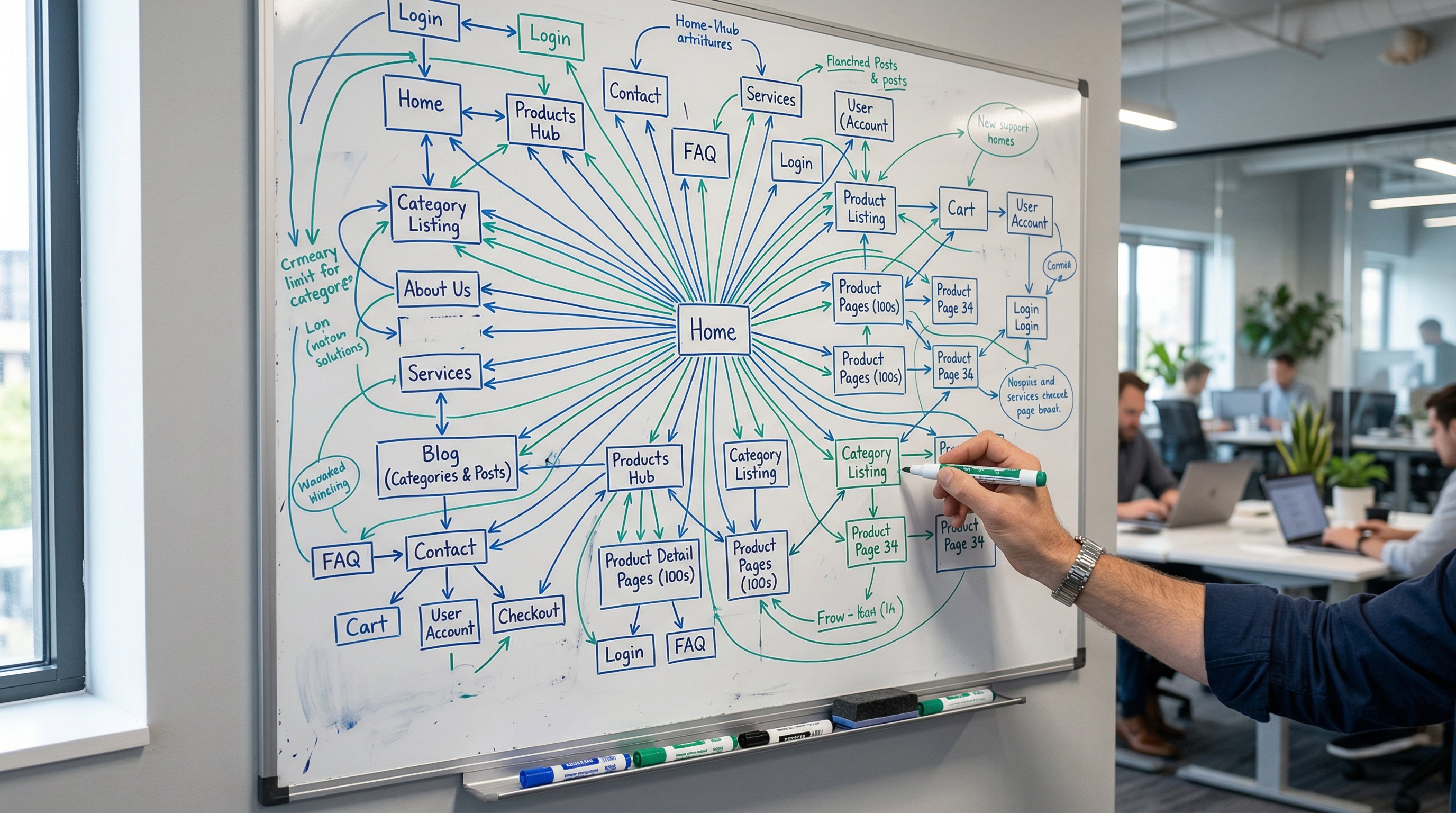
The hub-and-spoke model is the most effective internal linking architecture I have used across dozens of sites. The idea is straightforward: identify your most important topics, create a comprehensive pillar page (hub) for each one, and then build a cluster of supporting pages (spokes) that go deep on specific subtopics. Every spoke links back to the hub. The hub links out to every spoke. The result is a tightly interconnected content cluster where authority circulates between the hub and its supporting pages.
In practice, the hub is typically a long-form pillar post or a core service page. If your business is an SEO agency, your SEO service page is a hub. So is a comprehensive pillar post covering the full scope of a topic. The spokes are more focused pieces: a post on technical SEO, one on anchor text strategy, one on crawl budget, one on local SEO. Each spoke covers one dimension of the hub topic in greater depth than the hub itself can. When a user lands on the hub and wants to go deeper on a specific subtopic, a spoke is right there to send them. When a user lands on a spoke and wants the broader picture, the hub is linked at the top.
The SEO benefit of this architecture compounds over time. As Google crawls and re-crawls the cluster, it sees that your hub page is the central authority on the topic — it receives the most internal links and links out to the most supporting content. The spokes reinforce this by consistently pointing back to the hub. When an external backlink lands on any spoke, some of that equity flows back to the hub through internal links. The whole cluster rises together. This is the architecture we implement from day one on every site we build at Search Scale AI, and it is a primary reason new sites can begin accumulating topical authority quickly rather than waiting months for it to develop organically.
How do you identify which pages should be hubs vs. spokes?
Hubs are your broadest, highest-commercial-intent pages: core service pages, category pages, and cornerstone posts that cover a full topic. Spokes are more specific: individual service features, location-specific variations, how-to posts, and comparison content. A useful rule of thumb is that if a page is the most important page you have on a topic, it is a hub. If it goes deep on one specific aspect of a topic that the hub covers, it is a spoke. Every spoke should have exactly one primary hub it links back to — if it is relevant to two hubs, choose the closer one and create a secondary contextual link to the other.
Anchor Text Best Practices: Descriptive, Varied, and Natural
Anchor text is the visible, clickable text of a hyperlink. It is one of the strongest signals available for telling Google what a destination page is about. When you link to your on-page SEO guide using the anchor text "on-page SEO guide," you are telling Google that the destination page is relevant to the phrase "on-page SEO guide." That signal reinforces the page's relevance for that keyword. When you link to the same page using "click here," you pass no useful semantic signal whatsoever.
The best anchor text for internal links is descriptive and keyword-relevant. It should incorporate the primary keyword or a close variant of the target keyword for the destination page. It should also read naturally in the sentence where it appears — if the anchor text makes the surrounding sentence feel awkward or forced, rewrite the sentence rather than compromise the anchor. I aim for anchors that tell a reader exactly what they will find if they click, because that is also what tells Google exactly what the destination page covers.
Variation is important. If you have 10 blog posts linking to your pillar on SEO strategy, do not use the exact same anchor text on all 10. Vary it naturally: "SEO strategy guide," "comprehensive SEO strategy," "how to build an SEO strategy," "full guide to SEO strategy." This variation looks natural to Google and helps the destination page rank for a broader set of related phrases rather than a single exact match. The anchors that raise red flags for over-optimization are exact-match commercial phrases repeated identically across dozens of pages — that pattern is associated with low-quality link building and can attract algorithmic scrutiny.
- Use the destination page's primary keyword in the anchor text, or a natural close variant.
- Write anchor text that reads naturally in context — if it sounds forced, rewrite the surrounding sentence.
- Vary anchor text across multiple links to the same destination page.
- Avoid generic anchors: "click here," "read more," "here," "this post," "this page."
- Keep anchors concise — 3-6 words is usually the sweet spot. Avoid anchors that are entire sentences.
- Never use the same anchor text for links to two different destination pages — that sends contradictory signals.
How Many Internal Links Per Page
The honest answer is that there is no single correct number — it depends on page length, page type, and the structure of your site. That said, for a standard blog post between 1,500 and 2,500 words, 10-15 contextual internal links is a practical and effective range. This range gives Google enough topical connection signals to understand how the page relates to the rest of your site, without creating a page that reads like a link directory.
The more important question than count is quality and placement. Ten well-placed contextual links in body copy — each one linking to a genuinely related page using descriptive anchor text — are worth more than 25 links crammed into a list at the bottom of the page. Contextual links are those embedded naturally in the flow of the content, where a link to a supporting page genuinely helps the reader go deeper on a point being discussed. These are the links that Google weights most heavily because they reflect actual topical relationship, not just co-location on a page.
Service pages and location pages tend to have fewer contextual links than blog posts simply because they are shorter and more focused. For a typical service page, 5-8 contextual internal links is appropriate. For a homepage, the goal is different — the homepage should link to every primary service and major content category, which may mean 15-25 internal links including navigational ones. The guiding principle across all page types is that every link should earn its place by helping either the user or Google understand the relationship between the pages.
Linking to Deep Pages That Need Authority
One of the most valuable and most overlooked internal linking tactics is deliberately sending authority to deep pages — location pages, individual service variant pages, and niche blog posts that are critical to your business but far from the homepage in the site architecture. The further a page is from the homepage in terms of click depth, the less natural link equity it tends to receive. Addressing that imbalance is one of the highest-leverage things you can do with internal linking.
At Search Scale AI, we have location pages for dozens of Florida markets — pages like the St. Augustine SEO page, Orlando, Tampa, and Jacksonville. Each of those pages needs to rank for competitive local SEO terms in its respective market. Those pages are not going to get dozens of external backlinks on their own. What they can get is consistent internal links from the homepage, from the main service pages, and from relevant blog posts. When I write a post about local SEO strategies for St. Augustine businesses, I link to the St. Augustine location page. When I write a post about SEO for Florida markets, I link to each relevant location page with descriptive anchor text. Over time, that pattern of internal links elevates those deep pages in Google's understanding of the site's authority structure.
The same principle applies to deep service pages. If your main SEO service page is strong but your AI SEO or AEO subservice pages are struggling, one of the first interventions should be increasing the number and quality of internal links pointing to those subpages from the main service page, from blog posts, and from the homepage where relevant. This is not complicated — it is a matter of looking at which high-value pages are underlinked and then systematically adding contextual links to them from your most authoritative pages.
The Link Equity Flow Concept
Link equity — sometimes called PageRank or "link juice" — is the portion of a page's authority that it passes to pages it links to. Think of it as a budget. Every page on your site has an authority budget, accumulated from the external backlinks it receives and from internal links from other authoritative pages on your site. When that page links to another page, it shares a portion of its budget with the destination. The more links on the page, the smaller the share each destination receives. The fewer links, the larger the share each destination receives.
This has a direct practical implication: pages that link to many destinations pass less equity per link than pages that link to few destinations. If you have a very strong blog post that currently links to 30 other pages, adding a link to a deep service page that needs authority provides a smaller boost than adding that same link to a post that currently only links to 5 pages. When I am planning an internal link audit, one of the first things I look at is which strong pages have relatively few outbound internal links — those are the pages with the most untapped equity to redistribute.
Equity flow also degrades across redirect hops. If Page A links to Page B, and Page B redirects to Page C, the equity that reaches Page C is diminished compared to a direct link from Page A to Page C. This is why keeping your internal link URLs clean and direct — pointing to the final destination URL without intermediate redirects — is important for link equity efficiency. It is also why internal link audits need to check for broken links and redirect chains, not just missing links.
How We Interlink 200+ Pages at Search Scale AI
Managing internal linking across a site with 200+ pages — service pages, location pages, blog posts, and supporting content — requires a system, not ad-hoc decision-making. Here is the exact framework we use at Search Scale AI, which is also what we implement for our clients.
We start with an internal link map built in a spreadsheet. Every page on the site gets a row. For each page, we record its primary keyword, its hub assignment (which pillar page it is a spoke of, if applicable), and the list of pages it should link to and receive links from. This map is built before content is created for new sites, and updated quarterly for existing sites. The map makes it possible to audit the link graph systematically rather than relying on memory or intuition.
For blog posts specifically, every post is required to link back to its primary hub, to at least two or three related spoke posts, and to at least one relevant service or location page. A post about local SEO strategies for Tampa businesses, for example, links back to the main SEO pillar, to the Tampa location page, and to related posts on Google Maps optimization and local business SEO. This pattern creates a dense web of topical connections rather than isolated posts that happen to share a category tag.
We also conduct a quarterly internal link audit using a site crawl tool. The audit identifies orphan pages, broken internal links, redirect chains in the link graph, pages with fewer than three inbound internal links, and pages where the anchor text is generic or missing. Every finding goes into a prioritized fix list. Pages that are both high-value and underlinked get addressed first. The audit typically takes two to three hours for a 200-page site and produces a reliable return in rankings and crawl efficiency. This systematic approach to internal linking is part of the broader on-page SEO process that underpins everything we do.
Tools and Methods for Internal Link Auditing
A good internal link audit requires a tool that can crawl your entire site, map the link graph, and surface actionable problems. Several tools handle this well, and each has a slightly different strength.
Screaming Frog SEO Spider is the most thorough option for a full site crawl. It maps every internal link on the site, identifies orphan pages, surfaces broken links, and shows the inbound and outbound link count for every URL. The free version handles sites up to 500 URLs. For larger sites, the paid license is worth it. After a Screaming Frog crawl, export the internal links report and filter for pages with zero inbound internal links — those are your orphan pages, and addressing them is almost always a quick win.
Ahrefs and Semrush both offer internal link analysis in their site audit tools. Ahrefs Site Audit shows internal link depth — how many clicks from the homepage it takes to reach each page — which is useful for identifying important pages buried too deep in the site structure. Semrush's site audit flags internal link issues as part of its broader technical health score, making it easy to triage. Google Search Console does not provide a comprehensive internal link map, but its Links report shows which of your internal pages receive the most internal links — useful for confirming that your highest-priority pages are actually receiving the most equity.
Beyond tools, a manual content audit is valuable for identifying anchor text quality. Tools can tell you how many internal links exist, but reviewing whether the anchor text is descriptive and varied requires reading the actual links. I recommend doing a manual anchor text review on your 20 most important pages every six months — checking that links pointing to those pages use keyword-relevant anchors and that no single generic anchor dominates. This review catches the kind of quality issues that automated tools miss.
- Screaming Frog: full site crawl, orphan page detection, broken link identification.
- Ahrefs Site Audit: link depth analysis, internal link distribution, click-depth mapping.
- Semrush Site Audit: internal link health score, issue prioritization, integration with broader SEO metrics.
- Google Search Console Links report: confirms which pages receive the most internal links from within your own site.
- Manual review: anchor text quality, contextual relevance, and whether linking pages are the most authoritative available.
Common Internal Linking Mistakes
After auditing dozens of sites, I see the same internal linking mistakes appearing repeatedly. Each one is fixable, but each one is also costing the site rankings it should already have.
Orphan pages are the most damaging and the most common. An orphan page is a page with no internal links pointing to it. It can only be discovered via sitemap submission or external backlinks — both slower and less reliable than being discovered through internal links from crawled pages. Orphan pages include important location pages that were added to the sitemap but never linked from any other content, new service pages that were published without being added to the navigation or linked from related posts, and old blog posts that were never linked from any newer content. Fix: run a monthly crawl and immediately link any orphan page from at least two relevant existing pages.
Generic anchor text is the second most common mistake. Sites that built their internal links with anchors like "click here," "learn more," "read this post," and "find out more" are leaving ranking signal on the table for every one of those links. The fix is not to go back and change every link at once — that would be disruptive and unnecessary. Instead, when creating new content, always use descriptive anchors; and when updating old content, replace generic anchors on the highest-priority pages first.
Overlinking is less common but still a real issue. A page with 50+ internal links in its body copy is passing a fraction of the equity per link that a focused page with 10-15 links would pass. More importantly, a page with 50 links reads poorly — it feels like a resource dump rather than authoritative content. If a page has accumulated too many links over time, audit them and remove those that are least relevant or least valuable to the reader.
Another common mistake is linking only to top-level pages and ignoring the deep pages that actually drive business. I see this frequently with service pages: the homepage links to the main SEO page, the main SEO page links to the homepage and a couple of blog posts, but the individual location pages — the pages that need to rank for city-specific terms — receive almost no internal link equity. Deep pages need deliberate, consistent linking from multiple sources to compete in search results. For our clients across markets like Miami, Fort Lauderdale, and West Palm Beach, ensuring the location pages receive strong internal links is one of the first optimizations we make.
Finally, redirect chains in the internal link graph are a significant and often invisible problem. If a URL was changed and the old URL now redirects to the new one, every internal link still pointing to the old URL is passing equity through an unnecessary redirect hop. Google follows the redirect and eventually reaches the destination, but each hop reduces the equity passed. After any URL restructuring, always update internal links to point directly to the current final URL — not to the old URL that redirects to it.
Internal Linking and Crawl Budget
Crawl budget is the number of pages Googlebot will crawl on your site within a given timeframe. For small sites under a few hundred pages, crawl budget is rarely a concern — Google will typically crawl the whole site frequently. For larger sites with hundreds or thousands of pages, crawl budget management becomes meaningfully important. Internal linking is one of the most powerful tools for directing how that budget is spent.
Googlebot follows links. When it crawls a page, it queues up the pages linked from that page for future crawling. Pages that receive many internal links get placed in the crawl queue repeatedly and crawled more often. Pages that receive few or no internal links get queued less frequently. This means that the pages you most want crawled and re-crawled — your most important service pages, your freshest blog posts, your highest-priority location pages — should be the pages that receive the most internal links. Not because of PageRank equity alone, but because link frequency drives crawl frequency.
Orphan pages are a crawl budget problem as much as a link equity problem. A page with no internal links is only discovered when Google processes the sitemap or follows an external backlink. If neither of those events triggers a crawl, the page may go weeks or months without being re-crawled. For pages that are updated frequently or that you need indexed quickly after publication, having at least two or three contextual internal links from already-crawled pages is the most reliable way to ensure prompt discovery.
Redirect chains also waste crawl budget. When Googlebot follows a link and hits a redirect, it spends crawl budget on the redirect response before following to the final destination. A page buried behind a chain of three redirects costs three crawl budget units to reach instead of one. Keeping your internal link graph clean — direct links to final URLs, no chains, no broken links — ensures that your crawl budget is spent reaching and indexing actual content rather than following dead ends. This is covered in detail in our technical SEO guide on site speed and indexing, which goes deep on crawl efficiency as part of the full technical SEO picture.
For sites running AI-assisted SEO at scale — publishing new content frequently across many topic clusters and geographic markets — an efficient internal link graph is not optional. It is how you ensure that each new piece of content gets discovered, indexed, and credited to the right topical cluster quickly rather than sitting isolated in the sitemap for weeks. The internal link system we build for clients is designed so that every new page published automatically receives contextual links from relevant existing pages, and links out to the appropriate hub and sibling pages. That automatic integration into the link graph means every new page starts its ranking journey with equity and context from day one.
Getting the internal linking right is part of a broader on-page discipline that includes proper heading structure, meta data, schema markup, and content quality. If you want a complete reference for all the elements that go into a high-performing page, the on-page SEO checklist for ranking higher covers every factor in a format you can work through systematically. Internal linking is one item on that checklist — but it is one of the items with the highest return on the time invested to get it right.
Frequently Asked Questions
What is an internal linking strategy in SEO?
An internal linking strategy is a deliberate plan for connecting pages within your own website so that link equity flows to your most important pages, Google can discover and crawl every page efficiently, and users can navigate between related content naturally. A strong strategy maps which pages link to which, uses descriptive keyword-rich anchor text, and structures the site around pillar pages (hubs) supported by cluster pages (spokes). Without a documented strategy, most sites develop random, inconsistent link patterns that leave high-value pages starved of authority.
How many internal links should a blog post have?
For a standard 1,500-2,500 word blog post, 10-15 contextual internal links is a practical target. That range gives Google enough signals to understand topical relationships without creating a page that feels like a link farm. The key is that every link should be contextual — placed within body copy where it genuinely adds value for the reader — not forced in artificially. Navigational links in headers, footers, and sidebars are separate from contextual links and should not be counted toward the same target.
What is the hub-and-spoke model for internal linking?
The hub-and-spoke model structures your site around pillar pages (hubs) that cover a broad topic comprehensively, supported by cluster pages (spokes) that go deep on specific subtopics. The hub page links out to every spoke, and every spoke links back to the hub. This bidirectional linking creates a content cluster that signals topical authority to Google — the algorithm can see that your site covers the subject from multiple angles. Service pages, category pages, and cornerstone blog posts typically serve as hubs. Supporting blog posts, location pages, and FAQ pages serve as spokes.
What anchor text should I use for internal links?
Use descriptive, keyword-relevant anchor text that tells both the reader and Google what the destination page is about. Avoid generic anchors like "click here," "read more," or "learn more" — these pass no semantic signal about the linked page. Instead, use phrases like "on-page SEO checklist," "technical SEO guide," or "local SEO strategies for St. Augustine" that incorporate the target keyword of the page you are linking to. Vary the anchor text slightly across multiple links to the same page to look natural and avoid over-optimization signals.
Do internal links help with crawl budget?
Yes. Internal links are one of the primary ways Googlebot navigates a website. Pages that receive more internal links get crawled more frequently because Google's crawlers follow those links as they move through the site. Orphan pages — pages with no internal links pointing to them — are often crawled rarely or missed entirely, even if they exist in your sitemap. A strong internal linking strategy ensures that every page you want indexed receives at least one contextual link from a crawled page, keeping your crawl budget spent efficiently on the pages that matter.
What are the most common internal linking mistakes?
The most common internal linking mistakes are: orphan pages with no internal links pointing to them; using generic anchor text like "click here" or "here"; overlinking a page with dozens of links so the equity passed by each one is diluted; linking only to top-level pages and neglecting deep service or location pages that need authority; noindexing a page that receives significant internal links and then losing that equity; and failing to update internal links when URLs change, creating chains of redirects that leak equity with every hop.
Ready to build an internal linking strategy that actually moves rankings? Search Scale AI builds and manages complete SEO systems for businesses across Florida and beyond — from site architecture and internal link mapping to content creation and technical audits. Call us at 772-267-1611 or visit our SEO services page to learn how we help businesses in St. Augustine, FL and across the country rank faster and stay ranked.