Local SEO Strategies That Work for St. Augustine Businesses in 2026
By Search Scale AI Team · April 8, 2026 · 12 min read
Quick Answer
Effective local SEO in St. Augustine requires a dual-focus strategy: capturing the city's substantial year-round resident population in St. Johns County while also targeting the millions of tourists who search for dining, lodging, and attractions near the Historic District. The businesses winning in St. Augustine local search combine an optimized Google Business Profile, steady review generation, and neighborhood-specific content for areas like Nocatee, Anastasia Island, World Golf Village, and Ponte Vedra.
Key Takeaways
- St. Augustine's dual tourism-and-resident economy means you need two separate content strategies targeting different search intents.
- Google Business Profile optimization delivers the highest ROI of any single local SEO activity — most St. Augustine businesses leave major gaps here.
- Nocatee and World Golf Village represent the fastest-growing search markets in St. Johns County for home services and professional businesses.
- Review velocity — generating new five-star reviews every week — is the clearest differentiator between top-ranked and page-two businesses in St. Augustine.
- Local citations from St. Johns County-specific directories carry stronger geographic relevance signals than national directories alone.
- Neighborhood-specific landing pages for Anastasia Island, Vilano Beach, and Ponte Vedra dramatically expand local keyword coverage.
- Consistent NAP data across all directories is foundational — a single inconsistency can suppress rankings across the entire market.
Table of Contents
- Why Local SEO Is Critical for St. Augustine Businesses in 2026
- How to Optimize Your Google Business Profile for St. Augustine
- Targeting Both Tourist and Resident Search Intent
- Building a St. Augustine Citation Foundation
- Reviews and Reputation in St. Augustine Local Search
- Neighborhood Landing Pages for St. Johns County
- On-Page Local SEO Signals That Drive Rankings
- Local Backlink Building in St. Augustine
- Tracking and Measuring Local SEO Results
- Frequently Asked Questions
Why Local SEO Is Critical for St. Augustine Businesses in 2026
St. Augustine is one of Florida's most economically complex local markets for digital marketing. The city draws more than 7 million tourists annually to the nation's oldest European settlement, while simultaneously being home to one of the fastest-growing residential counties in Florida. St. Johns County's population has grown over 40% in the last decade, driven by master-planned communities like Nocatee and World Golf Village drawing families and professionals from across the state. Search engine optimization sits at the center of capturing both audiences at exactly the moment they are ready to act.
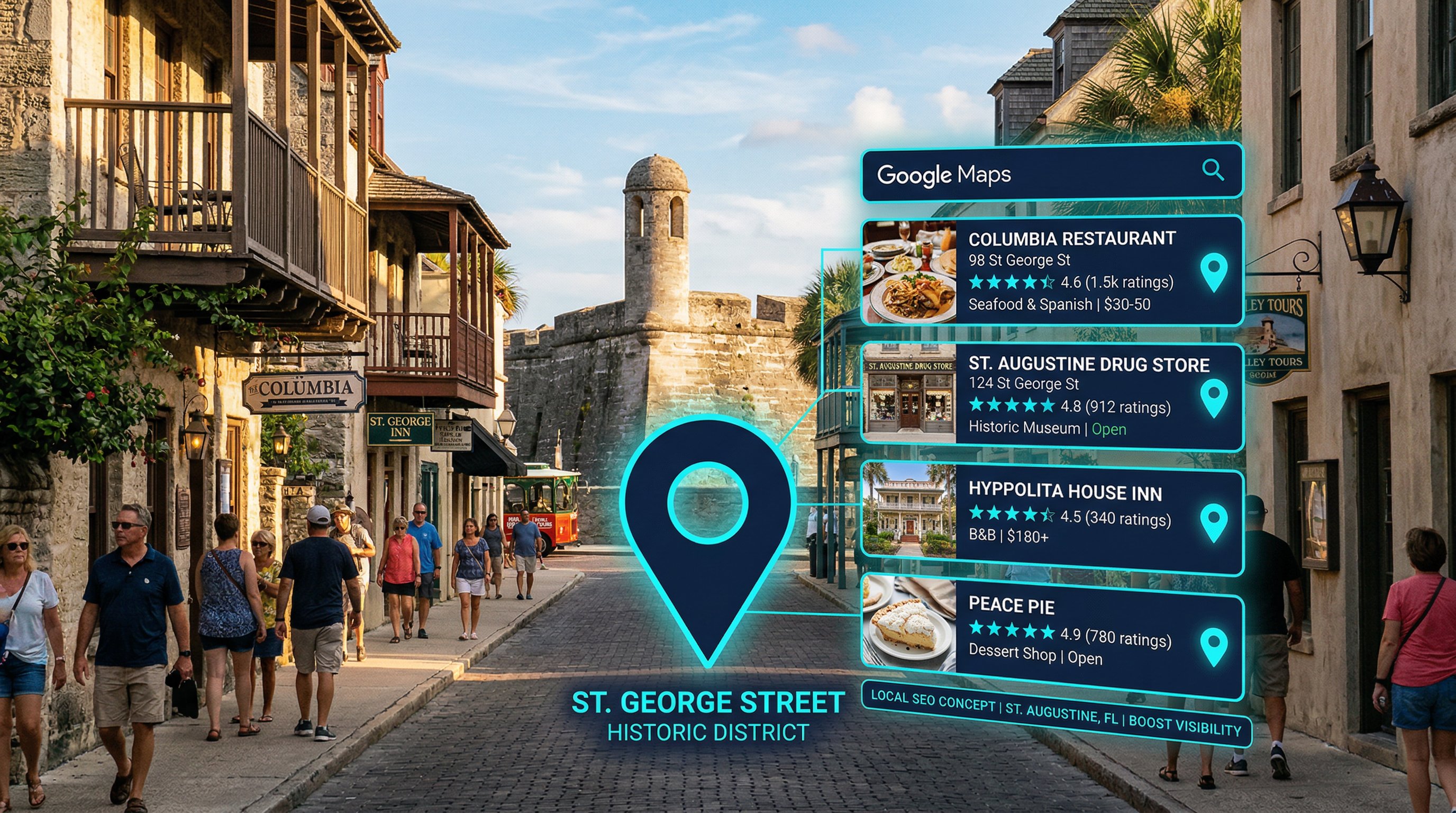
For tourism-facing businesses — restaurants on St. George Street, bed-and-breakfasts in the Historic District, kayak tour operators on Anastasia Island — Google Maps visibility is directly tied to foot traffic and booking volume. When a visitor searching "best restaurant near St. Augustine historic district" sees your listing in the Maps 3-pack, they are already in town and ready to make a decision. Not appearing means sending that customer to a competitor down the street. The conversion rate from Maps impressions to actual visits in tourism corridors routinely exceeds 30%.
For resident-facing businesses — HVAC contractors, dentists, law firms, real estate agents — the St. Johns County market is extraordinarily valuable. The county's median household income is among the highest in Florida, and the Nocatee community alone has added tens of thousands of new households who need every category of local service. These searches happen year-round and carry high purchase intent. A Nocatee-area plumber who ranks in the top three of Google Maps for "plumber Nocatee FL" can build an entire business around that single ranking. Our digital marketing services are built around capturing both of these distinct St. Augustine audiences.
- The Historic District and St. George Street corridor drive tourism-intent searches for dining, lodging, tours, and shopping — peak season is spring and summer.
- Anastasia Island and St. Augustine Beach attract year-round searches for vacation rentals, water sports, and beachside dining.
- Nocatee is the fastest-growing community in St. Johns County and represents the highest concentration of new-homeowner service searches.
- World Golf Village is a premium residential and golf resort community with dense demand for luxury services, professional firms, and high-end dining.
- Ponte Vedra straddles St. Johns and Duval counties, requiring careful geographic targeting to capture both markets effectively.
How to Optimize Your Google Business Profile for St. Augustine
Your Google Business Profile is the single most important piece of digital real estate for local search visibility in St. Augustine. It controls whether you appear in the Maps 3-pack — the box of three local results that appears above the organic search results for location-specific queries. For most service and tourism businesses in St. Augustine, the Maps 3-pack drives more phone calls and direction requests than the entire organic results page combined. Treating your GBP as a static directory listing rather than an active marketing channel is the most common mistake St. Augustine businesses make.
Start with completeness. Fill in every available field: business name (exactly consistent with how it appears everywhere else), address, phone number, website URL, business hours including special holiday hours, all applicable business categories (primary plus up to 9 secondary), and a detailed business description using your most important service and location keywords naturally. For tourism businesses, add specific product and service listings describing each offering. For service businesses, configure your service area to cover all neighborhoods you serve — Historic District, Anastasia Island, Vilano Beach, St. Augustine Beach, World Golf Village, and Nocatee should all be named explicitly.
Activity is equally important as completeness. Google rewards active profiles with higher placement in Maps results. Post to your GBP a minimum of twice per week: one post promoting a service, seasonal offering, or event, and one post featuring a completed job, customer story, or community engagement. Every post should include a high-quality photo and naturally use your target keywords. A Historic District bed-and-breakfast should use phrases like "historic accommodations St. Augustine" and "weekend getaway near Flagler College" to reinforce both service and location relevance in every post.
How many photos should my St. Augustine GBP have?
Aim for 50 or more photos at minimum, with 3-5 new photos added weekly. For tourism businesses, include photos of your location exterior, interior ambiance, signature products or services, and seasonal experiences. For home service businesses, include before-and-after project photos, team shots, and vehicle photos. Profiles with 100+ photos consistently rank higher than those with fewer than 20 images, because Google interprets photo uploads as a signal of business activity and customer engagement.
The Q&A section of your GBP is a frequently overlooked opportunity. You are permitted to ask and answer your own questions on your profile — take full advantage. Add 10-15 questions covering what customers actually ask: your service area (list St. Augustine neighborhoods specifically), pricing ranges, whether you accept walk-ins, parking information near your Historic District location, pet policies for vacation rentals, and any specialties. These Q&A entries appear directly on your Maps listing and improve click-through rates by pre-answering searcher questions before they even visit your website.
- Historic District businesses should specify their address proximity to Flagler College, the Castillo de San Marcos, and the St. Augustine Lighthouse in their GBP description for tourist-intent relevance.
- Anastasia Island businesses benefit from noting their location relative to the St. Augustine Alligator Farm, Butler Beach, and the Anastasia State Park.
- Nocatee-area businesses should explicitly name the Nocatee community in their service area and GBP description to capture the high volume of community-specific searches.
- Businesses serving Vilano Beach should note their ocean access and proximity to the Vilano Town Center to capture both local and visitor searches.
- World Golf Village providers should reference the Slammer & Squire course, the Renaissance resort, and the St. Augustine Outlets proximity for context and relevance.
Targeting Both Tourist and Resident Search Intent
St. Augustine's dual market structure demands a deliberate dual content strategy — and most businesses in the city fail to execute this properly. They either optimize entirely for tourists and miss the stable year-round resident revenue, or they focus on residents and leave high-value tourist traffic on the table. The businesses that consistently win in St. Augustine local search create separate content tracks for each audience, each with distinct keywords, landing pages, and calls to action.
Tourist-intent keywords are characterized by high seasonality, transactional language, and proximity-based phrasing. Searches like "best seafood restaurant St. Augustine historic district," "things to do St. Augustine Beach this weekend," and "hotels near Castillo de San Marcos" represent tourist intent. These searchers are often on mobile, are physically in or near St. Augustine, and will convert quickly. Content targeting tourist intent should emphasize experience, atmosphere, location proximity to landmarks, and urgency around reservation availability or seasonal offerings.
Resident-intent keywords are steadier year-round and typically reflect service-based needs. Searches like "AC repair Nocatee FL," "pediatric dentist World Golf Village," and "estate attorney St. Johns County" represent resident intent. These searchers are evaluating multiple providers before committing, so content targeting resident intent should emphasize expertise, credentials, local experience, and social proof from other St. Johns County customers. AI-powered SEO tools can identify keyword clusters for each audience segment and prioritize which pages to build first based on search volume and competition level.
The most effective approach integrates both strategies under one website architecture. Your homepage targets your primary audience with core city keywords. Secondary service pages drill into specific offerings. Then a content layer of blog posts and neighborhood pages captures the full range of both tourist and resident search queries across St. Augustine's diverse geography. Social media marketing running in parallel to your SEO campaigns reinforces brand awareness with both audiences and supports review generation — a critical local ranking factor.
Building a St. Augustine Citation Foundation
Local citations — online mentions of your business name, address, and phone number (NAP) — form the trust infrastructure that Google uses to verify your business is real, locally established, and accurately represented. For St. Augustine businesses, strong citation coverage across both national and hyper-local directories is essential for competitive local rankings. Without it, even a well-optimized Google Business Profile will plateau in the Maps rankings.
The national foundation includes Yelp, YellowPages, Bing Places, Apple Maps, and the major data aggregators (Data Axle, Localeze, Foursquare) that feed hundreds of smaller directories automatically. Get these right first, because inaccuracies in the aggregators propagate to dozens of downstream directories. Then layer in St. Augustine and St. Johns County-specific sources: the St. Augustine, Ponte Vedra & The Beaches Chamber of Commerce directory, the St. Johns County Economic Development Council listings, the City of St. Augustine business directory, and tourism-oriented platforms like the St. Augustine & St. Johns County Visitors and Convention Bureau.
NAP consistency is absolutely non-negotiable. If your GBP lists "100 Cathedral Place" but your Yelp page lists "100 Cathedral Pl" and your website footer says "100 Cathedral Place Suite 201," those represent three different NAP signatures and Google flags them as a reliability concern. Conduct a full citation audit using BrightLocal or Semrush's listing management tool, find every discrepancy, and fix them before building new citations. One inconsistency can suppress your entire local rankings footprint. Answer engine optimization and schema markup on your website work in tandem with citation consistency to give Google a fully verified, trustworthy picture of your business.
What are the best local citation sources for St. Augustine businesses?
Beyond national directories, St. Augustine businesses should prioritize: St. Augustine, Ponte Vedra & The Beaches Chamber of Commerce, St. Johns County Economic Development Council, the Visitors and Convention Bureau listings, Florida Association of Chamber Professionals directory, community-specific directories for Nocatee (Nocatee.com resident resources), and neighborhood news platforms like St. Augustine Record online business listings. These hyper-local citations carry disproportionate geographic authority for St. Augustine and St. Johns County rankings.
Reviews and Reputation in St. Augustine Local Search
Reviews are one of the three most powerful local ranking factors in Google Maps, and St. Augustine's highly tourism-driven economy makes review volume and quality even more consequential than in purely residential markets. A Historic District restaurant with 1,200 five-star Google reviews will outrank a competitor with 80 reviews in almost every relevant search — regardless of other optimization efforts — because Google interprets that review volume as overwhelming community and visitor endorsement.
The dimensions of reviews that influence rankings include total count, average star rating, review velocity (how consistently new reviews arrive), review recency, your response rate, and the presence of keywords and location names in review text. That last point matters more than most business owners realize. When a customer writes "incredible ghost tour near the Castillo de San Marcos, best experience in St. Augustine," those geographic and service keywords appear directly on your GBP listing and reinforce your local relevance signals to Google's algorithm.
Building a systematic review generation process is the highest-return investment most St. Augustine businesses can make in local SEO. After every completed service or customer interaction, send an automated SMS or email with a direct link to your Google review page. Train staff to ask verbally. Use a CRM platform like Go High Level to automate the follow-up sequence across multiple touchpoints. Businesses with a structured review process generate five to ten times more reviews than those who rely on organic posting, and that volume advantage compounds over time into a dominant local ranking position.
- Tourism businesses should also target TripAdvisor reviews — St. Augustine's large tourist volume makes TripAdvisor a significant secondary traffic source that feeds Google's local knowledge graph.
- Restaurants on St. George Street and the Historic Bayfront should prioritize Yelp reviews alongside Google given Yelp's strong presence in dining search results.
- Vacation rental operators on Anastasia Island and St. Augustine Beach should actively cultivate Airbnb, VRBO, and Google reviews simultaneously for maximum visibility.
- Medical and dental practices in St. Johns County should pursue Healthgrades and Zocdoc reviews in addition to Google for complete coverage of patient search behavior.
- Professional services firms — law offices, financial advisors — near the US-1 corridor should seek Google and industry-specific platform reviews to signal authority in their vertical.
Ready to Dominate St. Augustine Search?
Get a Free SEO & Digital Marketing Strategy
Our Florida marketing experts will audit your online presence and build a custom local SEO growth plan for your St. Augustine business — no obligation, no fluff.
Neighborhood Landing Pages for St. Johns County
Neighborhood-specific landing pages are one of the highest-leverage strategies for St. Augustine businesses with service areas spanning multiple communities. Each dedicated page multiplies the number of local keyword variations you can rank for and dramatically improves your relevance for geographic queries that include specific community names. A landscaping company serving all of St. Johns County should have individual pages for Nocatee, World Golf Village, Palencia, Ponte Vedra, and St. Augustine Beach — not a single generic service area page.
Each neighborhood page must contain genuinely unique content — not boilerplate service descriptions with the city name swapped. What makes a Nocatee page unique: reference the community's master-planned HOA requirements for landscaping and hardscaping, the CDD structure that governs outdoor improvements, the specific plant species that thrive in the coastal St. Johns County soil, and testimonials from Nocatee homeowners. A World Golf Village page discusses the golf course-adjacent properties, the premium landscaping standards expected in the community, and proximity to the World Golf Hall of Fame as a local landmark anchor. This geographic specificity is what converts visitors and signals local authority to Google.
The technical architecture of neighborhood pages matters as much as the content. Each page needs its own title tag including the neighborhood name ("Landscaping Services Nocatee FL"), a unique meta description, an H1 that includes the location, and LocalBusiness schema markup with the specific service area. Internal links from your main service page to each neighborhood page, and from neighborhood pages back to the main service page, create the structured local site hierarchy that Google favors. Professional web design with clean URL structures and fast page load times ensures these pages perform at their full SEO potential.
- Nocatee pages should reference the Crosswater Village Town Center, the community's age-restricted Del Webb section, and the network of nature trails and waterways that characterize the community.
- Palencia pages benefit from noting the intracoastal waterway access, Palencia Club amenities, and the community's A-rated school proximity that attracts young families.
- St. Augustine Beach pages can leverage the Beach Walk boardwalk, the St. Johns County Pier, and the community's mix of vacation rental and permanent resident properties.
- Vilano Beach is a distinct community from St. Augustine proper — businesses serving this area should create a separate Vilano Beach page rather than lumping it into generic St. Augustine content.
- Hastings and Elkton represent rural St. Johns County markets with less competition — businesses willing to create content for these areas can capture uncontested local search traffic.
On-Page Local SEO Signals That Drive Rankings
On-page local SEO signals are the website-side elements that explicitly tell Google you are a locally operating St. Augustine business. The most impactful on-page factors are: your primary keyword and city name in the title tag of every key page, LocalBusiness schema markup with complete and accurate NAP data, an embedded Google Map on your contact page, and a physical address displayed in your website footer on every page. These elements work together to create a consistent geographic identity that Google can verify against your GBP and citation profiles.
Title tags are the single highest-weight on-page signal for local search. Your homepage title should include your primary service and location clearly: "HVAC Company St. Augustine FL | [Business Name]" or "[Business Name] — Plumbing Services St. Augustine & St. Johns County." Including "St. Johns County" alongside "St. Augustine" captures both the city-level and county-level searches that represent different geographic intent. Many St. Augustine businesses only target the city name and miss the substantial volume of county-level searches. Strong SEO services include complete title tag optimization across every page of your site.
Schema markup is a technical implementation that deserves special attention for St. Augustine businesses, particularly those in tourism. LocalBusiness schema on your homepage establishes your basic business identity. TouristAttraction or FoodEstablishment schema on relevant pages tells Google specifically what type of business you are and what intent it should match you to. For restaurants, Restaurant schema with cuisine type, priceRange, and servesCuisine fields directly influences which discovery searches you appear for. Use Google's Rich Results Test tool to verify all schema is implemented correctly after any change. Our AI automation tools can audit and update schema markup at scale across multi-page websites.
Local Backlink Building in St. Augustine
Local backlinks — links from other St. Augustine and St. Johns County websites to your site — are among the strongest signals Google uses to determine your geographic authority. A link from the St. Augustine, Ponte Vedra & The Beaches Chamber of Commerce carries dramatically more local ranking weight than a link from a generic national business directory, because it is a geographically relevant, locally authoritative source confirming your business belongs in the St. Augustine ecosystem.
The most productive local link sources for St. Augustine businesses: join and secure a listing on the Chamber of Commerce; sponsor local events at Flagler College, the St. Augustine Amphitheatre, or community festivals like the Nights of Lights or the Rhythm & Brews series to earn sponsor page links; get featured in St. Augustine Record articles or St. Augustine Social press coverage; and partner with complementary local businesses for cross-linking opportunities. A vacation rental manager and a kayak tour operator, for example, can naturally link to each other as recommended local experiences for visitors. PPC management campaigns running alongside link building efforts can accelerate overall search visibility during the time it takes organic rankings to respond to new links.
Tourism associations represent a unique link building opportunity specific to St. Augustine. The St. Augustine & St. Johns County Visitors and Convention Bureau, Florida Tourism, and the Florida Restaurant & Lodging Association all maintain member directories that represent authoritative, topically relevant backlinks for tourism-adjacent businesses. Getting listed on Visit St. Augustine's official tourism site is a highly coveted link that carries both direct referral traffic and significant local SEO authority. Press releases about business milestones, new offerings, or community involvement distributed to local media outlets are a repeatable link earning strategy that also builds brand awareness in the St. Johns County market.
Tracking and Measuring Local SEO Results
Tracking local SEO performance in St. Augustine requires monitoring several data sources simultaneously, because local search impacts manifest differently across different platforms. The minimum measurement stack: Google Business Profile Insights for Maps-specific performance data, Google Search Console for organic keyword performance, Google Analytics 4 for traffic and conversion trends, and a rank tracking tool that monitors your Google Maps 3-pack position for priority keywords across different neighborhoods in St. Johns County.
GBP Insights provides the most direct window into local SEO health. The key metrics to monitor weekly: profile impressions (how often your listing appeared), direction requests (the highest-intent action — someone actively navigating to you), calls from Maps, and website clicks. A seasonal business in the Historic District should expect dramatic swings in these metrics from winter to spring — that context is critical for interpreting performance data correctly. A flat February followed by a strong March is a normal pattern, not an SEO problem.
For tourism-facing businesses, tracking rankings in both Google Maps and organic results for a blend of tourist-intent and resident-intent keywords is essential. A downtown St. Augustine restaurant needs to rank for "best restaurants St. Augustine FL" (tourist intent) as well as "dinner near Flagler College" (proximity intent) and "St. Augustine seafood restaurant" (category intent). Tracking all three clusters gives you a complete picture of where you are capturing search demand and where you have gaps to close. AI SEO platforms can automate rank tracking across large keyword sets and surface the opportunities with the greatest revenue potential for your specific business model.
For a complete overview of our SEO services in St. Augustine, visit our dedicated SEO Agency in St. Augustine, FL page.
Frequently Asked Questions
Common questions about local SEO from St. Augustine and St. Johns County business owners.
How long does local SEO take to work in St. Augustine?
Most St. Augustine businesses see meaningful movement in Google Maps rankings within 60-90 days of consistent local SEO work. Competitive niches like vacation rentals, HVAC, and legal services typically take 4-6 months to fully dominate. The timeline depends on your Google Business Profile completeness, citation volume, and how actively you generate reviews compared to competitors in the St. Johns County market.
What makes local SEO in St. Augustine different from other Florida cities?
St. Augustine has a uniquely dual economy: a year-round local population in St. Johns County and a massive tourism economy centered on the Historic District, St. Augustine Beach, and Anastasia Island. Businesses must optimize for both resident searchers and tourist intent queries. Additionally, the proximity to Nocatee and World Golf Village means competing for fast-growing suburban search volume alongside historic downtown keywords.
How much does local SEO cost for a St. Augustine business?
Local SEO services for St. Augustine businesses typically range from $497 to $2,497 per month depending on your niche competitiveness and scope of work. Businesses in tourism-heavy verticals like hospitality, dining, and attractions typically require more investment than service businesses targeting the residential St. Johns County market. Most local businesses see strong ROI starting at the $997 per month level.
Should St. Augustine businesses target tourist or resident search traffic?
Both, but with separate strategies. Tourist traffic peaks in spring and summer and centers on Historic District keywords, attraction searches, and dining near St. George Street. Resident and year-round traffic is more stable and covers home services, professional services, medical, and retail. The most effective St. Augustine SEO strategies create separate content clusters for each audience segment rather than trying to serve both with the same pages.
Do I need a physical address in St. Augustine to rank there?
A physical St. Augustine address is a strong local ranking signal, but service-area businesses can rank without a storefront by setting their Google Business Profile service area to include St. Johns County and surrounding zip codes. The key is to have consistent NAP data, strong reviews from St. Augustine customers, and local citations from St. Johns County business directories to establish geographic relevance.
What neighborhoods should I target for local SEO in St. Augustine?
St. Augustine's highest-value neighborhoods for local SEO include the Historic District, Anastasia Island, Vilano Beach, St. Augustine Beach, World Golf Village, Nocatee, Ponte Vedra, and Palencia. Nocatee in particular has exploded in population and represents a fast-growing search market for home services, pediatric care, restaurants, and retail. Businesses should create dedicated location pages for each major area they serve.
Related Posts
Start Growing Today
Your St. Augustine Competitors Are Investing in SEO.
Are You?
Search Scale AI delivers measurable results for Florida businesses. Let's build your custom local SEO strategy and start driving real leads within 90 days.
No contracts. No BS. Just results.