How St. Augustine Businesses Can Dominate Google Maps in 2026
By Search Scale AI Team · April 8, 2026 · 11 min read
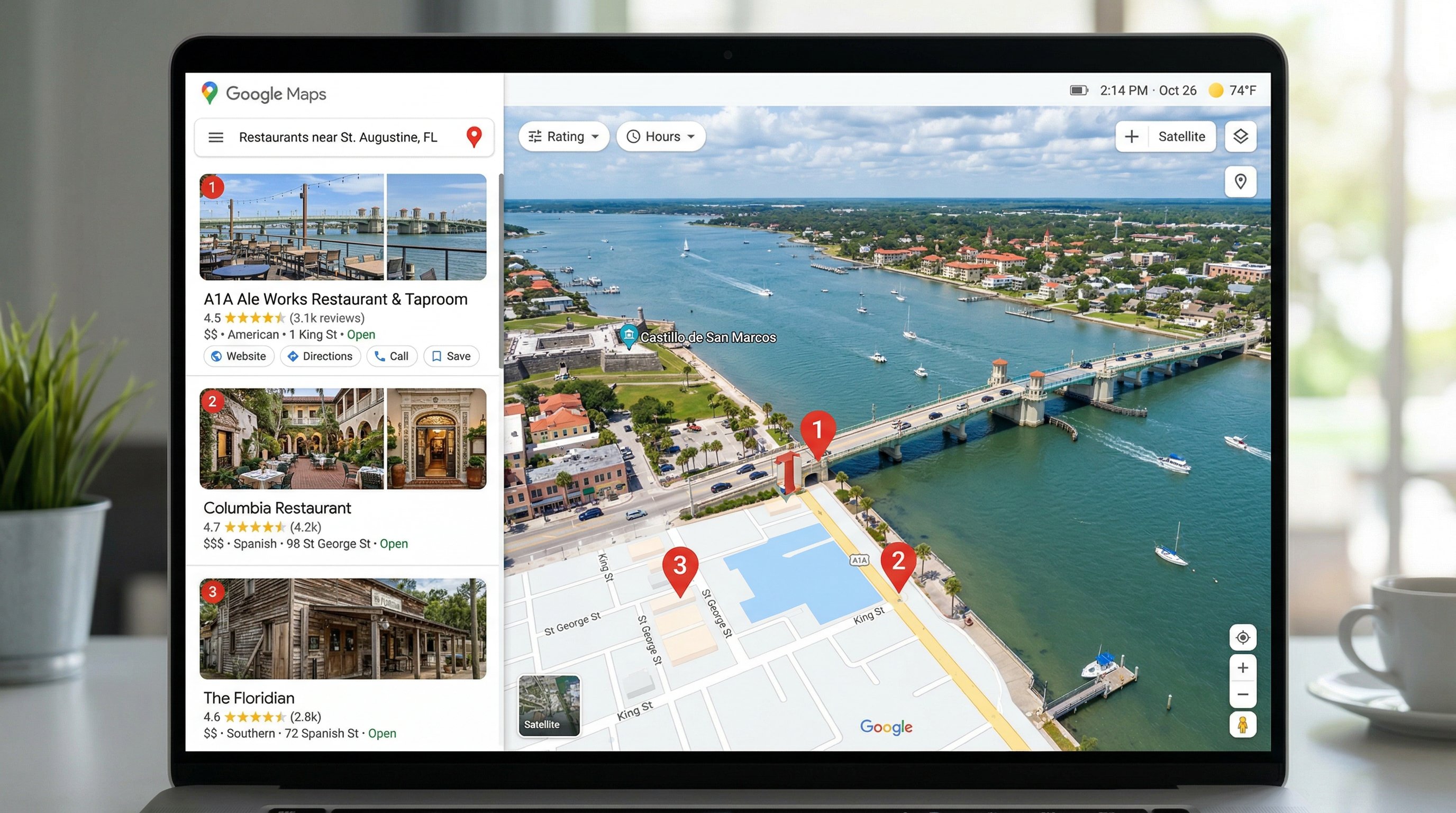
Quick Answer
Dominating Google Maps in St. Augustine requires winning on three fronts simultaneously: a fully optimized and actively managed Google Business Profile, a high volume of recent five-star reviews that outpaces every competitor in your category, and consistent local SEO signals across your website and citation network. St. Augustine's competitive tourism-driven market means the bar is higher than in smaller Florida markets — but most local businesses are still doing the basics poorly, which means focused execution delivers outsized results.
Key Takeaways
- The Google Maps 3-pack drives the majority of local search conversions — being outside it means near-invisibility for most purchase-intent queries.
- Google Business Profile completeness and activity are the single highest-leverage factors for Maps visibility in St. Augustine.
- Review velocity — generating new reviews consistently every week — separates top-ranked businesses from page-two competitors in every St. Augustine niche.
- Maps rankings vary by searcher location, so businesses serving multiple St. Augustine neighborhoods need neighborhood-specific content and service area settings.
- NAP consistency across all directories is foundational — a single inconsistency can actively suppress Maps rankings.
- Local backlinks from St. Johns County sources give Google geographic confidence signals that boost Maps placement.
- Photo volume and upload frequency are measurable GBP signals that correlate directly with higher Maps rankings.
Table of Contents
- How Google Maps Rankings Work in St. Augustine
- Completing Your Google Business Profile for Maximum Impact
- Choosing the Right Business Categories for St. Augustine
- Photo Strategy: How Images Drive Maps Rankings
- Building a Review Machine for St. Augustine Businesses
- Citation Consistency and Geographic Trust
- Proximity, Relevance, and Prominence Explained
- Ranking Across Multiple St. Augustine Neighborhoods
- Measuring Google Maps Performance
- Frequently Asked Questions
How Google Maps Rankings Work in St. Augustine
Google Maps rankings are determined by three core factors that Google calls proximity, relevance, and prominence. Proximity is how close your physical location is to the searcher. Relevance is how well your business profile matches what the searcher is looking for. Prominence is how well-known and trusted your business is online — measured through reviews, citations, backlinks, and website authority. Understanding how these three factors interact in St. Augustine's specific geographic and competitive context is the foundation of any effective Maps strategy.
Proximity matters most for searches that include "near me" or are conducted without a specific location modifier. A searcher standing on St. George Street who types "coffee shop near me" will see results biased toward shops within walking distance of their current location. This is why businesses on the San Marco Avenue corridor may not appear for searches conducted in Davis Shores, even though both are within St. Augustine city limits. The implication: businesses serving multiple St. Augustine neighborhoods need SEO services that optimize for geographic reach beyond their immediate physical location.
Relevance is controlled primarily through your Google Business Profile — specifically, your business categories, business description, services listed, and the content of your posts and Q&A entries. A restaurant that lists "Seafood Restaurant" as its primary category with "Florida seafood dining" in its description will rank for different queries than one that lists "American Restaurant" with no description. Getting categories and descriptions exactly right is a precision exercise that many St. Augustine businesses have never revisited since setting up their GBP years ago.
Prominence is the most complex factor and the one that takes the most time to build. It encompasses your total review count and star rating, your citation footprint across local directories, the number and quality of local backlinks to your website, and the overall authority of your web presence. For tourism businesses in St. Augustine's Historic District and Cathedral Parish, prominence is heavily influenced by TripAdvisor rankings and local press mentions alongside Google-specific signals. Our digital marketing services include comprehensive prominence building strategies tailored to St. Augustine's unique market dynamics.
- San Marco Avenue businesses are well-positioned for searches from the I-95 corridor approaching the city — an important capture point for first-time visitors.
- Cathedral Parish and downtown businesses benefit from the highest foot traffic but face the most competitive Maps environment in St. Augustine.
- Davis Shores businesses on Anastasia Island have a distinct geographic proximity advantage for searches conducted in and around the island communities.
- Lincolnville's historic residential and commercial character creates niche opportunities for businesses targeting St. Augustine's arts, culture, and culinary scene.
- The Flagler Hospital area near Lewis Point Road is a distinct healthcare cluster with concentrated medical and professional service search traffic.
Completing Your Google Business Profile for Maximum Impact
A complete Google Business Profile is the prerequisite for Maps visibility — Google simply cannot confidently rank an incomplete profile for competitive queries. Audit every section of your GBP against this checklist: business name (consistent with all other online presence), address (service area configured if no public storefront), phone number (local St. Augustine number preferred over toll-free), website URL, primary and secondary categories, business description (750 characters, use keywords naturally), attributes, products or services with descriptions and photos, booking link if applicable, and full business hours including any special holiday hours.
The business description is where most St. Augustine businesses underinvest. You have 750 characters — use them. A description for a Historic District bed-and-breakfast might read: "St. Augustine's most intimate bed and breakfast, steps from the Castillo de San Marcos and St. George Street. Our 1890s Victorian inn offers eight uniquely appointed rooms with authentic period decor, gourmet breakfast service, and personalized local tours. Located in the heart of the Historic District, we serve travelers from across the country seeking an authentic Old Florida experience." That description is keyword-rich, location-specific, service-descriptive, and differentiating — exactly what Google needs to match your profile to relevant searches.
Posts are one of the most underused features of the GBP platform and one of the most direct activity signals Google uses in Maps ranking algorithms. Every St. Augustine business should post a minimum of twice per week. For tourist-facing businesses, this means posting about current events near your location — Nights of Lights photos in December, spring break specials in March, summer tours in July — content that's timely, local, and visually compelling. For service businesses, post completed project highlights, team introductions, and seasonal service reminders. Each post reinforces that your business is active, locally engaged, and trustworthy. AI automation tools can generate and schedule GBP posts in bulk, keeping your posting cadence consistent without manual effort every week.
What GBP features are most important for St. Augustine tourism businesses?
Tourism businesses in St. Augustine should prioritize: the Products section to list specific tours, experiences, or menu items; the Booking button integration with your reservation system; the Questions and Answers section pre-populated with 10+ common visitor questions about location, parking, and policies; and seasonal photo uploads showing your space during St. Augustine's signature events like Nights of Lights, the Lighted Boat Parade, and the Rhythm & Brews Festival. These features collectively increase both Maps visibility and the click-through rate from Maps listings to bookings.
Choosing the Right Business Categories for St. Augustine
Business category selection in Google Business Profile is one of the highest-leverage, lowest-cost optimizations available for Maps rankings — and it is routinely done incorrectly by St. Augustine businesses. Your primary category tells Google the single most important thing about what type of business you are. Your secondary categories (up to 9) expand the range of searches your profile is eligible to appear for. Choose wrong categories and you will be invisible for your most valuable searches regardless of how strong the rest of your profile is.
For St. Augustine's diverse business landscape, category selection requires research into exactly what categories top-ranked competitors are using. A bed-and-breakfast in the Historic District should use "Bed and breakfast" as primary, not "Hotel" — the distinction matters for matching to the searcher intent of people specifically looking for intimate accommodations. A restaurant on Aviles Street should choose the most specific food-type category available ("Seafood Restaurant" or "Florida Restaurant") rather than the generic "Restaurant" category, which is a weaker relevance signal.
Secondary categories should be chosen to capture every legitimate service variation your business provides. A St. Augustine vacation rental company might use primary category "Vacation Home Rental Agency" with secondary categories including "Property Management Company," "Real Estate Agency," and "Concierge Service" if applicable. Each additional relevant category expands the query space your GBP can appear for without diluting your primary category signal. Research your top Maps competitors, identify what categories they are using, and ensure your GBP includes every applicable category they have. Answer engine optimization through structured data on your website reinforces whatever category signals your GBP sends to Google's local algorithm.
Photo Strategy: How Images Drive Maps Rankings
Photo volume and upload frequency on Google Business Profile are measurable signals that correlate directly with higher Maps rankings across virtually every business category in St. Augustine. Google interprets active photo uploads as evidence of business vitality and customer engagement. A GBP with 20 photos last updated two years ago signals stagnation. A GBP with 150 photos updated weekly signals an active, thriving business — and Google rewards that signal with better Maps placement.
The minimum photo target for any St. Augustine business competing for Maps visibility is 50 photos to start, with an ongoing cadence of 3-5 new photos uploaded weekly. Categories to cover include: exterior shots from the street and parking areas (critical for tourist-facing businesses so visitors can recognize your location), interior ambiance photos, team and staff photos, product and service photos (food shots for restaurants, project photos for contractors, before/after for service businesses), and action photos showing the business actively operating. For Lincolnville and historic neighborhood businesses, architectural and character photos of your building context add local authenticity that resonates with visitors researching the area.
Encourage customers to upload their own photos to your GBP listing as well. Customer photos generate a separate trust signal from owner-uploaded photos and often feature real experiences that convert hesitant searchers. A tour company on St. Augustine Beach with 200 customer-uploaded photos showing happy visitors on kayaks will consistently outperform a competitor with 200 owner-uploaded promotional shots. Include a request for photo uploads in your post-service review request sequence. Tools like Go High Level can automate personalized follow-up messages that drive both review submissions and photo uploads from satisfied customers.
Building a Review Machine for St. Augustine Businesses
Reviews are the most visible trust signal in Google Maps and one of the most powerful ranking factors for local search in St. Augustine. The volume, recency, quality, and keyword content of your reviews directly influence both your position in the Maps 3-pack and your click-through rate once you appear there. A listing showing 4.9 stars across 350 reviews simply attracts more clicks than a listing showing 4.2 stars across 40 reviews — every time, regardless of business quality.
Review velocity — the rate at which new reviews arrive — is as important as total review count. Google's algorithm favors businesses that consistently accumulate new reviews over those with high historical totals but few recent additions. A St. Augustine restaurant that gets 5 new Google reviews per week will outperform one with 500 total reviews but only 2 new reviews per month. Building a systematic review process means making review requests a non-optional part of your customer service workflow, not an occasional reminder.
The most effective review generation systems for St. Augustine businesses combine multiple touchpoints: an automated SMS within one hour of service completion (the highest conversion moment), a follow-up email 48 hours later for non-responders, and verbal requests from staff at the point of handoff. Every request should include a direct link to your Google review page — removing friction from the review process dramatically increases completion rates. Pay-per-click campaigns can drive targeted traffic to your Maps listing in the short term while your organic review volume builds — a useful bridge strategy for businesses entering competitive St. Augustine markets.
- Historic District tourism businesses should also request TripAdvisor reviews — TripAdvisor signals feed into Google's local knowledge graph and drive significant incremental traffic.
- Responding to every review within 24 hours — both positive and negative — signals to Google that your business is actively managed and responsive to customers.
- Encourage customers to mention specific services, their neighborhood, and the experience details in reviews — keyword-rich reviews reinforce your local relevance signals.
- Never offer incentives for reviews — it violates Google's guidelines and can result in penalties that remove existing reviews from your profile.
- Negative reviews should receive professional, empathetic responses — how you handle criticism is itself a trust signal that prospective customers evaluate before choosing a business.
Ready to Dominate Google Maps in St. Augustine?
Get a Free Local SEO & Maps Strategy Session
Our Florida marketing experts will audit your Google Business Profile and build a custom Maps domination plan for your St. Augustine business — no obligation required.
Citation Consistency and Geographic Trust
Citations — online mentions of your business name, address, and phone number — create the geographic trust infrastructure that Google uses to verify your business is real, locally established, and accurately represented. For Maps rankings specifically, citation consistency is more important than citation volume: 30 perfectly consistent citations outperform 100 inconsistent ones. A single transposed digit in your phone number appearing on a major directory can create enough uncertainty in Google's verification algorithm to suppress your Maps ranking.
Conduct a complete citation audit before building new listings. Use BrightLocal or Moz Local to find all existing mentions of your business online and flag every inconsistency in name, address, or phone format. Fix existing inconsistencies first — this alone often produces a measurable Maps ranking improvement within 30-45 days for businesses with many legacy citation errors. Then build new citations in priority order: national aggregators (Data Axle, Localeze, Foursquare), major directories (Yelp, YellowPages, Bing Places, Apple Maps), then St. Johns County and St. Augustine-specific directories.
St. Augustine-specific citation sources with strong local authority include the St. Augustine, Ponte Vedra & The Beaches Chamber of Commerce, the St. Johns County government business directory, Visit St. Augustine's business listings, the Florida Attraction Association for tourism businesses, and neighborhood community platforms like the Davis Shores Community Association website and Nocatee resident platforms. Each hyper-local citation adds a geographic specificity signal that national directories cannot replicate. Pair citation building with professional web design that includes properly formatted schema markup on every page to give Google a fully corroborated picture of your business identity and location.
Proximity, Relevance, and Prominence Explained
The three factors driving Google Maps rankings in St. Augustine — proximity, relevance, and prominence — each require different tactics to influence and reward different types of effort. Proximity is mostly fixed by your physical location and cannot be changed without moving your business. Relevance is optimized through GBP categories, descriptions, and website content. Prominence is built over months through reviews, citations, backlinks, and consistent online activity. Understanding which factor is limiting your current rankings tells you exactly where to focus your effort.
Businesses in lower-traffic areas of St. Augustine — such as the US-1 corridor north of downtown or Hastings — can partially compensate for reduced proximity by maximizing relevance and prominence. When proximity cannot be the primary ranking driver, your GBP must be so thoroughly optimized and your review profile so clearly dominant that Google's relevance and prominence calculations overcome the proximity disadvantage for searchers who are not physically adjacent to your location. This is achievable for most business categories with sustained effort over 3-6 months.
Prominence building is the long game of Google Maps SEO, and it encompasses more than just reviews. Every high-quality local backlink to your website, every St. Johns County citation, every press mention, and every piece of locally-relevant content on your website contributes to the prominence signal Google uses to determine how well-established and trustworthy your business is. AI-powered SEO tools can identify the specific prominence gaps between your profile and the top-ranked competitors in your Maps category — giving you a prioritized action list rather than a generic optimization checklist. For businesses in Jacksonville looking at the broader Northeast Florida market, our Jacksonville FL digital marketing team can extend these strategies across the full First Coast region.
Ranking Across Multiple St. Augustine Neighborhoods
Google Maps rankings are location-sensitive, meaning a business physically located in the Cathedral Parish neighborhood of downtown St. Augustine will have a proximity advantage for searches conducted there, but a proximity disadvantage for searches conducted in Davis Shores, Anastasia Island, or the US-1 corridor. For businesses with service areas spanning multiple St. Augustine communities, ranking broadly across the market requires deliberate neighborhood targeting strategies that go beyond simply claiming a wide service area in GBP settings.
The most effective neighborhood expansion strategy combines three elements: service-area configuration in GBP (explicitly naming Anastasia Island, St. Augustine Beach, Vilano Beach, and other communities in your service area), neighborhood-specific landing pages on your website (each targeting the distinct local keywords for that community), and locally sourced reviews from customers in each target neighborhood. When a customer from Vilano Beach leaves a review mentioning their neighborhood, that geographic keyword appears on your GBP and reinforces your relevance for searches conducted from that area.
For businesses serving both the tourist corridor and St. Johns County residential communities, a split strategy makes sense. Create separate service page clusters on your website — one cluster targeting tourism-intent searches centered on the Historic District and St. George Street keywords, another targeting residential service searches centered on community names like Nocatee, Palencia, and World Golf Village. This structure allows you to rank in Maps for tourist-intent searches during peak season while maintaining steady residential service search visibility year-round. Our Orlando, Tampa, and Miami digital marketing teams use similar multi-neighborhood strategies in larger Florida markets with comparable results.
Measuring Google Maps Performance
Measuring Google Maps performance requires looking beyond traditional website analytics, because most of the value generated by Maps rankings never touches your website. Calls placed directly from Maps listings, direction requests, and clicks on your Maps listing to visit your storefront all represent conversion actions that Google Analytics 4 cannot track without additional configuration. The primary measurement tool for Maps performance is Google Business Profile Insights — the native analytics dashboard within your GBP account.
The GBP Insights metrics to monitor weekly: search impressions (how many times your profile appeared in search results), Maps views, phone calls initiated from your profile, direction requests (the highest-intent action indicating someone is physically coming to your location), and website clicks from GBP. For St. Augustine tourism businesses, track these metrics with seasonal context — direction requests should spike dramatically from March through September and dip in winter. For service businesses in residential communities like Nocatee, expect steadier month-over-month trends with smaller seasonal variations.
Supplement GBP Insights with a Maps-specific rank tracker. Tools like BrightLocal, Local Falcon, and Grid My Business allow you to track your Maps 3-pack position for specific keywords from specific geographic points within St. Augustine — a capability GBP Insights does not provide. Checking your rank from the Cathedral Parish, Anastasia Island, and Nocatee areas simultaneously shows you exactly how your Maps visibility varies across the market and where you have the most ground to gain. Call tracking through a platform like CallRail adds the final attribution layer, connecting Maps impressions to actual phone calls and ultimately to booked revenue. Combine these tools with your broader digital marketing services reporting for a complete picture of how Maps rankings contribute to your total marketing ROI.
For a complete overview of our SEO services in St. Augustine, visit our dedicated SEO Agency in St. Augustine, FL page.
Frequently Asked Questions
Common questions about Google Maps SEO from St. Augustine and St. Johns County business owners.
Why does my St. Augustine business not appear in Google Maps?
The most common reasons St. Augustine businesses don't appear in Google Maps include: an unclaimed or incomplete Google Business Profile, NAP inconsistencies between your GBP and website, too few reviews compared to competing businesses, insufficient local citations, and incorrect or missing business categories. Start by claiming your GBP, completing every field, fixing NAP consistency across all directories, and implementing a systematic review generation process.
How do I get my St. Augustine business into the Maps 3-pack?
Reaching the Google Maps 3-pack in St. Augustine requires optimizing three core areas simultaneously: your Google Business Profile (completeness, activity, photos, posts), your review profile (volume, velocity, and keyword-rich review text), and your local authority (citations, backlinks, and on-page local signals). The businesses consistently in the top three are doing all three well — most competitors are neglecting at least one area, which is your opportunity.
Does Google Maps ranking vary by neighborhood in St. Augustine?
Yes, Google Maps rankings are heavily influenced by the searcher's physical location. A business on San Marco Avenue will rank higher for searches conducted near San Marco than for searches conducted near St. Augustine Beach. This is why businesses serving multiple St. Augustine neighborhoods need neighborhood-specific landing pages, service area settings, and local content — to maintain relevance across the full geographic area they serve.
How many reviews does a St. Augustine business need to rank in Maps?
The review threshold for the Maps 3-pack varies by niche and how competitive that category is in St. Augustine. In less competitive service categories, 25-50 reviews with a 4.5+ star rating may be sufficient. In competitive categories like dining on St. George Street, HVAC, or legal services, top-ranked businesses often have 200-500+ reviews. More important than hitting a specific number is review velocity — getting new reviews consistently every week signals an active, trustworthy business.
Can I rank in Google Maps without a storefront in St. Augustine?
Yes. Service-area businesses (plumbers, HVAC technicians, landscapers, cleaning services) can rank in Google Maps without a public-facing storefront by configuring their GBP as a service-area business and setting St. Johns County as their service area. You should hide your home address in GBP settings to comply with Google's guidelines for home-based businesses, and instead focus on reviews, citations, and service-area content to establish geographic relevance.
How often should I post to my Google Business Profile in St. Augustine?
Post to your Google Business Profile at least twice per week to maintain the activity signals that influence Maps rankings. For St. Augustine tourism businesses, post more frequently during peak tourist season (spring break through Labor Day) when competition for Maps visibility intensifies. Each post should include a photo, a call to action, and naturally incorporate your target keywords and neighborhood names.
Related Posts
Start Growing Today
Your St. Augustine Competitors Are Climbing the Maps Rankings.
Are You?
Search Scale AI builds custom Google Maps domination strategies for Florida businesses. Let's audit your GBP and start driving real leads within 90 days.
No contracts. No BS. Just results.