The Complete Google Business Profile Guide for St. Augustine Companies
By Search Scale AI Team · April 8, 2026 · 13 min read
Quick Answer
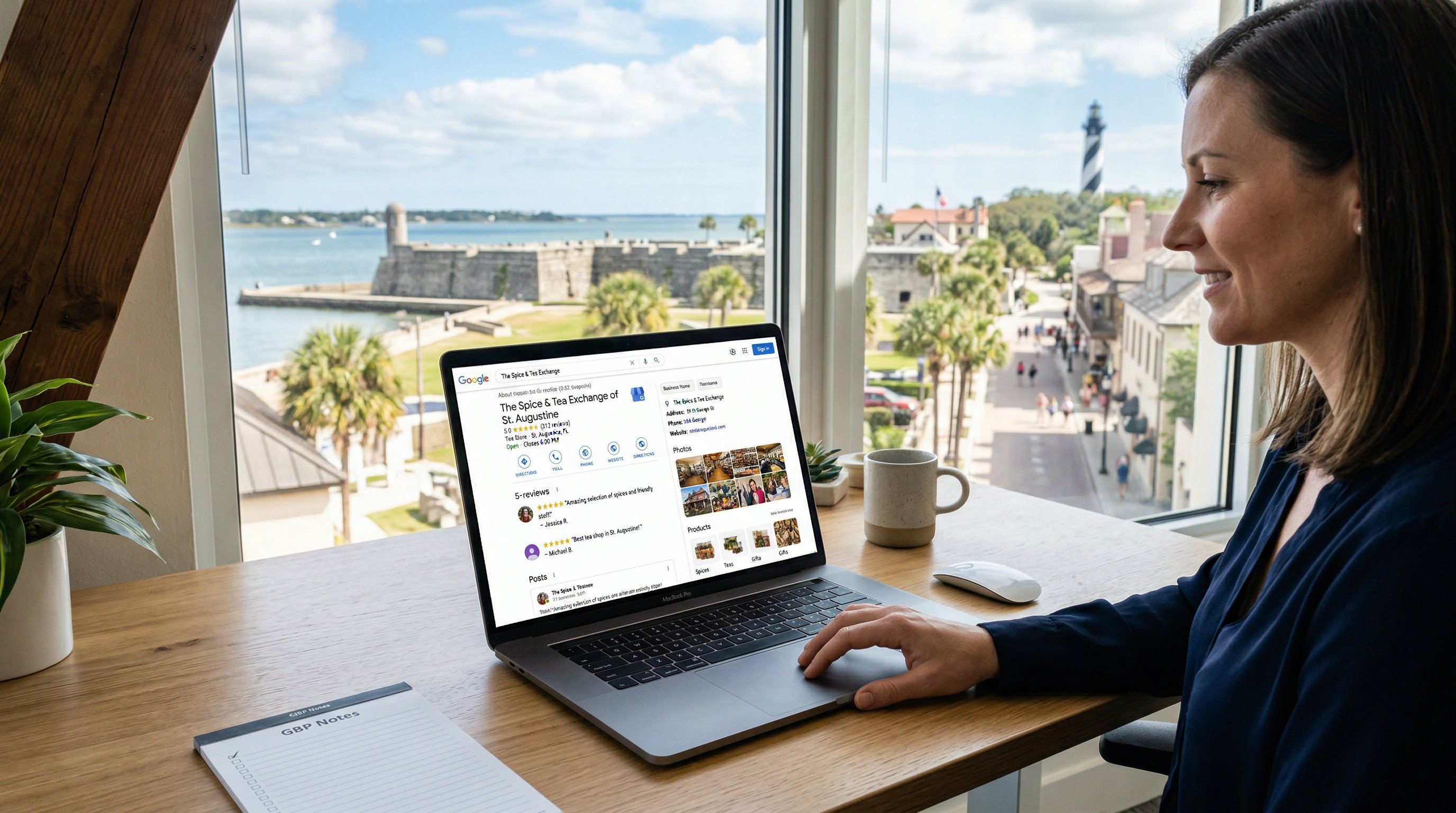
Google Business Profile is the most powerful free marketing tool available to St. Augustine and St. Johns County businesses — and most local companies are using it at 20% of its potential. A fully optimized GBP controls your Google Maps visibility, your Knowledge Panel display in search results, your review aggregate, and the first impression every potential customer forms before visiting your website. This guide covers every GBP feature — from initial setup and verification through advanced optimization tactics specific to St. Augustine's tourism and residential market dynamics — to help you turn your GBP into a consistent lead generation asset. Proper local SEO starts here.
Key Takeaways
- Google Business Profile is free and represents the highest ROI per hour of any digital marketing activity for St. Augustine small businesses.
- Most St. Augustine businesses have incomplete GBPs — fixing gaps in categories, descriptions, and attributes delivers immediate ranking improvements.
- GBP posts expire after seven days — a consistent twice-weekly posting schedule is the minimum for maintaining activity signals.
- The Q&A section allows you to pre-populate your own questions and answers, directly improving Maps listing click-through rates.
- Service-area businesses serving Downtown, US-1 corridor, SR-16, World Golf Village, Nocatee, and Ponte Vedra should configure their GBP service area to name each community explicitly.
- Photo upload frequency is a measurable GBP ranking signal — 3-5 new photos per week consistently outperforms bulk uploads done monthly.
- Review responses within 24 hours signal active business management and directly influence both rankings and customer conversion decisions.
Table of Contents
- Why Google Business Profile Is the Foundation of Local Search
- Setting Up and Verifying Your St. Augustine GBP
- Choosing Categories for Maximum Relevance
- Writing a Description That Ranks and Converts
- Configuring Service Area for St. Johns County Coverage
- Photo Strategy: Upload Frequency, Types, and Quality
- GBP Posts: The Weekly Activity Signal Most Businesses Ignore
- Q&A: The Underused GBP Feature That Converts Browsers to Buyers
- Review Management: Generation, Response, and Damage Control
- Reading GBP Insights to Guide Your Local SEO Strategy
- Frequently Asked Questions
Why Google Business Profile Is the Foundation of Local Search
Google Business Profile (GBP) — formerly called Google My Business — is the dashboard through which you control how your business appears across Google Search and Google Maps. It is the source of the information in your Maps listing, your Knowledge Panel, your review aggregate display, and the business data that appears when someone searches your company name directly. For St. Augustine businesses, GBP is not optional infrastructure — it is the primary customer acquisition interface for local search, which is where the majority of purchase decisions in service, retail, and hospitality categories begin.
The impact of GBP on local business revenue is direct and measurable. Businesses in the Google Maps 3-pack — the top three results shown on the map for local search queries — typically capture 70-80% of the click-through traffic for that query. A St. Augustine HVAC company in the Maps 3-pack for "AC repair St. Augustine" will receive dramatically more phone calls than a company with position 4-7 in the same search, and vastly more than companies ranking on page two. That difference in call volume translates directly to booking revenue — making GBP optimization one of the highest-return activities a St. Augustine business can invest in.
Most St. Augustine businesses have claimed their GBP at some point, filled in a few basic fields, and then ignored it. The optimization gap between a minimally claimed profile and a fully optimized, actively managed one is enormous — and closing that gap is where the competitive advantage lies. SEO services that include comprehensive GBP management consistently produce faster local ranking results than SEO approaches that focus only on website optimization while neglecting the GBP. Our digital marketing services treat GBP as the cornerstone of every St. Augustine local marketing strategy we build.
Setting Up and Verifying Your St. Augustine GBP
If you have not yet claimed your Google Business Profile, start at business.google.com. Search for your business name and address — Google may have created an unverified listing for your business already based on data from other sources. If an existing listing exists, claim it. If not, create a new profile from scratch. The setup process asks for your business name, category, address (or service area for mobile businesses), phone number, website, and business hours. Fill in every field accurately during setup — you can always add more details later, but starting with accurate basics prevents the NAP inconsistencies that suppress rankings.
Verification is required before your GBP listing becomes visible in Google Maps and Search. The most common verification method for St. Augustine businesses is postcard verification — Google mails a postcard with a 5-digit PIN to your business address, which you then enter in your GBP account to confirm your physical presence at that location. Postcard delivery typically takes 5-14 days. Some businesses qualify for phone or email verification, which is faster. During the verification waiting period, continue completing your profile — you cannot post or edit your business information after submission until verification is complete, but you can prepare your photos, post drafts, and Q&A content to publish immediately after verification.
Home-based service businesses in Nocatee, World Golf Village, the SR-16 corridor, and other St. Johns County communities should select "I deliver goods and services to my customers" during setup and configure a service area rather than displaying a home address. This is the correct GBP configuration for businesses like mobile mechanics, house-cleaning services, landscapers, and independent consultants. Once configured as a service-area business, you set your geographic coverage by entering the communities, cities, or zip codes you serve — and those service area settings become part of the relevance signals Google uses to match your profile to local searches across St. Johns County. Combining a properly configured service-area GBP with AI-powered SEO on your website creates the complete local signal stack that drives Maps 3-pack placement without a physical storefront.
What do I do if someone else has already claimed my St. Augustine GBP listing?
If another party has claimed your business listing — a previous owner, an employee, or in rare cases a competitor — you can request ownership transfer through Google's ownership request process. In your GBP account, find the existing listing, click "Request Access," and submit your request. The current owner has three days to respond and grant access. If they do not respond or deny the request, Google will evaluate your claim. Prepare documentation of your business ownership (business license, utility bill to the business address, tax documents) to support your request if Google asks for verification of your claim.
Choosing Categories for Maximum Relevance
Business category selection is one of the highest-impact, lowest-effort optimizations in Google Business Profile. Your primary category tells Google the most fundamental thing about your business — what type of entity you are — and directly determines which search queries your profile is eligible to appear for. Secondary categories (up to 9 total) expand that eligibility to additional query types. Choosing your categories with the same precision you apply to keyword research is the correct approach.
Research your top three to five Google Maps competitors in your St. Augustine business category. View their GBP profiles and note their primary and secondary categories. Then compare against your own category selections. If your competitors are using more specific categories than you are — "Seafood Restaurant" versus your generic "Restaurant," or "Commercial HVAC Contractor" versus your generic "HVAC Contractor" — those specificity differences explain a portion of any ranking gaps you are experiencing. Google's categories are finite and specific; choosing the most accurate ones is not subjective but rather a matching exercise between Google's category list and your actual business operations.
For businesses serving St. Augustine's diverse market — downtown, US-1 corridor, World Golf Village, Nocatee, Ponte Vedra — category selection should reflect every legitimate service line you provide. A full-service marketing agency might use "Marketing Agency" as primary with secondary categories including "SEO Agency," "Web Design Company," "Social Media Marketing Service," and "Advertising Agency." Each secondary category expands the pool of local searches your profile can rank for without any additional content creation. This is free additional keyword coverage — exploit it fully. Well-chosen categories combined with answer engine optimization and schema markup on your website create a mutually reinforcing local relevance signal that Google's algorithm reads with high confidence.
Writing a Description That Ranks and Converts
The Google Business Profile description field gives you 750 characters to describe your business in a way that incorporates target keywords naturally, communicates your value proposition clearly, and motivates searchers to click through to your website or call you directly. Most St. Augustine businesses treat this field as an afterthought — a generic company overview copied from their website's about page. The businesses ranking in the top three of Maps for competitive queries treat their GBP description as a precision keyword placement tool.
A well-structured GBP description for a St. Augustine business starts with the most important service and location information in the first 100 characters (which are visible in the Maps listing preview before the "more" expansion). Then it describes your primary services with natural keyword inclusion, your service area naming specific communities (Downtown, US-1 corridor, World Golf Village, Nocatee, Ponte Vedra), your differentiating factors (years in business, awards, specialties), and a subtle call to action. Every sentence should earn its place by either targeting a search query or converting a potential customer.
Update your GBP description seasonally to reflect St. Augustine's market rhythms. During tourist season (spring through Labor Day), emphasize services and experiences relevant to visitors. During the winter months, emphasize services relevant to St. Johns County residents and the snowbird population that swells the area from November through March. Seasonal description updates signal GBP activity to Google's algorithm while ensuring your listing's messaging stays relevant to the dominant searcher intent at any given time of year. Pair your description strategy with active social media marketing that reinforces the same messaging across platforms and drives branded searches that further improve your GBP prominence score.
Configuring Service Area for St. Johns County Coverage
Service area configuration in Google Business Profile is how you tell Google which geographic areas your business serves — and this setting directly influences which local searches your profile is eligible to appear for beyond your immediate physical address. For St. Augustine businesses with large service footprints spanning multiple communities across St. Johns County and beyond, precise service area configuration is a meaningful ranking lever that most businesses set once at setup and never revisit.
Configure your service area using the most specific geographic units applicable to your business. For a plumbing company serving all of St. Johns County plus parts of Duval and Flagler counties, enter each county plus the specific cities within them: St. Augustine, St. Augustine Beach, Ponte Vedra, Nocatee, World Golf Village, Palencia, Hastings, Palm Coast. Entering community names alongside county names gives Google both the broad geographic signal and the neighborhood-level specificity that drives hyperlocal Maps rankings for community-name searches. Service area businesses should revisit and update this configuration at least annually as service footprints expand.
Service area configuration is especially important for the high-growth Nocatee and World Golf Village communities, where new housing developments constantly add new households searching for service providers. Setting these communities explicitly in your service area — not just "St. Johns County" — increases the likelihood your profile appears for searches like "roofer Nocatee FL" and "electrician World Golf Village" because Google treats named community service area settings as stronger geographic relevance signals than county-level settings alone. For businesses considering expanding into neighboring markets like Jacksonville or Orlando, a separate GBP listing verified in each metro area is the correct approach rather than trying to extend one St. Augustine profile across a multi-market footprint.
Photo Strategy: Upload Frequency, Types, and Quality
Photo optimization in Google Business Profile is simultaneously a ranking signal and a conversion factor — and the two dimensions reinforce each other. The ranking signal comes from upload frequency: Google's algorithm interprets regular photo additions as evidence of an active, trustworthy business. The conversion factor comes from photo quality and relevance: high-quality photos of your business, team, and work output build the visual trust that converts a Maps listing view into a phone call or direction request.
The photo types that matter for St. Augustine business GBPs include: exterior shots from the street (at different times of day, in different seasons, from multiple angles), interior shots showing your space and atmosphere, team and staff photos (individually and in group settings), product or service photos (completed projects for contractors, dishes for restaurants, merchandise for retailers), and action shots showing your business in operation. Cover all these categories in your initial photo library, then maintain a weekly upload cadence of 3-5 new photos across these types. A business uploading photos weekly for a full year will have 150+ photos on its profile — a volume that correlates directly with top-three Maps placement across virtually every business category in St. Augustine.
Customer-uploaded photos deserve separate attention. Photos uploaded by customers appear on your GBP alongside owner-uploaded photos and generate distinct trust signals — they represent authentic, unsolicited visual testimonials from real customers. Encourage customers to photograph and share their experience with your business, and include a gentle request for photo uploads alongside your review request process. A kayak tour company on Anastasia Island with 300 customer-uploaded action photos from happy visitors builds a visual social proof portfolio that no competitor's marketing budget can replicate. AI automation tools can manage the messaging sequence that drives photo submissions alongside review requests from every completed customer interaction, keeping both streams consistently active without manual effort.
Ready to Maximize Your Google Business Profile?
Get a Free GBP Audit for Your St. Augustine Business
Our Florida marketing experts will review every section of your Google Business Profile and identify the specific gaps suppressing your Maps rankings — no obligation, actionable results.
GBP Posts: The Weekly Activity Signal Most Businesses Ignore
Google Business Profile posts are one of the most consistently underutilized GBP features by St. Augustine businesses — and one of the most directly actionable ranking signals available. Posts appear on your Maps listing and Knowledge Panel, expire after seven days (for standard posts), and signal to Google that your business is actively managed and locally engaged. Businesses that post twice per week consistently outperform those that post monthly or sporadically across virtually every local search category.
The four post types available in GBP serve different purposes. "What's New" posts are the default type — use them for general business updates, staff highlights, seasonal offerings, and community involvement. "Offer" posts are for time-limited promotions with start and end dates — ideal for tourist-season specials, holiday promotions, and event tie-ins. "Event" posts promote upcoming events at or hosted by your business — particularly valuable for restaurants, entertainment venues, and tourism businesses during St. Augustine's active events calendar. "Product" posts showcase specific products or services with photos, descriptions, and links — useful for retailers and service businesses with distinct service lines to highlight.
Content strategy for St. Augustine GBP posts should align with the city's seasonal rhythms. During spring break (March-April), post about your peak-season availability, tourist-friendly services, and proximity to historic attractions. During summer, focus on the visitor experience — beach access, outdoor dining, waterfront activities. During Nights of Lights (November-January), post photos and content related to this marquee St. Augustine event that draws visitors from across the Southeast. The snowbird season (November-March) drives demand for home services, medical care, and luxury amenities — target these searches with posts specific to the seasonal residential influx. Marketing automation platforms can schedule all these seasonal posts in advance so your GBP posting cadence never lapses even during busy operational periods.
Q&A: The Underused GBP Feature That Converts Browsers to Buyers
The Questions and Answers section of Google Business Profile appears prominently on your Maps listing and allows anyone — including you, the business owner — to ask and answer questions about your business. Most St. Augustine businesses either have no Q&A entries at all, or have unanswered questions from customers left sitting with no response for months. Both situations represent missed conversion opportunities and potential ranking disadvantages.
You can proactively populate your own Q&A section by submitting questions as a Google user (not as the business owner) and then answering them from your business owner account. This is Google's intended use of the feature. Add 10-15 questions covering the information that drives the most customer hesitation: What areas do you serve in St. Johns County? Do you serve the Nocatee community? What are your hours during the holiday season? Is parking available near your downtown St. Augustine location? Are you licensed and insured in Florida? What is your typical response time for emergency services? What payment methods do you accept? Each answered question in your Q&A represents searcher intent fulfilled without the customer ever leaving your Maps listing — a powerful pre-conversion tool.
Monitor your Q&A section weekly for new customer-submitted questions. Any unanswered question is a public indication of an unresponsive business — and an opportunity for your competitors to answer first (any user can answer GBP questions, not just the business owner). Set up notifications in your GBP account to alert you whenever a new question is submitted so you can respond within hours. Questions and answers that naturally include your target keywords — "Do you provide HVAC services in Nocatee?" answered with "Yes, we service all Nocatee communities including Crosswater Village and Seabrook Village" — add geographic keyword content to your Maps listing without any additional website work. This kind of answer engine optimization in your GBP directly improves your match rate for hyperlocal voice search queries and conversational search queries that are growing in volume across all St. Augustine market segments.
Review Management: Generation, Response, and Damage Control
Reviews on Google Business Profile are simultaneously a ranking signal and the most influential trust factor in local search conversion. The volume, recency, and rating of your reviews directly affect where you appear in the Maps 3-pack. And once you appear, the visual presentation of your review aggregate — the yellow stars and total count visible in every Maps listing — is the first thing potential customers evaluate when choosing between competing businesses in St. Augustine's local market.
Systematic review generation is the highest-leverage ongoing activity for most St. Augustine businesses. The foundation is a simple automated sequence: send a review request via SMS within two hours of service completion, follow up with an email 48 hours later if no review was left, and train your team to make a verbal request at every point of sale or service completion. The SMS request should be concise — no more than three sentences — and must include a direct link to your Google review submission page. Every additional step between the customer and the review form reduces completion rates by 20-40%. Using a CRM platform like Go High Level automates this entire sequence and allows you to track review request conversion rates by staff member, service type, and day of week.
Review response is not optional for St. Augustine businesses competing for Maps visibility. Google's own guidance indicates that businesses that respond to reviews rank higher than those that do not. More practically, a prospective customer reading your GBP reviews will evaluate your responses as carefully as the reviews themselves — your response to a critical review tells them how you handle problems, which is often more revealing than the positive reviews. Respond to every review within 24 hours, positive or negative. For positive reviews, acknowledge the specific service mentioned and reinforce your commitment to continued excellence. For negative reviews, acknowledge the concern, apologize without admitting fault prematurely, and offer to resolve the issue offline through a phone call. For reviews that violate Google's policies — demonstrably fake, from non-customers, or containing prohibited content — flag them for removal through the GBP management interface. Pair your review management strategy with comprehensive PPC management campaigns to capture search traffic while your organic review volume builds to competitive levels in your St. Augustine category.
Reading GBP Insights to Guide Your Local SEO Strategy
Google Business Profile Insights provides the most direct window into your local search performance available from any free tool. It shows you how many times your profile appeared in Search and Maps, how customers found your listing (direct search vs. discovery search), which specific queries triggered your listing, and what actions customers took after finding you — calls, direction requests, website clicks, and booking actions. For St. Augustine businesses, these metrics carry both strategic and tactical implications that should guide every subsequent GBP optimization decision.
The distinction between "direct searches" (customers who searched your business name specifically) and "discovery searches" (customers who found you through a category or service search) is strategically critical. A high ratio of direct searches and low discovery searches means your GBP is mostly visible to people who already know your business exists — not generating new customer acquisition. The goal of GBP optimization for St. Augustine businesses is to grow discovery search impressions, which represent net-new customers finding you through category queries. Tracking this metric monthly tells you whether your GBP activity is expanding your local search reach or just serving your existing audience.
Direction requests are the highest-intent GBP action and the strongest indicator of revenue-proximate engagement. Someone requesting directions to your business is planning a visit — this metric directly correlates with in-store visits and service appointments. Track direction requests by month to identify seasonal patterns specific to your St. Augustine business type, and track the zip codes from which directions are most frequently requested to identify your highest-demand geographic pockets within St. Johns County. If a large share of your direction requests originate from Nocatee but you have not yet created Nocatee-specific content on your website, that data point tells you exactly where to invest next. Combine GBP Insights with the broader reporting provided by your digital marketing services partner to build a complete attribution picture from Maps impression to booked revenue for every customer segment you serve.
For a complete overview of our SEO services in St. Augustine, visit our dedicated SEO Agency in St. Augustine, FL page.
Frequently Asked Questions
Common Google Business Profile questions from St. Augustine and St. Johns County business owners.
Is Google Business Profile free for St. Augustine businesses?
Yes, Google Business Profile is completely free to claim, verify, and maintain. It is the highest-ROI free marketing tool available to any St. Augustine or St. Johns County business. The investment is time: completing every field accurately, uploading photos weekly, posting twice per week, responding to every review, and keeping your hours and information current. Done consistently, a well-managed GBP is the single most powerful local search visibility asset a small business can have.
How do I verify my Google Business Profile in St. Augustine?
Google Business Profile verification for St. Augustine businesses is typically completed by postcard (Google mails a 5-digit PIN to your business address, which you enter in your GBP account), phone call, email, or video verification for some business types. Postcard verification typically takes 5-14 days for delivery. Some businesses may qualify for instant verification if they have an existing verified Google Search Console account associated with the same website domain.
Can a St. Augustine service-area business use Google Business Profile without a public address?
Yes. Service-area businesses like plumbers, HVAC contractors, landscapers, and home cleaners operating from a home address can hide their physical address in GBP settings and instead configure a service area covering St. Johns County and surrounding zip codes. You must still verify your GBP through the standard process, but your home address will not be publicly displayed on your Maps listing. Focus your optimization on service area, reviews, and local citations rather than proximity.
How often should I update my St. Augustine Google Business Profile?
At minimum: post twice per week, upload 3-5 new photos per week, respond to every new review within 24 hours, and update your hours whenever they change. Quarterly, review and refresh your business description, service list, and attributes. Seasonally, update your description and posts to reflect St. Augustine's tourist seasons — peak summer, Nights of Lights, spring break — and any corresponding changes in your services, hours, or offerings.
What should I do if someone posts a fake negative review on my St. Augustine GBP?
Flag the review for removal through the Google Business Profile management interface by clicking the three-dot menu next to the review and selecting "Report review." Provide specific reasons why the review violates Google's policies (e.g., the reviewer is not a real customer, the review contains false claims, or it appears to be a competitor attack). While awaiting Google's decision, post a professional, measured response to the review that addresses the claim calmly — this signals to other readers that you are responsive and fair-minded.
How do GBP posts affect local search rankings for St. Augustine businesses?
GBP posts are a direct activity signal in Google's local ranking algorithm. Regular posting (at least twice per week) indicates to Google that your business is actively managed, locally engaged, and continuously providing value to customers. Posts that include local keywords, current photos, and clear calls to action contribute to the overall engagement signals that influence Maps 3-pack placement. Posts expire after seven days for most types, so consistent weekly posting is necessary to maintain the signal.
Related Posts
Start Growing Today
Your Google Business Profile Is Either Working or Losing You Customers.
Find Out Which.
Search Scale AI provides free GBP audits for St. Augustine and St. Johns County businesses. We identify the gaps, build the fix, and deliver measurable Maps ranking improvements within 90 days.
No contracts. No BS. Just results.