SEO for St. Augustine Restaurants: Fill More Tables with Search
By Search Scale AI Team · April 8, 2026 · 12 min read
Quick Answer
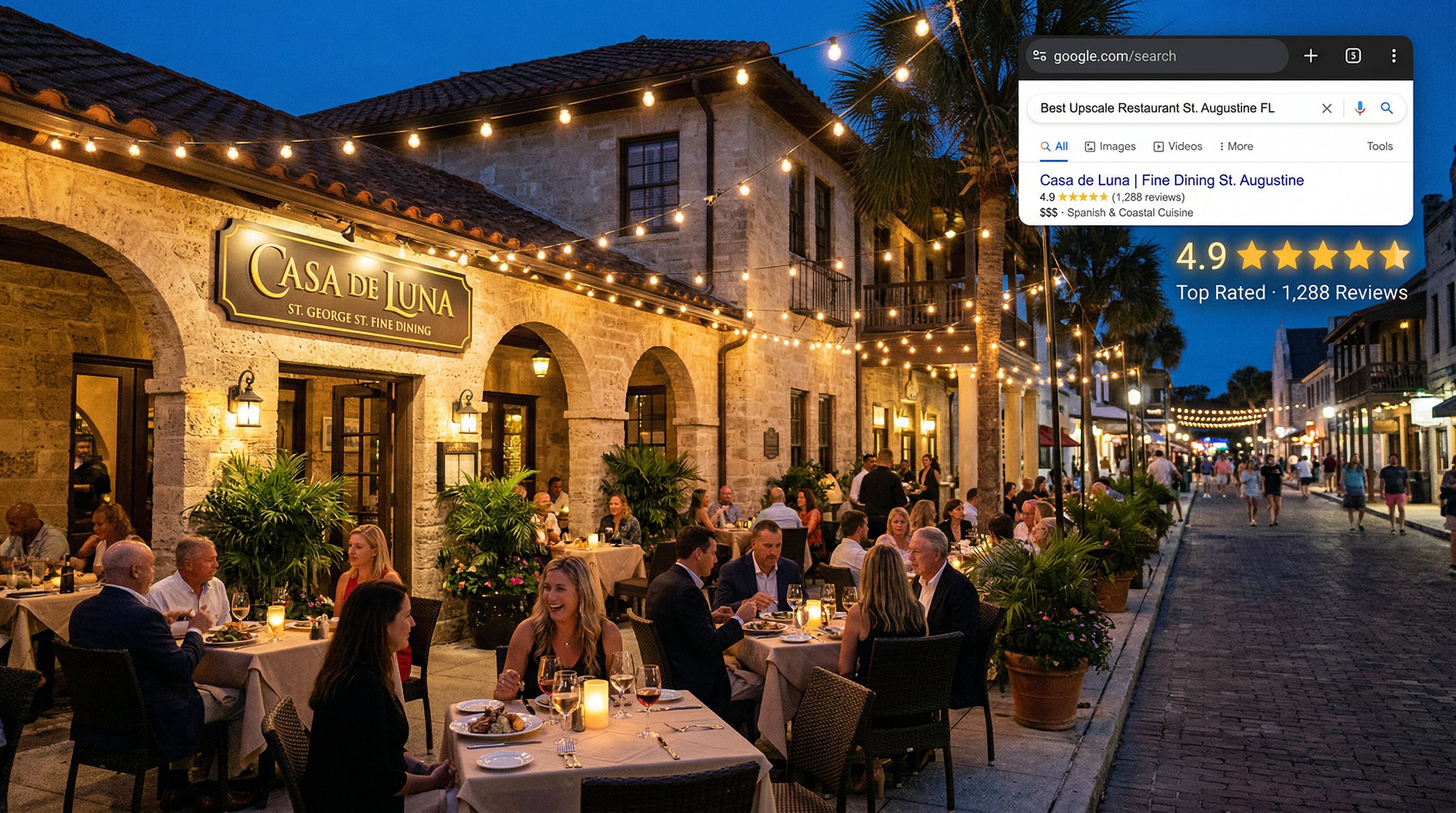
Restaurant SEO in St. Augustine requires capturing two distinct dining audiences: tourists exploring St. George Street, the Historic Bayfront, and Aviles Street for an authentic experience, and year-round residents in communities from San Marco to St. Augustine Beach looking for their next regular spot. The restaurants filling every table in St. Augustine dominate Google Maps through a combination of obsessive review generation, frequent photo uploads, Restaurant schema markup, and neighborhood-specific content that captures the full range of dining search intent in St. Johns County.
Key Takeaways
- Google Maps is where the majority of restaurant discovery in St. Augustine happens — the Maps 3-pack is the most valuable real estate in local dining search.
- Restaurant schema markup on your website directly improves how Google categorizes and displays your listing in dining-intent searches.
- Review velocity — consistently generating new five-star reviews — is the clearest differentiator between top-ranked and buried restaurants in every St. Augustine dining corridor.
- Menu content on your website creates hundreds of long-tail keyword opportunities, including dish-specific searches that competitors with PDF menus cannot capture.
- Tourist-intent and resident-intent search queries require different content approaches — a single generic homepage cannot rank for both effectively.
- Photo uploads — especially food photography — are a direct GBP ranking signal that most St. Augustine restaurants dramatically underutilize.
- TripAdvisor and Yelp rankings matter alongside Google for St. Augustine dining searches given the city's high tourist traffic volume.
Table of Contents
- The St. Augustine Dining Search Landscape in 2026
- Google Business Profile Optimization for Restaurants
- Restaurant Schema Markup That Drives Discovery
- Building a Review Engine for Your Restaurant
- Food Photography and Photo Strategy for Maps
- Your Menu as an SEO Asset
- Targeting Tourist and Local Dining Searches Separately
- Neighborhood-Specific SEO for St. Augustine Dining Corridors
- Social Media and SEO Synergy for Restaurants
- Frequently Asked Questions
The St. Augustine Dining Search Landscape in 2026
St. Augustine is one of Florida's most competitive restaurant markets for local search, driven by the combination of 7+ million annual tourists actively searching for dining recommendations and a growing year-round residential population in St. Johns County that dines out frequently. The city's dining clusters — St. George Street, Aviles Street, the Historic Bayfront, San Marco Avenue, and St. Augustine Beach — each have distinct search dynamics and competitive landscapes that require tailored SEO approaches.
The search journey for tourist diners typically begins before they arrive in St. Augustine. Visitors research dining options on Google, TripAdvisor, and Yelp while planning their trip — often days or weeks in advance. This means ranking well for informational queries like "best seafood restaurants St. Augustine FL" and "waterfront dining St. Augustine historic district" is as important as ranking for near-me proximity searches. Restaurants that invest in search engine optimization to capture both the research phase and the on-location search phase build a compounding advantage over competitors who only optimize for immediate proximity.
For resident-serving restaurants in San Marco, Davis Shores, Lincolnville, and St. Augustine Beach, the search landscape is different. Local diners search more frequently for category and occasion queries: "happy hour near St. Augustine Beach," "family-friendly restaurants San Marco," and "brunch spots St. Augustine this weekend." These searches happen year-round with less seasonal variation than tourist queries, making resident-focused SEO a reliable, consistent traffic source even during slower tourist months. Understanding which audience mix your restaurant primarily serves determines where to focus your SEO investment first. Our digital marketing services include a complimentary audience analysis to help St. Augustine restaurants identify their highest-value search traffic opportunities.
- St. George Street restaurants face the highest tourist search volume and review competition in all of St. Augustine — 200+ Google reviews is effectively the floor for Maps visibility here.
- San Marco Avenue dining businesses serve a loyal local audience with steady year-round search patterns and high repeat customer rates.
- Aviles Street's arts and culture character drives searches from visitors looking for an authentic, non-touristy St. Augustine dining experience — a valuable long-tail niche.
- St. Augustine Beach restaurants benefit from both summer tourist volume and year-round beach community residents who dine locally.
- Vilano Beach's small restaurant scene has lower competition and represents an opportunity for businesses willing to create focused neighborhood content.
Google Business Profile Optimization for Restaurants
Your Google Business Profile is the most important digital asset your restaurant has for local search visibility — outranking even your own website in terms of its direct impact on Maps 3-pack placement. A perfectly optimized restaurant GBP includes a complete and accurate business name, address (formatted consistently with your website and all other directories), local St. Augustine phone number, website URL, current hours including holiday hours, and every applicable attribute Google provides for restaurants: dine-in available, outdoor seating, delivery, takeout, reservations, wheelchair accessible, and more.
Category selection is critical for restaurant GBP optimization. Use your most specific applicable cuisine category as your primary (e.g., "Seafood Restaurant," "Southern United States Restaurant," "Fine Dining Restaurant") rather than the generic "Restaurant" category. Specific categories generate higher relevance scores for cuisine-specific searches. Add every secondary category that legitimately applies — a Historic District restaurant might list "Seafood Restaurant" as primary with "Fine Dining Restaurant," "Waterfront Restaurant," "Bar and Grill," and "Brunch Restaurant" as secondaries, each expanding the query space you rank for.
The business description for a restaurant GBP should read as a compelling, keyword-integrated pitch to both tourists and local diners. Name your neighborhood, describe your cuisine style and signature dishes, note your atmosphere and occasion suitability, and mention any awards or recognition you have received. Reference your proximity to St. Augustine landmarks — "steps from the Castillo de San Marcos," "overlooking the Matanzas Bay" — to capture proximity-based searches from tourists already exploring the area. Update the description seasonally to reflect menu changes, new offerings, or seasonal specials. This signals GBP activity to Google's algorithm while keeping your listing relevant for time-sensitive search queries. Using AI automation tools to schedule and publish GBP posts at consistent intervals keeps your activity signals high without requiring manual daily management.
What dining attributes matter most for St. Augustine restaurant GBP?
The GBP attributes that most influence dining search visibility for St. Augustine restaurants include: outdoor seating (critical for the mild Florida climate and tourist experience expectations), reservations accepted (improves conversion rate for advance-planning tourists), live music (high-value attribute for the Historic District entertainment corridor), happy hour specials (drives repeat local customer searches), and pet-friendly patio (a frequently searched attribute in walkable tourist districts). Fill in every applicable attribute — each one expands the query set your listing is eligible to appear for.
Restaurant Schema Markup That Drives Discovery
Restaurant schema markup is structured data code added to your website that tells Google — in machine-readable format — exactly what type of business you are, what you serve, when you are open, and how to book a table. For St. Augustine restaurants, properly implemented schema markup is the bridge between your website's content and Google's ability to match your listing to specific dining intent searches. Restaurants with correct schema regularly appear in enhanced search result features including the Knowledge Panel, the dining filter results, and voice search responses.
The core schema types every St. Augustine restaurant should implement: Restaurant schema on the homepage with name, address, telephone, URL, openingHoursSpecification, priceRange, cuisineType, servesCuisine, menu URL, acceptsReservations, and hasMap fields fully populated. BreadcrumbList schema on every page for navigation structure. FAQPage schema on a dedicated FAQ page covering common diner questions about parking, reservations, and dietary accommodations. MenuItem schema for signature dishes, which can produce rich results showing specific dishes in Google's dining discovery features. Correct schema markup implementation requires technical precision — use Google's Rich Results Test tool to validate every schema block after implementation.
The servesCuisine and cuisineType fields in Restaurant schema deserve particular attention for St. Augustine restaurants. St. Augustine has a culinary identity centered on fresh Florida seafood, Minorcan-influenced cuisine (a unique local tradition), and farm-to-table dining — these regional distinctions should be captured in your schema to differentiate your listing from generic seafood or American restaurants in Google's understanding of your business. A restaurant that accurately represents its Minorcan clam chowder and datil pepper dishes in schema and website content can rank for queries that no competitor who uses only generic category labels can target. Our AI-powered SEO audit process identifies every schema implementation opportunity specific to your restaurant and dining category.
Building a Review Engine for Your Restaurant
For St. Augustine restaurants, reviews are not just an SEO signal — they are the primary conversion mechanism that turns a Maps listing impression into a table reservation or walk-in visit. A tourist standing on St. George Street choosing between three nearby restaurants will default to the one with the most recent positive reviews in almost every case. Review volume, recency, and quality collectively determine whether your restaurant gets the click or the competitor does.
Building a systematic review engine means making the review request a standard part of your service process, not an occasional campaign. The most effective trigger point is immediately after a positive dining experience — before the customer leaves, while the experience is fresh. Train servers and hosts to mention Google reviews verbally and to provide a table card, receipt insert, or QR code linking directly to your Google review page. Remove every possible friction point from the review process: a QR code that opens directly to the write-a-review page takes three seconds; asking a diner to search for your restaurant manually takes three minutes and most won't complete it.
For tourist-heavy St. Augustine dining locations, a post-visit email or SMS follow-up is equally important. Many tourists book through OpenTable, Resy, or direct reservation forms — use those contact details to send an automated review request within two hours of the reservation end time. The message should be brief, personal in tone, and include a direct link. A typical high-performing review request SMS reads: "Thanks for dining with us at [Restaurant Name] tonight! If you enjoyed your experience, we would love a Google review — it helps us more than you know: [link]." Platforms like Go High Level can automate this entire sequence across SMS and email with zero manual effort per customer.
- Respond to every Google, Yelp, and TripAdvisor review within 24 hours — response rate is a public signal that influences both rankings and diner conversion decisions.
- Encourage reviewers to mention specific dishes, the neighborhood, and the occasion — keyword-rich reviews reinforce your dining category relevance in Google's algorithm.
- Address negative reviews professionally and specifically — offering to make things right demonstrates service culture to prospective diners reading the exchange.
- Never offer discounts, free items, or any incentive in exchange for reviews — this violates Google's policies and can result in review removal penalties.
- Monitor review platforms weekly and track your review velocity month-over-month to detect any slowdown before it affects your Maps ranking position.
Food Photography and Photo Strategy for Maps
Food photos are the single most powerful conversion driver in restaurant Google Maps listings. Before a diner ever reads your menu, checks your hours, or visits your website, they form an impression of your restaurant's quality and appeal based on the photos visible in your GBP. Low-quality photos — even of genuinely excellent food — suppress click-through rates and communicate the wrong story. High-quality, appealing food photography is simultaneously a conversion asset and a measurable SEO ranking signal, because photo upload frequency directly correlates with Maps ranking performance.
Every St. Augustine restaurant should invest in at least one professional food photography session annually, producing 50-100 high-quality images across menu categories, ambiance shots, exterior shots, and team photos. These provide the baseline photo library for your GBP, website, and social media channels. Supplement professional photography with quality smartphone shots of specials, seasonal dishes, and events uploaded to GBP weekly — Google values upload frequency and recency alongside photo quality. A restaurant uploading 5 new photos per week consistently outperforms one with better photos uploaded only quarterly.
Photo strategy for St. Augustine restaurants should also account for the city's distinct visual identity. Photos featuring the architectural character of the Historic District, outdoor seating with views of the Matanzas Bay, or the warm ambiance of a Lincolnville dining room create context that resonates with visitors specifically planning a St. Augustine experience. This geographic visual context in your GBP photos is a soft relevance signal that differentiates your listing from generic restaurant listings and improves your match rate for the experience-driven searches that St. Augustine tourists conduct most frequently. Combine strong photo strategy with active social media marketing to build brand visibility across both search and social platforms simultaneously.
Ready to Fill More Tables with Search?
Get a Free Restaurant SEO Strategy for Your St. Augustine Dining Business
Our Florida marketing experts will audit your restaurant's search visibility and build a custom plan to fill more seats through Google Maps and organic search — no obligation.
Targeting Tourist and Local Dining Searches Separately
St. Augustine restaurant SEO fails most often when businesses try to capture tourist and local dining searches with the same single page. Tourist searches have fundamentally different intent, timing, and language than local resident searches — and a single homepage optimized for "best restaurants St. Augustine historic district" will consistently underperform for "family-friendly dinner near San Marco" and vice versa. The restaurants outperforming competitors in St. Augustine dining search create distinct content for each audience cluster.
Tourist-intent content should emphasize experience, landmark proximity, occasion types (romantic dinners, anniversary celebrations, post-tour meals), and the distinctive character of the St. Augustine dining scene. Phrases like "historic atmosphere," "waterfront views of the Matanzas," "steps from the Castillo de San Marcos," and "Minorcan-inspired Florida cuisine" resonate with visitors conducting experience research before arriving. Blog content covering "what to eat in St. Augustine," "best seafood restaurants near St. Augustine historic district," and "St. George Street dining guide" captures the research-phase traffic that precedes tourist-season peaks by weeks or months.
Resident-intent content focuses on different values: consistency, value, neighborhood convenience, community connection, and local specialties. Content targeting resident dining searches might include pages for specific meal occasions ("brunch in San Marco," "happy hour near St. Augustine Beach"), community-focused pages addressing neighborhood regulars ("our favorite local families keep coming back to Aviles Street"), and seasonal menu content relevant to the year-round St. Johns County lifestyle. Pairing your restaurant SEO strategy with targeted Google Ads campaigns lets you test which content angles drive the highest table conversion rates before investing in long-term organic content development.
Neighborhood-Specific SEO for St. Augustine Dining Corridors
Each of St. Augustine's major dining corridors has a distinct search identity, competitive landscape, and customer demographic that rewards neighborhood-specific SEO approaches. A one-size-fits-all St. Augustine restaurant SEO strategy leaves significant ranking opportunities uncaptured in the specific corridors where the highest-converting dining searches originate.
St. George Street restaurants compete in the most saturated dining search environment in all of St. Johns County. The competitive bar here is high — achieving Maps 3-pack visibility for generic queries like "restaurants St. George Street" requires strong review volume (200+ is effectively the minimum in 2026), consistent GBP activity, and a differentiated description that captures specific cuisine, occasion, or experience types. The winning strategy for St. George Street is to dominate specific niche searches — "historic dining experience St. Augustine," "Minorcan cuisine St. George Street," "outdoor seating historic district" — where the competition is thinner than the generic dining category.
The Historic Bayfront area and restaurants near the Bridge of Lions attract both walk-up tourist traffic and special occasion diners seeking waterfront views of the Matanzas. SEO for this corridor should heavily emphasize view, ambiance, and occasion keywords: "waterfront dining St. Augustine," "romantic restaurant Matanzas Bay," "special occasion dinner historic St. Augustine." Creating a dedicated landing page targeting "waterfront restaurants St. Augustine" with schema markup and locally-sourced review content can capture a persistent high-value search cluster that drives reservations from tourists planning anniversary and birthday dinners months in advance. Our Jacksonville and Orlando restaurant SEO clients use identical neighborhood content strategies to dominate dining searches in their respective metro areas with consistent results.
For a complete overview of our SEO services in St. Augustine, visit our dedicated SEO Agency in St. Augustine, FL page.
Frequently Asked Questions
Common restaurant SEO questions from St. Augustine and St. Johns County dining business owners.
What are the most important SEO tactics for St. Augustine restaurants?
The most impactful restaurant SEO tactics for St. Augustine are: optimizing your Google Business Profile with Restaurant schema, accurate hours, and weekly photo uploads; building a review engine that generates 5+ new Google reviews per week; implementing Restaurant structured data on your website with menu items, price range, and cuisine type; and creating neighborhood-specific content for St. George Street, San Marco, the Historic Bayfront, and St. Augustine Beach separately.
How do St. Augustine restaurants rank for tourist dining searches?
Ranking for tourist dining searches in St. Augustine requires optimizing for proximity-based queries ("restaurants near Castillo de San Marcos"), experience-based queries ("best seafood St. Augustine historic district"), and occasion-based queries ("romantic dinner St. Augustine waterfront"). Your Google Business Profile must include accurate category tags, keyword-rich description, current hours, and a high volume of reviews from both tourist and local diners to rank for these high-intent seasonal searches.
Does having a menu on my website improve restaurant SEO?
Yes, significantly. A detailed menu on your website — with dish names, descriptions, and prices — creates a large volume of long-tail keyword content that matches specific menu searches. When someone searches "minorcan clam chowder St. Augustine," a restaurant with that dish described on its website will rank for that query. Menu content also enables MenuItem schema markup, which can generate rich results in Google search showing dishes directly in the search listing.
How important are Yelp reviews for St. Augustine restaurants?
Yelp carries meaningful weight for St. Augustine restaurant search because of the platform's strong presence in dining-specific local searches and its integration with Apple Maps. For tourist-facing restaurants, Yelp reviews supplement Google reviews in ways that reach visitors planning trips on desktop browsers and Apple devices. Maintain an active Yelp presence with current photos and owner responses, but prioritize Google reviews for the greatest Maps ranking impact.
Should St. Augustine restaurants use Google Ads alongside SEO?
Google Ads and SEO serve different roles for St. Augustine restaurants. Ads provide immediate visibility for competitive tourist-season keywords while SEO builds long-term organic authority. During peak tourist seasons — spring break, summer, Nights of Lights — running targeted Google Ads for dining searches near the Historic District can capture search volume that your organic rankings may not yet cover. The best strategy combines both: use paid search as a bridge while organic SEO compounds over time.
What schema markup should St. Augustine restaurants use?
St. Augustine restaurants should implement Restaurant schema on the homepage with fields for name, address, phone, hours, cuisineType, priceRange, servesCuisine, menu URL, and acceptsReservations. Add MenuItem schema for signature dishes. Use BreadcrumbList schema for navigation structure and FAQPage schema for a frequently asked questions section. These structured data elements help Google match your restaurant to specific dining intent searches and can generate enhanced search result displays.
Related Posts
Start Growing Today
Your St. Augustine Competitors Are Filling Tables with SEO.
Are You?
Search Scale AI delivers measurable results for Florida restaurants. Let's build your custom search visibility strategy and start driving real reservations within 90 days.
No contracts. No BS. Just results.
Social Media and SEO Synergy for Restaurants
Social media and SEO function as mutually reinforcing strategies for St. Augustine restaurants — each strengthens the other when coordinated through a unified content approach. While social media posts themselves are not direct Google ranking factors, the traffic, brand searches, links, and engagement they generate contribute meaningfully to the prominence signals that influence local search rankings over time.
Instagram and Facebook are the primary social platforms for St. Augustine restaurant marketing given the visual nature of food content and the high tourist social media usage during visits to the Historic District. A well-run restaurant Instagram account serves as a photo discovery platform for visitors who first find you on Google, find your Instagram linked in your GBP, and then follow to track seasonal specials and events before their next visit. This social follow creates a durable relationship that drives repeat business beyond the initial search-and-visit cycle.
The most effective content calendar for St. Augustine restaurant social media integrates with your GBP post schedule. Produce the content once — a high-quality photo of a new seasonal dish with a compelling caption — and publish it to Instagram, Facebook, and Google Business Profile simultaneously. This multiplies the reach of each piece of content across all three platforms without creating additional production work. Social media marketing run by professionals who understand both the St. Augustine local market and restaurant industry content conventions will consistently outperform restaurant owners trying to manage social media on top of their operational responsibilities. Pair social media with a free strategy consultation to identify the content formats and platforms generating the highest ROI for your specific dining concept and target customer mix.