SEO vs PPC: Which Is the Better Investment for Your Business in 2026?
By Search Scale AI Team · April 9, 2026 · 10 min read
Quick Answer
For most businesses with a 12+ month horizon, SEO delivers a higher return on investment than PPC because organic rankings generate compounding traffic without ongoing cost per click. PPC is superior for immediate lead generation, highly competitive short-term keyword targets, and time-sensitive promotions. The optimal strategy for most businesses is not SEO versus PPC — it is SEO plus PPC deployed in the right proportion at the right stage of growth. This guide gives you the data to make that decision clearly for your specific business situation.
Key Takeaways
- SEO builds long-term traffic equity that compounds over time; PPC generates traffic only while you pay for it.
- The average Google Ads click costs $2–$15+ depending on industry; organic clicks from SEO carry no per-click cost once rankings are established.
- SEO takes 3–12 months to produce significant results; PPC can generate first-page visibility the same day a campaign launches.
- Over a 24-month horizon, SEO almost always delivers a higher ROI than PPC for equivalent budget, with the compounding advantage growing each month.
- PPC converts at a slightly higher rate for bottom-of-funnel keywords but at dramatically higher cost per visitor.
- The winning strategy for most businesses: PPC to generate leads now, SEO to build the organic asset that reduces ad spend dependence over time.
- AI-powered SEO accelerates the timeline to organic traffic, shortening the period where full PPC dependence is necessary.
Table of Contents
- SEO and PPC Defined: What Each Channel Actually Does
- Cost Comparison: What You Actually Pay Per Visitor
- Timeline Differences: How Fast Each Channel Delivers
- ROI Comparison: The 24-Month Math
- Full SEO vs. PPC Comparison Table
- When to Choose SEO
- When to Choose PPC
- When to Use Both — and How to Split the Budget
- Trust, Click-Through Rates, and SERP Visibility
- The AI SEO Edge in 2026
- Frequently Asked Questions
SEO and PPC Defined: What Each Channel Actually Does
SEO — Search Engine Optimization — is the practice of improving a website's visibility in organic (non-paid) search results. When someone searches "best HVAC company in Jacksonville" and clicks a result that is not an advertisement, that visit is an organic search visit. SEO is the work that earns and sustains those positions: keyword-optimized content, technical site health, authoritative backlinks, and structured data that helps Google understand what your pages are about. The cost of SEO is the investment in the work itself — not a per-click fee paid to Google.
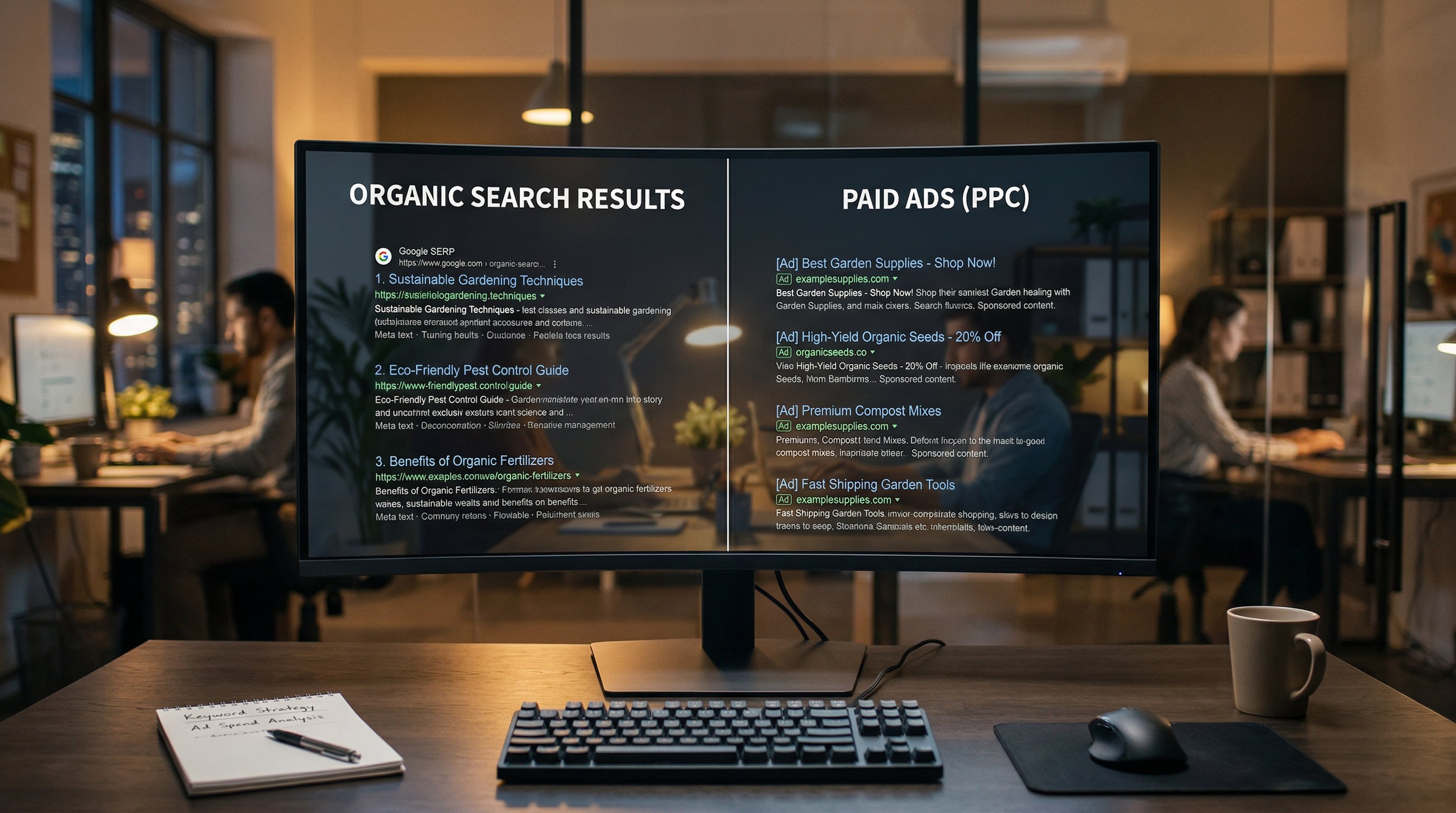
PPC — Pay-Per-Click — is paid search advertising, most commonly through Google Ads. When someone searches and clicks the ads labeled "Sponsored" at the top of the results page, the advertiser pays Google a fee for that click. PPC provides immediate, controllable visibility: you can appear at the top of search results the same hour you launch a campaign, for any keyword you are willing to bid on. The cost is direct and ongoing — every click costs money, and when the budget runs out, the traffic stops.
Both channels are aimed at the same outcome: putting your business in front of people searching for what you offer. The difference is the economic model, the timeline, and the compounding dynamics of each investment. Understanding those differences is what makes the SEO vs. PPC decision clear for your specific situation. For a full breakdown of SEO pricing by tier, see our complete SEO cost guide for 2026.
Cost Comparison: What You Actually Pay Per Visitor
The most direct way to compare SEO and PPC costs is to calculate the cost per organic or paid visitor over time. PPC costs are visible and immediate: if your average cost per click is $4 and you want 500 visits per month, you pay $2,000/month. That number is predictable and controllable. What it obscures is the long-term economics: after 12 months, you have spent $24,000 and generated 6,000 visits — but if you stop paying tomorrow, traffic drops to zero the same day.
SEO costs are front-loaded: you invest in content, links, and technical optimization for months before organic traffic materializes at scale. A $2,000/month SEO retainer over 12 months costs $24,000 — the same as that PPC example. But after month 12, the rankings and content built by that SEO investment continue generating traffic with no additional per-visit cost. By month 18 or 24, the cumulative visitor count from SEO has surpassed PPC while the monthly cost remains the same retainer fee — not an exponentially growing ad bill.
The cost per visitor comparison favors PPC in the short term and SEO in the long term — the crossover point typically occurs somewhere between months 6 and 18 depending on how competitive the keyword targets are. Businesses with a 6-month horizon should lean PPC-heavy. Businesses with a 24-month horizon should invest aggressively in SEO. Most businesses fall into the 12-18 month horizon where a balanced approach is optimal. AI-powered SEO moves the crossover point earlier by accelerating content and rankings velocity.
Industry-Specific PPC Costs Worth Knowing
The average cost per click on Google Ads varies dramatically by industry, and this variation significantly affects the ROI comparison with SEO. Legal services keywords average $6–$15 per click; insurance and financial services run $8–$20; healthcare and medical keywords average $3–$8; home services average $2–$6; e-commerce averages $1–$4. A law firm paying $10 per click needs 100 clicks to get 10 leads at a 10% landing page conversion rate — $1,000 spent per 10 leads. An SEO program that earns those same 100 clicks organically costs nothing per click once the rankings are established.
The higher the CPC in your industry, the more compelling the long-term SEO ROI becomes — because you are replacing the most expensive paid traffic with free organic traffic. Our PPC management services are designed for businesses that need both channels managed efficiently, ensuring that paid spend is concentrated where organic rankings cannot compete.
Timeline Differences: How Fast Each Channel Delivers
The timeline difference between SEO and PPC is real and significant. It is also the most commonly cited objection to SEO from businesses that need leads now. PPC delivers traffic on day one — literally. Launch a Google Ads campaign with a reasonable budget and relevant keywords, and your ad can appear at the top of search results within hours of approval. For businesses that have just launched, are promoting a time-sensitive offer, or have exhausted their organic traffic potential in the near term, PPC fills the gap immediately.
SEO operates on a longer timeline. New content takes days to weeks to get indexed; newly indexed pages take weeks to months to accumulate the authority needed to rank on page one. Competitive keyword targets — the head terms with high search volume and commercial value — can take 6–18 months of sustained SEO work to appear on the first page. Long-tail and local keywords, which carry real commercial value but face less competition, can rank within weeks or even days with a properly built and technically optimized site.
At Search Scale AI, our system of building and indexing sites rapidly — documented in our post on ranking a website in 48 hours — compresses the early-stage SEO timeline significantly. Targeting hyper-local and long-tail keywords from launch, combined with aggressive indexing acceleration, produces first-page movement for attainable keywords within the first week of a new site's life. The longer timeline for competitive head terms still applies — but the business is generating organic leads from day one rather than waiting months for any organic visibility at all.
The practical takeaway for timeline planning: budget for PPC to handle lead generation for the first 3–6 months of a new SEO campaign. As organic rankings build, the keyword-by-keyword transition from PPC to organic traffic becomes visible in your analytics — and you can reduce paid spend on each keyword as its organic position reaches page one. Our guide on how long SEO takes sets realistic expectations for every phase of this timeline.
ROI Comparison: The 24-Month Math
The most useful way to evaluate SEO vs. PPC ROI is to model both channels over the same time horizon with the same budget and compare cumulative traffic and revenue outcomes. The following scenario uses realistic figures applicable to a small-to-midsize service business.
Scenario: $2,500/month total search marketing budget over 24 months.
Option A: PPC only ($2,500/month Google Ads budget). At an average CPC of $4 and a 2% landing page conversion rate, this generates approximately 625 clicks per month and 12.5 conversions per month. At a $400 average lead value, that is $5,000/month in pipeline value from a $2,500 investment — a 2x return on ad spend. Over 24 months: $60,000 invested, consistent $5,000/month pipeline throughout. Total pipeline generated: approximately $120,000. Results stop immediately if budget stops.
Option B: SEO only ($2,500/month SEO retainer). Months 1–3: minimal organic traffic as content builds and links accrue. Months 4–6: early keyword wins begin delivering 50–150 organic visitors per month. Months 7–12: rankings compound, organic traffic reaches 300–600 visitors per month. Months 13–24: established authority drives 600–1,500+ organic visitors per month. At the same 2% conversion rate and $400 lead value: month 12 generates approximately $4,000–$6,000 in pipeline; month 24 generates $6,000–$12,000+ in pipeline — from the same $2,500 investment. Total 24-month pipeline: lower in months 1–6, comparable in months 7–12, and significantly higher in months 13–24.
Option C: Balanced approach ($1,500/month SEO + $1,000/month PPC). PPC generates consistent early-stage leads while SEO builds. By month 12, organic begins delivering enough traffic to maintain lead flow even as PPC budget is reduced. By month 18–24, organic rankings reduce or eliminate dependence on paid traffic for the keywords they cover. This is the model most businesses should follow — and it is the approach we recommend when clients are choosing between channels. Call us at 772-267-1611 to model the right split for your specific situation.
Full SEO vs. PPC Comparison Table
| Factor | SEO | PPC | Winner |
|---|---|---|---|
| Time to first traffic | Weeks to months | Same day | PPC |
| Cost per click | $0 (after rankings established) | $1–$20+ ongoing | SEO |
| 24-month ROI | High and compounding | Consistent but linear | SEO |
| Traffic continuity | Continues if budget stops | Stops immediately | SEO |
| Targeting precision | Broad keyword coverage | Exact keyword, time, device, location | PPC |
| Brand trust signals | High — organic results seen as earned | Lower — ads are labeled "Sponsored" | SEO |
| Scalability | Scales with content and links | Scales directly with budget | Both |
| Data and insights | Rich, but delayed | Rich and immediate | PPC |
| Algorithm risk | Rankings can shift with Google updates | Cost can rise with competition | Both carry risk |
| Best use case | Long-term growth, brand authority | Fast leads, competitive terms, launches | Use both strategically |
When to Choose SEO
SEO is the better primary investment in a well-defined set of circumstances. The common thread across all of them is a business that has the time horizon and budget stability to let the compounding dynamics of organic search work in its favor.
You Have a 12+ Month Horizon
If your business can sustain itself while organic traffic builds, SEO's long-term ROI superiority becomes increasingly decisive over time. A business that invests $2,000/month in SEO for 24 months and reaches 1,000 monthly organic visitors is earning those visitors for free indefinitely — a compounding asset that no PPC campaign can replicate. Our ROI analysis for small businesses models this precisely with real numbers.
You Are in a High-CPC Industry
The higher the cost per click in your industry, the more valuable it is to replace paid traffic with organic. A law firm or insurance agency paying $12 per click on Google Ads can calculate the exact revenue value of each organic ranking — every page-one keyword representing potentially thousands of dollars in monthly ad savings. Local SEO is particularly powerful here because local keywords often have lower competition than national terms, making page-one organic rankings achievable in months rather than years.
You Want to Build Brand Authority
Organic rankings carry an implicit trust signal that ads cannot replicate. Studies from search research firms consistently show that the majority of users are aware of the distinction between organic and paid results — and a significant portion specifically avoid clicking ads. A business that appears organically in positions 1–3 for its category keywords benefits from the trust halo of being seen as "the answer Google recommends" rather than "the business that paid to appear here."
You Want Content That Works Beyond Search
SEO content — blog posts, service pages, guides, FAQs — has value beyond organic rankings. It powers your social media, it answers customer questions, it supports your sales team, and it serves as the foundation for email marketing. AI-accelerated content production means the per-piece cost of SEO content has fallen dramatically, making it possible to build topical authority faster than ever before. PPC ads, by contrast, exist only within the Google Ads platform and generate no secondary value once the campaign ends.
When to Choose PPC
There are specific circumstances where PPC is the right primary channel — or the right supplement to an existing SEO program. The unifying characteristic is a need for immediate, controllable, high-precision traffic.
You Need Immediate Lead Flow
New businesses, new product launches, and businesses recovering from a Google algorithm update that hurt organic rankings all share the same problem: they need leads now, not in six months. PPC solves this problem directly. A well-structured Google Ads campaign for a local service business can be generating qualified calls the same day it launches. The cost is real and ongoing, but so is the lead flow. This is why most growth-stage businesses should be running PPC while their SEO foundation builds — not choosing one over the other.
You Have Time-Sensitive Promotions
Seasonal promotions, limited-time offers, and event-driven campaigns all benefit from PPC's immediate on/off control. SEO cannot respond to "we need to push our summer sale for the next 30 days" — content takes time to rank, and rankings are not predictable on 30-day timelines. PPC, by contrast, can be turned on and off with the precision of a light switch. For this use case, PPC is simply the right tool regardless of your long-term SEO strategy.
You Are Targeting Highly Competitive Head Keywords
Some keyword categories are dominated by websites with years of authority accumulation — insurance comparison sites, e-commerce giants, national media properties. For a new or mid-authority domain to compete organically for "car insurance quotes" or "cheap flights to Miami" would require years of sustained investment in content and links. PPC allows immediate visibility on those keywords at a predictable cost while your organic program focuses on the long-tail and mid-competition keywords where first-page organic rankings are achievable faster.
You Want Real-Time Keyword Conversion Data
PPC provides immediate, granular conversion data at the keyword level — you can see exactly which search queries are generating calls, form fills, and purchases, and at what cost. This intelligence has direct value for your SEO strategy: the keywords that convert at high rates in PPC are the same keywords worth prioritizing in organic. Running PPC and SEO simultaneously creates a data feedback loop that makes both channels more efficient. Our PPC management service is specifically designed to integrate with SEO programs for exactly this reason.
When to Use Both — and How to Split the Budget
The most effective marketing strategy for most growth-stage businesses is not SEO versus PPC but SEO and PPC working in parallel, with each channel doing what it does best. This approach acknowledges the real limitations of each channel — PPC's high ongoing cost and zero long-term equity; SEO's slower initial traffic build — while leveraging the strengths of both.
The practical framework for most businesses: allocate 60–70% of your search marketing budget to SEO and 30–40% to PPC. Use PPC to maintain lead flow on your highest-value bottom-of-funnel keywords while SEO builds organic authority across a broader keyword set. As organic rankings mature and deliver traffic on specific keywords, reduce PPC spend on those keywords and reallocate to terms where organic hasn't yet reached page one. Over 12–24 months, this strategy produces a steadily increasing organic baseline with declining paid dependence.
Businesses that start with pure PPC and then try to pivot to SEO after being burned by rising CPCs often find themselves starting an SEO program from scratch with no organic foundation. Businesses that invest in SEO from day one — even with a modest initial budget — reach the crossover point where organic traffic exceeds paid traffic faster, at lower total investment. Contact Search Scale AI to model the right budget split for your specific revenue goals and competitive market.
Location matters in this calculus too. A business serving St. Augustine, Orlando, or Tampa is competing in local markets where SEO investment tends to deliver first-page results faster than national campaigns — making the economic case for SEO-led strategy even stronger for Florida businesses. Our local SEO guide covers the specific tactics that accelerate results in regional markets.
Trust, Click-Through Rates, and SERP Visibility
One of the most important and underappreciated dimensions of the SEO vs. PPC comparison is how users actually interact with organic versus paid results. The data consistently challenges the assumption that top-of-page placement drives equivalent results regardless of whether the placement is paid or organic.
Multiple studies from BrightEdge, Moz, and SISTRIX have shown that organic results capture 70–80% of total search clicks, with paid ads capturing the remainder. The distribution is not uniform across query types: informational queries (research, comparisons, "how to" searches) heavily favor organic results. Commercial queries with strong purchase intent (especially those with local qualifiers like "near me") see a higher proportion of paid clicks — but organic results still capture a substantial majority even here.
The trust dimension is real. A significant portion of search users actively avoid paid ads, viewing them as less credible than organic results because organic rankings are perceived as earned rather than purchased. For businesses building long-term brand equity in their market, appearing organically in top positions is a brand signal that paid ads cannot replicate — "we are here because Google recognizes us as the best answer" versus "we are here because we paid to appear."
The implication for SEO investment: the click-through rate advantage of organic positions 1–3 over the same budget spent on PPC ads is measurable. A page ranking organically in position 1 for a given keyword captures approximately 25–30% of clicks on that keyword. A PPC ad in position 1 captures significantly fewer clicks for the same keyword — and at a cost of $2–$15+ per click. The organic click is structurally more valuable than the paid click. For a broader look at on-page optimization that maximizes those organic clicks, see our on-page SEO checklist.
The AI SEO Edge in 2026
The SEO vs. PPC calculus has shifted meaningfully in SEO's favor over the past two years, primarily because AI tools have dramatically compressed the timeline from SEO investment to organic traffic. The historic argument for PPC — "SEO takes too long, we need results now" — has weakened as AI-accelerated content production, faster indexing tools, and AI-assisted technical optimization allow well-executed SEO campaigns to produce meaningful traffic in months rather than years.
At Search Scale AI, AI-powered SEO enables us to build topical authority at a speed that was not achievable with traditional human-only content teams. A new site can launch with 50+ optimized pages simultaneously — establishing the breadth of content that Google associates with genuine subject-matter expertise — rather than building that coverage one page per week over a year. The content is AI-assisted but human-reviewed, ensuring quality while achieving volume.
AI also improves PPC performance when both channels are running. AI-assisted ad copy testing, bidding optimization, and keyword expansion mean PPC campaigns waste less budget on low-converting queries. And the data from AI-managed PPC flows directly into SEO keyword strategy — closing the loop between what converts in paid and what deserves priority in organic.
The practical conclusion for businesses evaluating their 2026 search marketing strategy: the traditional barriers to SEO's time-to-value have been reduced by AI execution capabilities. Businesses that may have defaulted to PPC-first in 2023 because SEO was "too slow" have a genuine opportunity to build organic assets faster in 2026. Our post on the best AI SEO tools covers the specific tools changing the execution economics of organic search. And our small business SEO strategy guide provides the implementation framework for businesses starting this journey.
Whether your business needs SEO, PPC, or both, the decision deserves analysis grounded in your specific market, keyword targets, competitive landscape, and revenue goals — not a general prescription. Reach out to Search Scale AI for a direct conversation about what the right channel mix looks like for your business. We are based in St. Augustine, FL but serve businesses across Florida and nationwide. Call us at 772-267-1611.
Frequently Asked Questions: SEO vs. PPC
Is SEO or PPC better for a new business with no online presence?
For a brand-new business needing immediate traffic, PPC delivers first-page visibility the same day a campaign launches. However, PPC stops the moment you stop paying. The recommended approach for most new businesses is to launch PPC for immediate lead generation while simultaneously building the SEO foundation that will reduce paid dependence over 6–12 months.
What is the average cost per click for Google Ads in 2026?
Average CPCs vary widely by industry. Legal services average $6–$15 per click; insurance and financial services run $8–$20; healthcare averages $3–$8; home services average $2–$6; e-commerce averages $1–$4. The higher your industry's CPC, the more compelling the long-term case for SEO as a cost replacement for paid traffic.
Does SEO or PPC have a better conversion rate?
PPC ads tend to convert at a slightly higher rate for bottom-of-funnel, high-intent queries because landing pages are specifically optimized for conversion. However, organic results capture 70–80% of total search clicks and carry higher trust with many users. The conversion rate advantage of PPC is real but narrow, and comes at significantly higher cost per visitor.
Can you run SEO and PPC at the same time?
Yes — and for most businesses, this is the optimal strategy. Running PPC alongside SEO maintains traffic and lead flow while organic rankings build. PPC conversion data also informs SEO keyword prioritization. As organic rankings grow, you can reduce PPC spend on those keywords to lower your cost per acquisition while maintaining visibility.
How long does it take for SEO to replace PPC traffic?
For most businesses, SEO takes 6–12 months to deliver enough organic traffic to meaningfully reduce PPC dependence. Local and long-tail keywords can rank within 3–6 months on a well-built site. Competitive national keywords typically take 12–24 months to reach top-3 organic positions.
What percentage of marketing budget should go to SEO vs PPC?
A common starting allocation is 60% SEO and 40% PPC — enough PPC to maintain early lead flow while SEO builds long-term equity. As organic rankings mature, that ratio typically shifts toward 70–80% SEO. Businesses in highly competitive verticals sometimes maintain a 50/50 split indefinitely, using PPC for the most competitive terms while SEO covers the long-tail.