Voice Search SEO for St. Augustine Businesses: Optimize for Alexa, Siri, and Google
By Search Scale AI Team · April 8, 2026 · 11 min read
Quick Answer
Voice search optimization for St. Augustine businesses requires targeting conversational, question-based keyword phrases rather than the short typed keywords that traditional search engine optimization focuses on, combined with complete and accurate listings on every voice search platform (Google Business Profile, Apple Maps, Yelp, Amazon Alexa). St. Augustine's unique market — a mix of tourism visitors exploring the Historic District, year-round local residents in Nocatee and World Golf Village, and a significant snowbird population in seasonal residences — creates three distinct voice search audiences with different query patterns, each requiring tailored optimization strategies to capture effectively.
Key Takeaways
- Voice searches use natural, conversational language — "What's the best seafood restaurant near the St. Augustine Historic District?" not "seafood restaurant St. Augustine."
- Google Business Profile is the single most important optimization for Google Assistant and Google Maps voice results.
- Apple Maps and Yelp are Siri's primary data sources — incomplete listings on these platforms mean invisibility for iOS voice searches.
- Amazon Echo and Alexa serve St. Augustine's significant snowbird population — Alexa business listings require separate claim and optimization.
- FAQ-format content structured with FAQPage schema is the most effective website format for capturing voice search featured snippets.
- Voice searches are overwhelmingly local and high-intent — "near me" queries are almost exclusively spoken rather than typed.
- Page speed under 2 seconds on mobile is a prerequisite for voice search visibility — slow pages are invisible to voice assistants.
Table of Contents
- St. Augustine Voice Search: Three Distinct Audiences
- Optimizing for Conversational Voice Keywords
- Optimizing for Google Assistant and Google Maps
- Optimizing for Siri and Apple Maps
- Optimizing for Amazon Alexa and the Snowbird Audience
- Schema Markup for Voice Search Visibility
- FAQ Content Strategy for Voice Search Snippets
- Technical Requirements for Voice Search Performance
- Frequently Asked Questions
St. Augustine Voice Search: Three Distinct Audiences
St. Augustine's voice search landscape is shaped by three audiences with fundamentally different contexts, devices, and information needs. Understanding which audience a business primarily serves determines which voice search platforms to prioritize and which query types to optimize for. Businesses that serve all three — as many St. Augustine service businesses do — need a comprehensive voice search strategy that addresses each audience's distinct patterns.
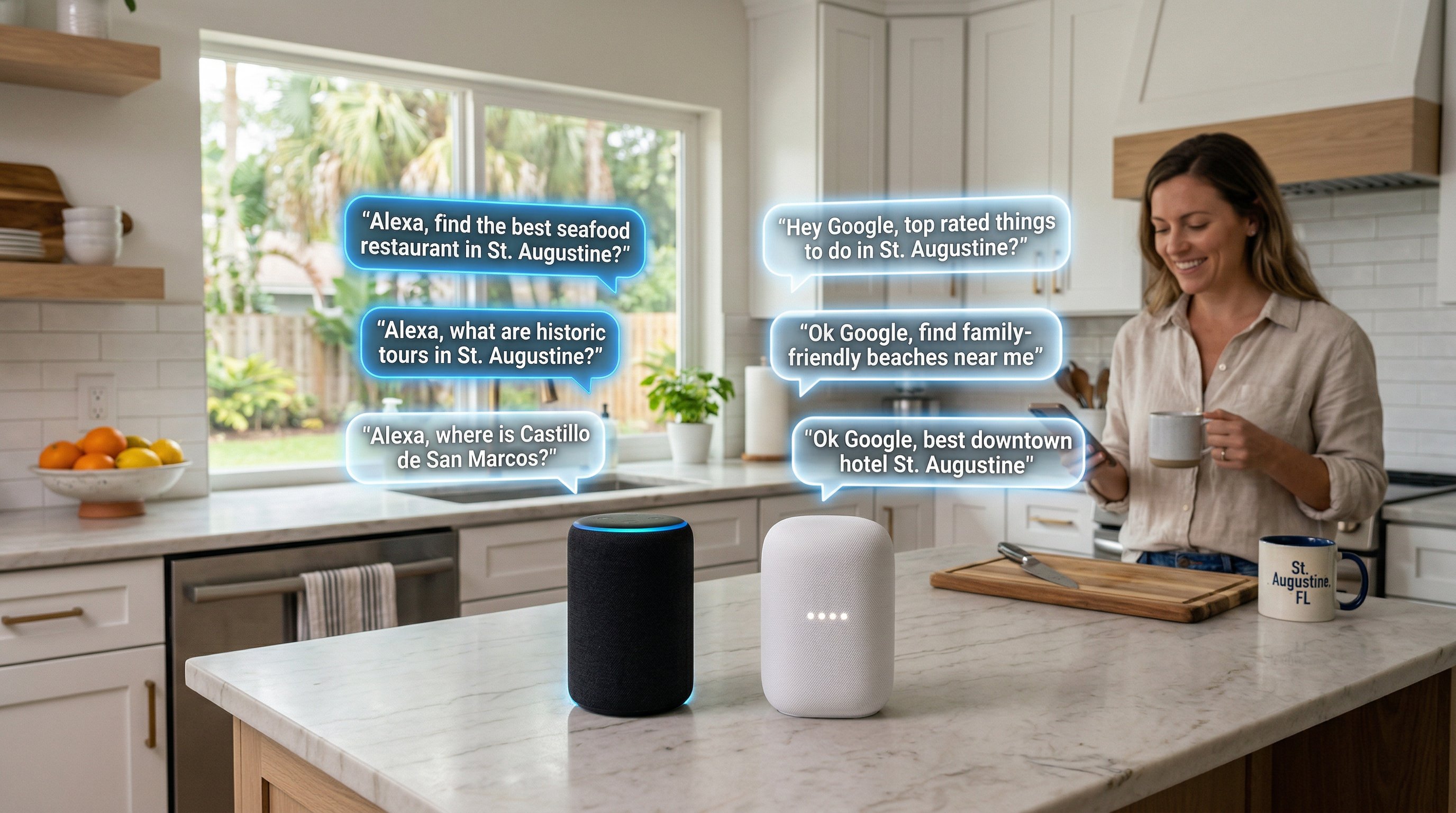
The tourism visitor audience is the most immediate voice search opportunity in St. Augustine. Visitors walking through the Historic District on St. George Street, exploring Castillo de San Marcos, or arriving in the city for the first time are constantly asking their phones and smart speakers for recommendations: "Hey Siri, find restaurants near me," "OK Google, what are the best seafood places in St. Augustine," "Alexa, what are the top-rated things to do in St. Augustine Beach." These searches happen in real time, on mobile devices, and at moments of high purchase intent. A restaurant or attraction that appears at the top of a voice search result at the moment a hungry visitor is asking their phone for dinner recommendations has captured a nearly guaranteed customer.
The local resident audience in communities like Nocatee, World Golf Village, Ponte Vedra, and Vilano Beach uses voice search differently — primarily through smart home devices (Amazon Echo, Google Nest) and smartphone assistants for service discovery and routine queries. "Alexa, what HVAC companies near me have the best reviews?" "OK Google, call a plumber near me." These queries are less impulsive and more considered than tourist searches, but they represent high-value, long-term customer relationships rather than single transactions. The snowbird population — retirees who live in St. Johns County seasonally — is a third distinct audience that relies heavily on voice devices for local service discovery. Snowbirds tend to use smart home devices and are particularly active on Alexa, making Amazon's ecosystem a critical voice search platform for any business targeting seasonal St. Johns County residents. Combining voice search optimization with a comprehensive digital marketing services strategy ensures your business captures this valuable audience across all channels.
- Tourism visitors generate the highest volume of immediate-intent voice searches in the Historic Downtown, St. George Street, and St. Augustine Beach zones.
- Nocatee and World Golf Village residents use voice search primarily for home services, dining, and medical provider discovery.
- The snowbird population skews heavily toward Amazon Alexa and Google Home for local service queries from seasonal residences.
- Military families near NAS Jacksonville use voice search for family-oriented services and healthcare provider discovery in St. Johns County.
- Agricultural community residents in Hastings and Elkton use voice search for practical service searches on mobile devices while working outdoors.
Optimizing for Conversational Voice Keywords
The fundamental difference between typed and voice searches is syntax. Typed searches are abbreviated: "seafood restaurant St. Augustine." Voice searches are conversational: "What is the best seafood restaurant near the St. Augustine Lighthouse?" "Where can I find fresh Gulf shrimp in St. Augustine Beach?" "Is there a seafood restaurant open right now near the Historic District?" Each of these conversational variations requires different content optimization — and a business that has only optimized for the short-tail typed version will be invisible for the majority of voice queries about their category.
The linguistic shift from typed to voice search follows predictable patterns. Voice queries are longer (averaging 6 to 8 words versus 2 to 3 for typed searches), begin with question words (who, what, where, when, why, how) more often than typed searches, include conversational filler words ("a little bit," "right now," "near me," "in St. Augustine"), and frequently use superlatives and qualifiers ("best," "most popular," "highest rated," "closest"). Content optimization for voice search means creating pages and sections that naturally answer these conversational queries — FAQ pages, neighborhood guides structured as Q&A, service pages that open with direct answers to common questions. Implementing answer engine optimization techniques alongside voice search optimization ensures your content is structured to appear in both traditional featured snippets and AI-generated voice responses across all major platforms.
Keyword research for voice search should explicitly target question-format phrases using tools like AnswerThePublic, SEMrush's question-based keyword filter, or Google's People Also Ask boxes for your category. For a St. Augustine landscaping company, the voice keyword list should include: "what landscapers work in Nocatee," "how much does landscaping cost in St. Johns County," "who does the best yard work near Ponte Vedra Beach," "when should I plant in St. Augustine's climate," and "where can I find a good lawn service in World Golf Village." Each of these conversational queries can be the focus of a specific FAQ entry, blog post section, or service page subsection optimized to appear as the voice assistant's spoken answer. Our AI-powered SEO tools can generate comprehensive voice keyword lists for any St. Augustine business category in minutes, dramatically accelerating the research phase of voice optimization.
- Create a spreadsheet of your 20 to 30 most common customer questions and structure each one as a voice-optimized FAQ entry on your website.
- Include natural conversational phrases like "if you are visiting St. Augustine" or "for St. Johns County residents" to match voice query context signals.
- Optimize for "near me" queries by ensuring your Google Business Profile service area is accurately set to all neighborhoods you serve.
- Target superlative voice queries ("best," "top," "highest rated") by maintaining the review count and rating necessary to justify those descriptions.
- Include time-sensitive voice search phrases ("open now," "available today," "same-day service") if your business offers immediate availability.
Optimizing for Google Assistant and Google Maps
Google Assistant is the dominant voice search platform for Android users — which represent the majority of smartphone users in most demographic groups — and Google's voice responses draw directly from the same data sources that power traditional Google search and Google Maps: primarily Google Business Profile, the organic website rankings, and Google's Knowledge Graph. This means that the foundational local SEO work that improves your traditional Google rankings also improves your Google Assistant voice search visibility, with some specific voice-optimization enhancements layered on top.
Your Google Business Profile is the single most important data source for Google Assistant local voice queries. When someone asks Google Assistant "call a dentist near me in St. Augustine" or "what are the hours for [business name]," Google pulls that information directly from your GBP. Ensuring your GBP phone number, hours, address, and category are perfectly accurate and current is the highest-priority optimization for Google voice search. Update your hours every time they change — including special holiday hours — because a voice assistant reading incorrect hours to a customer who then drives to a closed business creates a negative experience that translates directly into negative reviews.
Google's featured snippets — the boxed text answers that appear at the top of traditional search results — are also the primary source for Google Assistant spoken answers to informational voice queries. When someone asks "how do I file a homeowners insurance claim in Florida," Google reads aloud the featured snippet content from whatever page currently holds position zero for that query. Structuring your content to capture featured snippets for questions relevant to your St. Augustine business is therefore directly equivalent to capturing Google Assistant voice search results for those questions. The structural requirements are the same: clear question in the heading, direct concise answer in the first paragraph (40 to 60 words), supported by more detailed explanation below. Pair this content structure with professional web design that loads quickly on mobile to ensure Google can access and index your pages before surfacing them in voice results. For Jacksonville businesses facing similar voice search opportunities, the same Google-first optimization approach applies with Jacksonville-specific geographic targeting.
What is the most important thing I can do today to improve my Google voice search visibility?
The single highest-impact action is to verify that your Google Business Profile phone number, hours, address, and primary category are completely accurate and current. Then add your complete list of services, confirm your service area covers all communities you serve in St. Johns County, upload at least 10 recent photos, and write a complete 750-character business description that naturally includes your most important service category keywords. These foundational GBP optimizations are the direct gateway to Google Assistant voice search results for local queries, and most St. Augustine businesses have significant gaps in at least two of these areas.
Optimizing for Siri and Apple Maps
Siri is the voice assistant for the entire Apple ecosystem — iPhone, iPad, Apple Watch, Mac, HomePod — and it draws its local business information from Apple Maps as its primary source, supplemented by Yelp for ratings and reviews. St. Augustine businesses that have not claimed and optimized their Apple Maps listing through Apple Business Connect are essentially invisible to every iPhone user asking Siri for local recommendations. Given that iOS holds a significant market share among high-income demographics (the same demographics that dominate Ponte Vedra Beach, World Golf Village, and St. Augustine's premium residential communities), Apple ecosystem voice search optimization is not optional for businesses targeting affluent St. Johns County clientele.
Claiming your Apple Business Connect listing requires an Apple ID, business verification, and completing the full profile: business name, address, phone, website, hours, category, photos, and the services or products you offer. Siri uses your primary category to match voice queries, so category selection is as important in Apple Business Connect as it is in Google Business Profile. After claiming, upload high-quality photos (Apple Maps now displays photos prominently in its business listings), write a compelling description that matches your service categories, and set your precise location pin to ensure customers can navigate to you accurately.
Yelp optimization is the second critical lever for Siri visibility. Siri frequently cites Yelp review counts and ratings when answering superlative queries: "Siri, what's the best-reviewed [business type] in St. Augustine?" A business with 200 Yelp reviews and a 4.8-star average will consistently win those Siri recommendations over a competitor with 20 reviews and a 4.5-star average. Building your Yelp review count requires a separate, Yelp-specific review request strategy — Yelp prohibits directly soliciting reviews, but encouraging customers to "check out your Yelp profile" and making it easy for satisfied customers to find your profile generates organic Yelp reviews without violating platform policies. Coordinate your Yelp optimization with your broader review strategy managed through a CRM platform that tracks review generation across all platforms simultaneously.
- Claim your Apple Business Connect listing at businessconnect.apple.com — this is separate from and as important as your Google Business Profile.
- Upload high-resolution exterior and interior photos to Apple Maps — the platform now displays these prominently in location card previews.
- Build your Yelp review count to a minimum of 50 reviews with a 4.5+ star average to qualify for Siri's recommended results.
- Ensure your business name, address, and phone number are identical across Google Business Profile, Apple Maps, and Yelp to establish NAP consistency.
- Set your Apple Maps category to match your primary Google Business Profile category for consistent cross-platform category signals.
Optimizing for Amazon Alexa and the Snowbird Audience
Amazon Echo devices are ubiquitous in American homes, and their prevalence in the snowbird population — retirees who maintain seasonal residences in St. Johns County and rely on smart home devices for daily convenience — makes Alexa optimization a meaningful opportunity for St. Augustine businesses targeting this demographic. Snowbirds arriving in St. Augustine for the winter season often set up their Amazon Echo devices immediately upon arrival and use them to discover local services, ask for weather forecasts, and find businesses near their seasonal address.
Alexa for Business draws its local business information primarily from Yelp and Yext, making these platforms the critical optimization surfaces for Alexa voice search results. Businesses that manage their listings through Yext gain automatic distribution to Alexa's business data network alongside 70+ other directories and voice platforms, creating a single management point for consistent data across the entire voice ecosystem. Ensuring your Yelp profile is complete and current is doubly important for Alexa: it improves both Siri results (where Yelp is a primary source) and Alexa results (where Yelp is also a primary data feed). This platform-agnostic approach to listing management ensures voice search visibility regardless of which assistant a customer is using.
Content on your website that specifically addresses the needs and questions of St. Augustine's snowbird population creates voice search visibility for queries this demographic commonly asks: "Alexa, find a cardiologist accepting new patients in St. Augustine," "Alexa, what are the best restaurants for seniors near Ponte Vedra Beach," "OK Google, find a home repair service near my location in St. Johns County." Publishing blog content and FAQ sections that answer these specific queries — referencing the snowbird experience explicitly where appropriate — positions your business as the authoritative voice search result for seasonal resident queries in the St. Augustine market. Combining voice search optimization with comprehensive social media marketing to the retirement and snowbird community creates a multi-channel presence that maximizes exposure to this high-value demographic.
Schema Markup for Voice Search Visibility
Structured data markup — specifically JSON-LD schema placed in your website's HTML — is the technical bridge between your website content and the voice search systems that need to extract and present your information without a human reading it. Voice assistants cannot interpret ambiguous prose the way a human reader can; they need explicitly structured, machine-readable data to confidently surface a business's information in response to a voice query. Businesses with comprehensive schema implementations consistently achieve better voice search visibility than those without structured data, all else being equal.
The most important schema types for St. Augustine voice search optimization are LocalBusiness schema (declaring your business name, address, phone, hours, geographic coordinates, service area, and price range in machine-readable format), FAQPage schema (marking up question-and-answer pairs so voice assistants can extract and read your answers directly), and SpeakableSpecification schema (explicitly identifying which sections of your page content are appropriate for text-to-speech reading by voice assistants). Together these three schema types tell every major voice platform exactly what your business is, where it is located, what services it offers, and which content on your site provides the best answers to common voice queries. Our schema markup implementation services ensure your structured data is correctly formatted, validated, and comprehensive enough to qualify for voice search featured placements.
Schema validation is as important as implementation. Incorrect JSON-LD formatting can prevent schema from being parsed entirely, or worse, can cause conflicting signals that reduce your voice search visibility. Use Google's Rich Results Test tool to verify your schema syntax after implementation. Use the Schema Markup Validator to check for errors before submitting pages for indexing. Audit your schema markup annually as your business information changes — updated hours, new services, revised phone numbers — to ensure the structured data always matches the actual, current state of your business. Implementing schema as part of a comprehensive marketing automation system allows automatic schema updates when business information changes in your CRM, eliminating the risk of outdated structured data undermining your voice search performance.
- Implement LocalBusiness schema on your homepage and contact page with complete NAP, hours, geographic coordinates, and service area.
- Add FAQPage schema to every FAQ section across your service pages and blog posts — even a single FAQ pair with correct schema qualifies for rich results.
- Use SpeakableSpecification schema to mark the most important summary statements on your service pages as suitable for voice reading.
- Include speakable headline and summary fields that provide concise 30 to 50 word answers to your most common business queries.
- Validate all schema implementation using Google's Rich Results Test before and after every website update that touches schema-marked content.
FAQ Content Strategy for Voice Search Snippets
FAQ-format content is the single most effective website content type for capturing voice search featured snippets because its structure — a direct question followed by a concise, complete answer — mirrors exactly what voice assistants need to generate a spoken response. When a voice assistant receives a question it cannot answer from structured data alone, it searches for a web page that explicitly states the answer clearly and concisely. A well-written FAQ entry that begins with the question "How much does roof replacement cost in St. Augustine?" and answers with a specific, credible response ("Roof replacement in St. Augustine typically costs between $8,000 and $20,000 depending on...") is precisely what Google Assistant, Siri, and Alexa are designed to find and read aloud.
Building an effective FAQ content strategy for voice search requires systematically mapping every question your target audience asks before, during, and after their decision process, then creating a structured answer to each. For a St. Augustine HVAC company, this means covering: "how much does AC installation cost in St. Johns County," "how often should I service my AC in Florida," "what is the best AC brand for humid coastal climates," "what HVAC companies serve Nocatee," and dozens more. Each of these FAQ entries, properly structured with FAQPage schema, creates an independent opportunity to appear as the voice assistant's spoken answer for that specific query. A comprehensive FAQ library of 50 to 100 questions represents 50 to 100 separate voice search visibility opportunities — far more than any amount of keyword stuffing in page body text could produce.
For businesses serving both the tourist and local resident markets in St. Augustine, develop two distinct FAQ content sets: one addressing tourist-specific questions ("What are the best things to do near St. Augustine Historic District for families?", "Where can I park near Castillo de San Marcos?") and one addressing local resident questions ("What are the best elementary schools in Nocatee?", "Where can I find a primary care physician accepting new patients in Ponte Vedra?"). These distinct FAQ sets target the different voice query patterns of each audience and maximize your visibility across both market segments. Schedule a free strategy consultation to develop a custom FAQ content plan for your St. Augustine business's specific audience mix, and explore how Google Ads campaigns can complement your voice search organic strategy during the time your FAQ content takes to rank.
Technical Requirements for Voice Search Performance
Voice search optimization has strict technical prerequisites that are more demanding than traditional SEO because voice assistants actively avoid recommending slow, insecure, or poorly structured websites. A voice assistant's credibility depends on providing fast, accurate answers — a recommendation that leads to a frustrating mobile experience reflects poorly on the assistant itself. This means the technical bar for voice search visibility is meaningfully higher than for traditional organic rankings, making technical optimization a prerequisite rather than an enhancement.
Page speed is the most critical technical factor for voice search. Target a Time to First Byte (TTFB) under 600 milliseconds and total mobile page load time under 2 seconds. Achieving these targets for St. Augustine businesses typically requires: optimizing all images to WebP format with appropriate compression, enabling browser caching, using a content delivery network (CDN) to serve assets from edge locations closer to users, deferring non-critical JavaScript, and ensuring your hosting server has sufficient resources to handle simultaneous requests without slowdown. Businesses operating on cheap shared hosting frequently fail voice search speed requirements regardless of content quality — investing in quality hosting is a prerequisite for voice search competitiveness. A comprehensive website design rebuild that incorporates speed optimization from the ground up is often more cost-effective than iteratively patching performance issues on a slow legacy site.
HTTPS security is a non-negotiable baseline for voice search. Google explicitly states that HTTPS is a ranking signal, and voice assistants will not recommend insecure (HTTP) websites. Every St. Augustine business website should have a valid, active SSL certificate with proper HTTPS redirect configuration. Mobile-friendliness is equally non-negotiable — voice searches happen almost exclusively on mobile devices and smart speakers, and a website that is not mobile-optimized will be demoted in the voice search results regardless of its content quality. Run your website through Google's Mobile-Friendly Test quarterly to verify that all pages pass, especially after any website updates that may have introduced mobile rendering issues. Combining technical excellence with strong SEO services and voice-specific content creates the comprehensive digital presence needed to dominate St. Augustine local search in every format — typed, voice, or AI-assisted.
- Verify HTTPS is properly configured with a valid SSL certificate and 301 redirect from HTTP to HTTPS on all pages.
- Test mobile page speed monthly using Google PageSpeed Insights — target 80+ score on mobile for voice search competitiveness.
- Implement lazy loading for images below the fold to improve initial page load time without sacrificing content completeness.
- Use structured data breadcrumbs and clear heading hierarchies to help voice assistants navigate your site architecture efficiently.
- Ensure your website's robots.txt and canonical tags do not inadvertently block important FAQ and service pages from being indexed.
Ready to Capture St. Augustine Voice Searches?
Get a Free Voice Search SEO Strategy
Our Florida marketing experts will audit your voice search presence across Alexa, Siri, and Google Assistant and build a custom optimization plan.
For a complete overview of our SEO services in St. Augustine, visit our dedicated SEO Agency in St. Augustine, FL page.
Frequently Asked Questions
Common questions about voice search SEO from St. Augustine and St. Johns County business owners.
What percentage of St. Augustine local searches are now voice searches?
Precise local market data for St. Augustine specifically is not publicly available, but national research consistently shows that 20 to 30 percent of all mobile searches include voice input, and approximately 58 percent of smartphone users have used voice search to find local business information within the past year. In tourist-heavy markets like St. Augustine — where visitors are actively exploring an unfamiliar area — voice search rates are likely at or above national averages, particularly for restaurant, accommodation, and attraction searches.
How does Siri find local businesses in St. Augustine?
Siri relies primarily on Apple Maps and Yelp to answer local business queries on iOS devices. For a St. Augustine business to appear in Siri voice search results, it must have a complete and accurate Apple Maps listing through Apple Business Connect, a well-maintained Yelp profile with consistent NAP information, and strong review ratings on both platforms. Siri typically selects the business with the highest overall rating and most reviews when answering superlative queries.
Does Google Business Profile affect voice search results?
Yes, significantly. Google Business Profile is the primary data source for Google Assistant voice search results and for Google's "near me" and local query responses. A fully optimized GBP with accurate business hours, category, services, and a strong review profile is the most important single factor for appearing in Google voice search results for local queries. Google Assistant directly dials businesses whose GBP phone numbers it surfaces in response to voice calls.
What schema markup helps St. Augustine businesses rank for voice search?
The most impactful schema markup for voice search is LocalBusiness schema with accurate NAP, hours, coordinates, and service area; FAQPage schema on FAQ-format content which Google extracts to answer spoken questions; and SpeakableSpecification markup which explicitly identifies page sections optimized for text-to-speech reading. Implementing all of these creates multiple pathways for voice search systems to identify your business as the authoritative local answer.
How important is page speed for voice search optimization in St. Augustine?
Page speed is critically important for voice search. Voice search devices prioritize fast-loading pages because voice queries demand immediate answers. Target a Time to First Byte under 600 milliseconds and total page load time under 2 seconds on mobile for voice search competitiveness. This is especially relevant for St. Augustine tourism businesses whose mobile-searching visitors need instant answers while exploring the city.
How should St. Augustine businesses handle the snowbird population for voice search?
Businesses targeting snowbirds should ensure their Amazon Alexa business listing is claimed and updated through Yext or similar platforms, maintain complete Yelp and Google Business profiles with snowbird-season hours updates, and publish content addressing the specific needs of seasonal residents in St. Johns County. Smart home devices like Amazon Echo and Google Home are highly prevalent among the retired homeowner demographic that makes up St. Augustine's snowbird population.
Related Posts
Start Growing Today
Your Customers Are Talking to Their Phones.
Are You the Answer?
Search Scale AI delivers measurable results for Florida businesses. Let's build your voice search strategy and start capturing St. Augustine customers across every platform within 90 days.
No contracts. No BS. Just results.