Local SEO Playbook for St. Augustine: Outrank Every Competitor in 2026
By Search Scale AI Team · April 10, 2026 · 13 min read
Quick Answer
Local SEO for St. Augustine, FL requires a strategy built around two distinct searcher profiles — tourists and residents — that almost no other Florida market demands in equal measure. The businesses that dominate local SEO St. Augustine FL in 2026 are those that maintain separate keyword strategies for tourist-intent and resident-intent searches, build genuine topical authority across every St. Johns County neighborhood from the Historic District to Nocatee, optimize their Google Business Profile for St. Johns County's unique seasonal patterns, and generate reviews consistently enough to outpace national chains that ignore local relevance signals. This playbook covers the complete system, built from Search Scale AI's first-hand experience ranking businesses in this exact market.
Key Takeaways
- St. Augustine's dual tourist-and-resident economy creates two distinct keyword intent profiles that require separate targeting strategies within a single SEO campaign.
- Neighborhood-level targeting — Historic District, Anastasia Island, Vilano Beach, World Golf Village, Nocatee, Davis Shores — captures high-intent local searches that national chains consistently fail to serve.
- Google Business Profile optimization for St. Johns County must account for seasonal search volume shifts, peak tourism events, and the off-season opportunity that most local businesses ignore.
- Local citations from St. Augustine-specific and Northeast Florida sources signal local relevance in ways that generic national directories alone cannot achieve.
- Review generation strategies for tourism-adjacent businesses require systems that capture peak-season visitor volume — the highest natural review opportunity any St. Augustine business will ever have.
- National chains are beatable in almost every St. Augustine service category when a local business correctly executes neighborhood-level content and local authority signals.
- Search Scale AI chose St. Augustine as its headquarters specifically because the market's complexity makes it the ideal proving ground for every local SEO technique this agency builds and teaches.
Table of Contents
- Tourist vs. Local Intent: The Dual-Audience Problem Every St. Augustine Business Faces
- Neighborhood Targeting: From the Historic District to Nocatee
- Google Business Profile Optimization for St. Johns County
- Seasonal SEO: Peak Tourism vs. Off-Season Strategy
- Local Citation Strategy for Northeast Florida
- How to Beat National Chains with Local Authority
- Review Generation for Tourism-Adjacent Businesses
- Content Strategy for Near Me Searches in St. Augustine
- Why Search Scale AI Chose St. Augustine as Headquarters
- Frequently Asked Questions
Tourist vs. Local Intent: The Dual-Audience Problem Every St. Augustine Business Faces
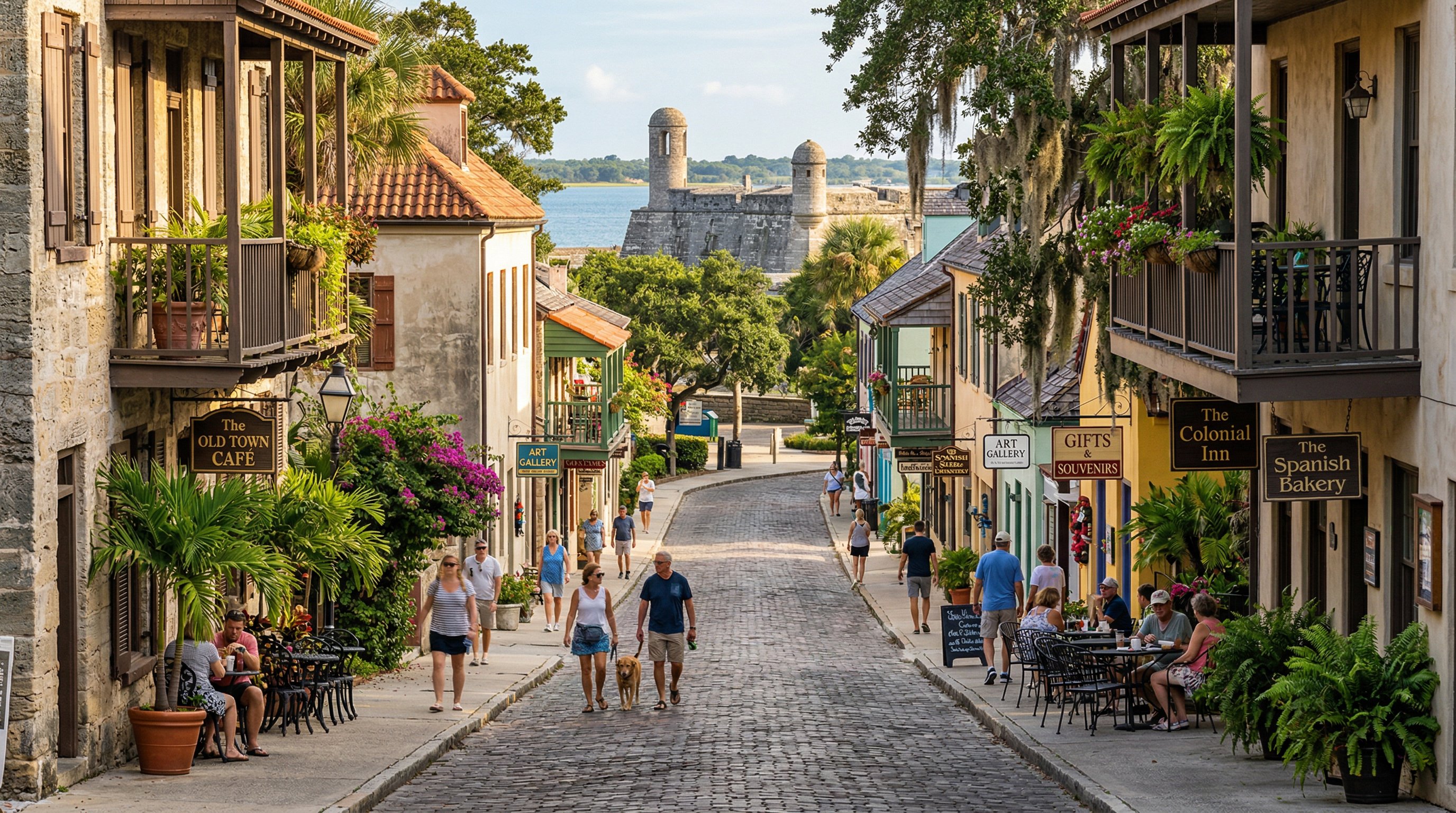
St. Augustine is the oldest continuously occupied European-established settlement in the United States, and that distinction drives roughly 7 million tourist visits per year. For local businesses, this creates a local SEO challenge that is genuinely unlike any other Florida market: the same search query can represent two completely different customers with completely different needs, lifetime values, and conversion behaviors.
Consider "best dentist St. Augustine FL." A tourist searching that query almost certainly has a dental emergency — they need someone today, they will likely never return, and the transaction ends at one visit. A resident searching the same query is evaluating a long-term provider relationship worth potentially thousands of dollars in recurring revenue over years. Treating these as the same customer with the same landing page is an SEO and conversion mistake that costs St. Augustine businesses revenue every month.
The correct approach is to build keyword clusters around each intent profile explicitly. Tourist-intent keywords skew toward discovery language: "best restaurants near St. Augustine Beach," "things to do Historic District St. Augustine," "shops Castillo de San Marcos area." Resident-intent keywords reflect service relationships: "HVAC company St. Augustine FL," "family doctor Nocatee," "property management World Golf Village." These clusters require different page structures, different calls to action, and different content depth. A tourism-intent page needs vivid immediate-value content that converts on first visit. A resident-intent page needs trust signals — reviews, local history, certifications, neighborhood familiarity — that overcome the inertia of switching a long-term service provider.
For local SEO strategies in St. Augustine, the practical implication is that any business with a mixed customer base needs at minimum two distinct content tracks running simultaneously in its editorial calendar. Seasonal peaks in tourism (spring, fall, December) demand more investment in tourist-intent content. The slower winter and mid-summer months are the time to build resident-intent authority. Businesses that only publish tourist-facing content during peak season and go quiet otherwise are surrendering the compounding benefit of year-round SEO momentum. Our AEO content framework structures both content types to rank and convert independently, without cannibalizing each other in the same SERP.
How do I know which intent is driving my current search traffic?
Google Search Console segments your queries clearly enough to identify patterns. Tourist-intent traffic typically spikes sharply in March through August and again in October through December, correlates with event-based queries tied to St. Augustine's calendar (Nights of Lights, Rhythm & Brews, St. Augustine Food & Wine Festival), and shows higher bounce rates because tourists make quick decisions. Resident-intent traffic is steadier month over month, shows longer session durations, and tends to produce more form submissions or phone calls than quick directory-style clicks. Segment your traffic by these behavioral signals before deciding where to invest next in your content strategy.
Neighborhood Targeting: From the Historic District to Nocatee
St. Johns County is geographically and demographically diverse in ways that the generic search term "St. Augustine" completely flattens. A plumber in Nocatee targeting only "plumber St. Augustine" is competing against every plumbing business in the entire county — including those ten miles closer to the searcher's location. Neighborhood-level targeting is not a nice-to-have in this market; it is the primary mechanism for capturing high-intent, high-proximity searches that national aggregators and out-of-area competitors are too broad to win.
The Historic District is the commercial core of St. Augustine's tourism economy. Businesses here face the most competitive SERP environment in the county, with national chains, regional franchises, and high-traffic tourism sites occupying much of the first page. Winning in the Historic District requires tight niche-plus-location combinations: "Spanish cuisine Historic District St. Augustine," "art gallery St. George Street," "boutique hotel near Flagler College." Broad terms like "hotel St. Augustine" are dominated by Booking.com, TripAdvisor, and hotel chains with authoritative domains that a local independent business cannot outrank through content alone. The path to visibility is niche specificity and review volume.
Anastasia Island — connected to the Historic District by the Bridge of Lions — carries a distinct resident population that searches for services independently of the Historic District's tourist cluster. Searches like "Anastasia Island dentist," "pizza delivery St. Augustine Beach," and "auto repair Anastasia Island" have real search volume and manageable competition. Creating dedicated Anastasia Island service pages with genuine neighborhood-level content (not boilerplate with the neighborhood name swapped in) positions a business for these searches with minimal content investment compared to the Historic District's competitive landscape.
Vilano Beach is a small coastal community north of the Historic District with a tight-knit residential base and almost no dedicated local SEO content from most businesses. Searches like "Vilano Beach contractor" or "surf lessons Vilano Beach" are essentially uncontested. Any business serving Vilano Beach that creates a genuine dedicated page for that neighborhood can rank on the first page within days. The same principle applies to Davis Shores, the quiet residential area directly across the river from the Historic District, and Saint Augustine Beach, which carries its own search identity separate from Anastasia Island despite geographic overlap.
World Golf Village and Nocatee represent the future of St. Johns County's search economy. These master-planned communities in the northern part of the county are among the fastest-growing residential areas in Florida, with median household incomes significantly above the state average and a population of newer residents actively searching for every service category — from healthcare and legal to home services and dining. The competitive SEO landscape in these neighborhoods is still underdeveloped relative to their search volume. A business that establishes topical authority in World Golf Village or Nocatee now, with dedicated service pages targeting those specific community names, will be exceptionally difficult to displace as the population continues to grow. Our St. Augustine SEO services prioritize this neighborhood-level architecture from the first day of every engagement.
Should I create separate pages for each St. Augustine neighborhood I serve?
Yes, provided each page contains genuinely unique, neighborhood-specific content — not the same service description with a different location name swapped in. Google's Helpful Content guidelines specifically target thin location-page content that provides no real value to local searchers. A Nocatee service page should reference the community's master-planned layout, its demographics, its distance from central St. Augustine, and the specific concerns a Nocatee resident might have that differ from a Historic District business owner. Genuine uniqueness is the difference between a neighborhood page that ranks and one that gets filtered out of the index entirely.
Google Business Profile Optimization for St. Johns County
The Google Business Profile (GBP) is the single highest-leverage asset in any local SEO campaign, and St. Augustine businesses have specific optimization opportunities that go beyond the standard GBP checklist. A fully optimized GBP in this market accounts for the county's tourism overlay, its seasonal search patterns, and the particular ways that visitors and residents interact differently with local search results on mobile devices — which is where the majority of St. Augustine's local search traffic originates.
Start with category selection. Most St. Augustine businesses choose one primary category and leave it at that, surrendering the additional visibility that secondary categories provide. A restaurant in the Historic District that serves seafood should select both "Restaurant" and "Seafood Restaurant" as categories; a spa on Anastasia Island should use both "Day Spa" and "Massage Therapist" if applicable. Google surfaces GBP listings for both primary and secondary categories in relevant searches, so every additional accurate category is an additional visibility opportunity. The complete Google Business Profile guide for St. Augustine covers the full category strategy in detail.
Services and products sections within GBP are chronically underused by St. Augustine businesses. Every service your business offers should be listed individually with its own name, description, and price range (even if price is approximate or listed as a range). Google surfaces service-specific information directly in search results and maps, meaning a potential customer can see that you offer "historic district walking tours" or "emergency AC repair same day" without clicking through to your website. This reduces friction in the conversion process and signals to Google's local algorithm that your listing is comprehensive and authoritative for those specific service terms.
Photo quality and volume matter significantly in a tourism market where visual decision-making is the norm. St. Augustine businesses should upload a minimum of 25 high-quality photos covering the exterior, interior, products or services in action, team members, and — for businesses with seasonal visual appeal — seasonal photography that reflects the current time of year. GBP photo views correlate with listing engagement, and listings with more photos consistently generate more direction requests and website clicks than comparable listings with fewer images. Update photos at least quarterly. For food and beverage businesses, menu photos that reflect current offerings are a distinct ranking signal for restaurant-category searches.
GBP posts are the most underutilized feature in the platform. Weekly posts — announcing seasonal specials, linking to new blog content, promoting upcoming events, or simply highlighting services — keep the listing algorithmically fresh and give potential customers a reason to engage. During Nights of Lights, Rhythm & Brews, or the St. Augustine Food & Wine Festival, a GBP post tied to the event can capture the burst of event-adjacent searches. The Google Maps dominance guide for St. Augustine outlines a full 52-week posting calendar for St. Johns County businesses.
- Verify the business address matches exactly across all citation sources — even minor discrepancies (St. vs Street, Suite vs Ste) weaken NAP consistency signals.
- Enable messaging in GBP and respond within one hour during business hours — response time is visible on the listing and influences conversion decisions.
- Add the service area geography correctly: St. Johns County plus any specific neighborhoods served, rather than just "St. Augustine."
- Use the Q&A section proactively — seed it with the questions tourists and residents actually ask, then answer them authoritatively. Unanswered public questions hurt trust and can be answered by anyone, including competitors.
- Link the GBP website field to the specific landing page most relevant to the listing, not always the homepage.
Seasonal SEO: Peak Tourism vs. Off-Season Strategy
No discussion of local SEO St. Augustine FL is complete without a framework for seasonal strategy. St. Augustine's economy follows a tourism calendar that creates dramatic search volume fluctuations across the year — and most local businesses respond to those fluctuations reactively rather than proactively, meaning they start optimizing for peak season content after the season has already arrived. The businesses with dominant local search visibility plan their content calendar four to six months in advance, so the content is indexed, established, and ranking before the search volume arrives.
The primary peak season runs from mid-March through late August, driven by spring break traffic, summer family vacations, and the city's general tourist season. Search volume for tourism-adjacent terms — restaurants, tours, accommodations, attractions — spikes dramatically during this window. Content targeting these searches should be published in November and December at the latest, giving Google three to four months to index and rank the pages before traffic peaks. A blog post about "best seafood restaurants St. Augustine summer 2026" published in June is competing against six months of established rankings from competitors who planned ahead. Published in December, that same content arrives at peak season already ranked.
The secondary peak is October through early January, anchored by St. Augustine's nationally recognized Nights of Lights event and the general fall tourism surge that runs from late September through Thanksgiving. Nights of Lights content — what it is, where to view it, nearby dining and accommodations — should be published in July and August. By October when search volume explodes, that content should already hold page-one positions for the queries that drive it.
Off-season months (January through mid-March and September) are not a break from SEO activity — they are the most important investment window of the year. This is when search volume for resident-intent keywords is highest relative to tourist traffic, when review generation campaigns have the most impact on a less crowded SERP, and when the technical and content foundations that will carry peak season performance are built. Businesses that invest in technical SEO audits, link-building, and long-form resident-intent content during the off-season consistently outperform competitors who see the slow months as downtime rather than investment time. The compounding nature of SEO means that every piece of content and every earned link from the off-season multiplies in value when search volume returns.
How far in advance should I create seasonal SEO content for St. Augustine?
A minimum of 90 days before your target search volume peak. For major annual events like Nights of Lights (November through January), publish dedicated content no later than August. For spring break and summer peak season, publish in November or December. For Thanksgiving and early December tourist traffic, August and September are the target publishing windows. New domains and newer businesses should extend these lead times to 120-180 days because they lack the domain authority that helps established sites rank quickly for new content.
Local Citation Strategy for Northeast Florida
Citation building for St. Augustine is a two-tier process: universal citations that every local business in any market needs, and St. Augustine- and Northeast Florida-specific citations that signal genuine local relevance to Google's local algorithm in ways that national directories alone cannot achieve. Most local SEO campaigns stop after the universal tier — and leave significant local authority on the table as a result.
The universal citation foundation includes Google Business Profile, Apple Maps, Bing Places, Yelp, Facebook, and the major data aggregators (Neustar Localeze, Data Axle, Foursquare) that feed hundreds of smaller directories automatically. These must be completed with perfectly consistent NAP data before any regional or niche citations are pursued, because inconsistency at the foundation level undermines the trust signals from everything built on top. A business listed as "Search Scale AI" in some directories and "SearchScaleAI" in others creates conflicting signals that Google's local algorithm weighs against the business in competitive Local Pack results.
The Northeast Florida-specific citation layer is where St. Augustine businesses can separate themselves from competitors who only complete the generic citation checklist. Priority regional citations include: the St. Augustine, Ponte Vedra & The Beaches Visitors and Convention Bureau, which carries significant topical authority for tourism-related searches and accepts business listings across most categories; the St. Johns County Chamber of Commerce member directory, which provides a high-authority local domain link alongside the citation; Historic City News, the locally focused news publication that frequently ranks for St. Augustine search queries and accepts local business information; and the St. Augustine Record's business directory, the county's primary newspaper publication with strong local domain authority.
Tourism-adjacent businesses — restaurants, accommodations, tours, retail — should additionally prioritize TripAdvisor, Expedia local listings, Viator for tour operators, and Florida's official tourism directory (VISIT FLORIDA), which feeds organic tourist-intent traffic from a domain with extraordinary authority in Florida-related searches. Each of these platforms is both a citation source and an independent traffic channel, meaning the investment produces returns beyond pure citation value. The local backlink building guide for St. Augustine covers the editorial link-building layer that sits on top of this citation foundation and is the difference between a business stuck in positions 4-7 of the Local Pack and one that consistently holds the top three.
- Audit existing citations before building new ones — duplicate or inconsistent listings actively hurt local rankings and must be corrected or removed first.
- For businesses near the Ponte Vedra and Jacksonville Beach border of St. Johns County, pursue citations in both Jacksonville and St. Augustine regional directories — geographic ambiguity at county lines benefits businesses that claim authority in both.
- Industry-specific citations carry more weight than generic directories: a restaurant listed in Open Table, Zagat, and the Michelin Guide (where applicable) sends stronger industry relevance signals than 50 generic business directory listings.
- Sponsorships of St. Augustine area nonprofits, schools, and civic organizations often include citation-level links from .org and .edu domains that carry elevated trust signals in Google's local algorithm.
How to Beat National Chains with Local Authority
The presence of national chains — from hotel brands on Anastasia Boulevard to franchise restaurants on US-1 to corporate-owned service businesses across St. Johns County — is one of the most consistent concerns we hear from St. Augustine business owners contemplating a local SEO investment. The concern is understandable: these chains have domain authority built over decades, marketing budgets that dwarf any local competitor, and corporate SEO teams maintaining their national web presence. The good news is that local authority — genuine, hyperlocal authority specific to St. Augustine and St. Johns County — is the one competitive dimension where corporate chains are structurally disadvantaged, and it is the dimension that matters most in local search results.
Google's local algorithm weighs three primary factors: relevance (does the listing match the search query), distance (how close is the business to the searcher), and prominence (how well-known and trusted is the business in its local area). National chains compete ferociously on relevance through brand recognition and on prominence through their high domain authority. But they are often structurally weaker on distance precision — a national hotel chain's St. Augustine location page is built from a corporate template optimized for "hotels St. Augustine" broadly, not "boutique hotel Vilano Beach" or "hotel near Flagler College." And they are almost always weaker on local prominence signals: reviews from actual St. Augustine customers, citations from local St. Johns County sources, and content that demonstrates genuine familiarity with the neighborhoods they serve.
The tactical path to outranking national chains begins with hyper-local keyword specificity. Corporate chain SEO optimizes for the highest-volume keywords in a market. A local business should systematically target the long-tail and neighborhood-specific keywords that chains cannot profitably pursue at scale: "plumber Nocatee FL same day," "family restaurant Davis Shores St. Augustine," "wedding photographer Vilano Beach Florida." These are the queries where a local business's geographic specificity is an advantage, not a disadvantage — and they are often the queries with the highest purchase intent and conversion rates, because the searcher has already qualified their geography before starting the search.
Content authority is the second lever. A national hardware chain's St. Augustine location page might have 300 words and a store hours table. A local hardware store with a comprehensive blog covering "hurricane prep for St. Augustine Beach homeowners," "best wood for coastal Florida humidity," and "St. Johns County permit requirements for deck construction" has built a library of local expertise that the national chain's corporate template cannot replicate. This topical authority signals to Google that the local business is the more relevant result for St. Augustine residents with genuine home improvement questions — and it creates the kind of organic traffic and engagement signals that compound over time into ranking superiority. Our content marketing approach for St. Augustine is built around exactly this expertise-gap strategy.
Finally, reviews are the most visible and arguably most impactful local authority signal for outranking chains. National hotel brands and restaurant franchises in St. Augustine receive high review volumes, but their review recency often lags because corporate systems do not always prioritize local review generation actively. A local business with a systematic review request process — texting every customer a direct Google review link within 24 hours of service completion — can accumulate review recency signals that outperform a chain with four times the total review count but no reviews in the past three months. Google's local algorithm weights recent reviews heavily because they signal active, current business operation and ongoing customer satisfaction.
Review Generation for Tourism-Adjacent Businesses
St. Augustine's tourism economy creates a review generation opportunity that most local businesses fail to fully capture. Every year, millions of visitors pass through St. Augustine — millions of people who had an experience with a local business, are willing to share it, and whose reviews carry the geographic diversity signal that Google interprets as broad relevance rather than a narrow local customer base. A St. Augustine restaurant with reviews from customers in Ohio, New York, Canada, and Georgia, alongside Florida residents, sends a geographic authority signal that a competitor with only local reviews cannot match.
The foundation of any review generation system for a tourism-adjacent St. Augustine business is timing. The review request must happen while the experience is still fresh — ideally within two to four hours of the interaction, before the customer has left the Historic District, driven back to their hotel on Anastasia Island, or boarded their flight home. For retail and restaurant businesses, this means a physical touchpoint at the point of sale: a small table card, a receipt message, or — ideally — a direct text message sent to a number collected during the transaction. The text-based review request, which delivers a direct Google review link to the customer's phone, consistently generates three to five times the review conversion rate of a generic verbal request or a card that requires the customer to search independently.
For service businesses — contractors, healthcare providers, legal services — the review request should be integrated into the post-service follow-up process. A 24-hour follow-up text or email that thanks the customer and includes a direct review link captures reviews at the moment of highest satisfaction, before the routine of daily life dilutes the motivation to write. Businesses using a CRM tool like Go High Level can automate this sequence entirely: service completion triggers an automated follow-up with a review link, removing the human error of forgetting to ask. Automated review request systems consistently double or triple the review generation rate for service businesses compared to manual processes.
Review responses are as important as review volume for SEO purposes and for conversion. Responding to every review — positive and negative — within 24 hours signals to Google that the listing is actively managed and to potential customers that the business cares about its service quality. For negative reviews, a professional, non-defensive response that acknowledges the concern and describes the resolution often converts a skeptical reader more effectively than ten positive reviews without responses. St. Augustine's tourism volume means that negative reviews from first-time visitors who had unrealistic expectations are inevitable; the response is the reputational management opportunity. The GBP optimization guide includes a full review response framework for the most common review scenarios St. Augustine businesses face.
Is it against Google's policies to ask customers for reviews?
No — Google explicitly permits businesses to ask customers for reviews. What Google prohibits is incentivizing reviews (offering discounts, gifts, or payment for positive reviews), gating reviews by only asking customers you believe will leave positive feedback, and generating fake reviews from non-customers. A straightforward post-transaction review request — by text, email, or in person — that asks the customer to share their honest experience is fully compliant with Google's review policies and is the single highest-ROI activity in most St. Augustine local SEO campaigns.
Content Strategy for Near Me Searches in St. Augustine
"Near me" searches have become one of the most commercially important query patterns in local search, and St. Augustine's geographic layout makes them particularly complex to serve well. The city's elongated north-south footprint — stretching from Ponte Vedra Beach in the north through the Historic District, Anastasia Island, and south to Palm Valley and beyond — means that "near me" results for two searchers both describing themselves as "in St. Augustine" can return completely different businesses based on their precise location within the county.
Content targeting "near me" searches does not mean literally using the phrase "near me" in your page content — Google understands that "near me" is a location modifier, not a content keyword, and populates near-me results based on the proximity of the business to the searcher's device location. What it does mean is ensuring every technical signal that communicates your business's precise location is correctly implemented: accurate GBP address, correct lat/long coordinates, consistent NAP across all citations, and location-specific structured data (LocalBusiness schema with latitude, longitude, and precise street address) on your website. Businesses with ambiguous or inconsistent location data are systematically disadvantaged in near-me results regardless of their content quality.
The content layer of a near-me strategy is about embedding genuine location context throughout your site in ways that reinforce your geographic identity to Google's crawler. This means using neighborhood names naturally in body copy — mentioning that your HVAC service area covers Nocatee, World Golf Village, and the Historic District by name; that your restaurant is three blocks from the Castillo de San Marcos; that your law office is convenient to the St. Johns County Courthouse. These geographic references create a web of location signals that go far beyond a single address field and tell Google's algorithm exactly where your business is relevant to searchers. Our voice search SEO guide for St. Augustine extends this framework to cover "near me" queries spoken through Alexa, Siri, and Google Assistant, which follow slightly different optimization patterns than typed queries.
For businesses serving a wide geographic area within St. Johns County, a hub-and-spoke content architecture is the most effective near-me strategy. The hub is a comprehensive county-level service page that establishes topical authority broadly. The spokes are neighborhood and community-specific pages — one each for Nocatee, World Golf Village, Vilano Beach, Anastasia Island, Davis Shores, and Saint Augustine Beach — that each make the case for your business's relevance and proximity to that specific community. Each spoke page links back to the hub, passing authority upward, while the hub links out to the spokes, distributing relevance signals to each location. This architecture allows a single St. Augustine business to be genuinely visible across near-me searches from any corner of the county. Pricing context and budget considerations for this content architecture are covered in depth in our complete SEO pricing guide for 2026.
- Embed Google Maps on your contact page and key location pages — map embeds are a proximity signal that many businesses overlook.
- Use LocalBusiness schema with the precise street address, latitude, and longitude on every location page, not just the homepage.
- Include driving directions and landmark references (near the Bridge of Lions, across from the Visitor Information Center) in your location page content — these references match the natural language of searchers who use near-me queries while physically navigating.
- Build pages for the specific communities you serve, not just the broad "St. Augustine" label — a searcher in Nocatee is six miles from the Historic District and uses entirely different geographic identifiers in their search queries.
Pairing this content strategy with a well-executed AI SEO system lets St. Augustine businesses scale neighborhood-level content production without proportionally scaling content costs. AI tools can generate accurate neighborhood-specific first drafts that human editors then refine with genuine local knowledge — the combination produces content that reads with local authority and ranks with the depth that Google's algorithm now requires for competitive local search terms. This is the exact approach our agency uses across our SEO client work, and it is the reason our clients in St. Augustine consistently hold first-page positions for neighborhood-level queries that their competitors have not even considered targeting.
Why Search Scale AI Chose St. Augustine as Headquarters
Search Scale AI is headquartered in St. Augustine, FL — not by default, and not because the founders happened to live here. It was a deliberate strategic choice, and the reasoning behind it shapes everything about how we approach local SEO for every client we serve, in every market.
St. Augustine is, without exaggeration, one of the most complex local search markets in the United States for its size. It combines the dual tourist-and-resident intent challenge described throughout this guide, a highly competitive Historic District commercial corridor, a series of distinct neighborhood markets each requiring its own targeting approach, dramatic seasonal search volume fluctuations, a rapidly growing suburban residential base in Nocatee and World Golf Village that is transforming the county's economic geography, and a competitive landscape that includes both entrenched national chains and sophisticated local businesses that have been investing in their online presence for years. Succeeding in St. Augustine requires solving every problem that local SEO presents — simultaneously.
For an agency whose core mission is building the most effective local and AI-driven SEO systems in the country, operating in St. Augustine is operating at the highest possible difficulty setting. Every technique we develop, every content framework we build, every GBP optimization strategy we test — all of it is validated first in our own backyard, in one of the most demanding local search environments available. When a system works in St. Augustine, it works anywhere. Our clients in Orlando, Tampa, Miami, and Jacksonville benefit from strategies that were first proven against St. Augustine's uniquely complex competitive conditions.
Being headquartered in St. Augustine also means we have genuine skin in the game for this market's success. When a local St. Augustine business ranks on page one because of our work, that is not a case study from a distant market — it is our community. We attend the same events, drive the same roads, and know the difference between World Golf Village and Nocatee from firsthand experience, not from a Wikipedia summary. That local knowledge is not a marketing claim; it is the foundation of every St. Augustine-specific recommendation in this playbook and in every St. Augustine SEO engagement we take on.
If your St. Augustine business is ready to build the kind of local search presence that compounds in value over time — the kind that outranks national chains, captures tourist and resident intent simultaneously, and holds first-page positions across every neighborhood you serve — the conversation starts with a call. Reach our St. Augustine team directly at 772-267-1611. We know this market, we live in this market, and we build local SEO systems that win in it. Learn more about how to choose the right SEO agency in St. Augustine before you make your decision — and see why businesses across St. Johns County trust Search Scale AI to build and defend their local search visibility.
Frequently Asked Questions
How is local SEO for St. Augustine different from other Florida cities?
St. Augustine presents a dual-intent challenge that most Florida markets do not: the same search query can come from a tourist looking for a one-time experience or a resident looking for a long-term service provider. Successful local SEO in St. Augustine requires separate keyword strategies targeting tourist intent and resident intent simultaneously — while also competing against national chains with massive domain authority that dominate broad tourism-adjacent searches. Cities like Orlando, Tampa, and Miami have their own complexities, but none combine the tourism overlay with a tight-knit residential market quite the way St. Augustine does.
Which St. Augustine neighborhoods should my business target for local SEO?
The priority neighborhoods depend on your business type and customer profile. The Historic District drives the highest search volume but the most competition. Anastasia Island, Vilano Beach, and Davis Shores each carry distinct residential communities with lower-competition hyper-local search intent. World Golf Village and Nocatee are the fastest-growing residential corridors in St. Johns County, with high-income households actively searching for local service providers and almost no established local SEO competition in most service categories. For a complete neighborhood-by-neighborhood approach, see the St. Augustine local SEO strategies guide.
How should I handle seasonal SEO for a St. Augustine business?
Seasonal SEO in St. Augustine requires two separate content and GBP strategies. Tourist season (March through August, with peaks in October and December) demands tourist-intent content published four to six months in advance. Off-season strategy pivots to resident-focused content, longer-form service pages, and review generation. Businesses that only optimize during peak season lose months of compounding ranking momentum to competitors who optimize year-round. The Google Maps dominance guide includes the full annual content calendar for St. Augustine businesses.
How do I compete against national chains in St. Augustine search results?
National chains win on domain authority but consistently lose on local relevance signals when a local business executes its SEO correctly. The key advantages are: a fully optimized GBP with location-specific services and photos; review recency that corporate locations rarely maintain; neighborhood-specific content mentioning Anastasia Island, the Historic District, Nocatee, or World Golf Village by name; and local citation consistency across St. Johns County-specific directories. National chains target "St. Augustine" broadly; a local business can own "HVAC repair Vilano Beach" or "family dentist Nocatee FL" before any national chain even creates the page. See our guide on affordable SEO services for St. Augustine businesses for budget-conscious approaches to this strategy.
What citation sources matter most for St. Augustine local SEO?
Beyond universal citations, St. Augustine businesses should prioritize: the St. Augustine, Ponte Vedra & The Beaches Visitors and Convention Bureau; the St. Johns County Chamber of Commerce member directory; Historic City News; and the St. Augustine Record's business directory. Tourism-adjacent businesses should also pursue TripAdvisor, Viator, and VISIT FLORIDA. Consistent NAP data across all sources is non-negotiable. Our local backlink guide covers the editorial link-building layer that works alongside citations.
How many Google reviews does a St. Augustine business need to rank in the Local Pack?
In most St. Augustine service categories, businesses with 50+ reviews and a 4.5+ average consistently outperform competitors with fewer reviews or lower ratings. More important than total count is review recency — 20 reviews from the past six months often outranks 200 reviews where the most recent is two years old. For tourism-adjacent businesses, the high visitor volume of peak season creates a natural review generation opportunity that should be systematically captured through automated follow-up systems. See our full breakdown of St. Augustine SEO agency costs to understand the investment required to build and maintain this review velocity.